


Listen to the article
US Military Hackers Disrupted Russian Trolls Before 2024 Election as Security Programs Now Face Cuts
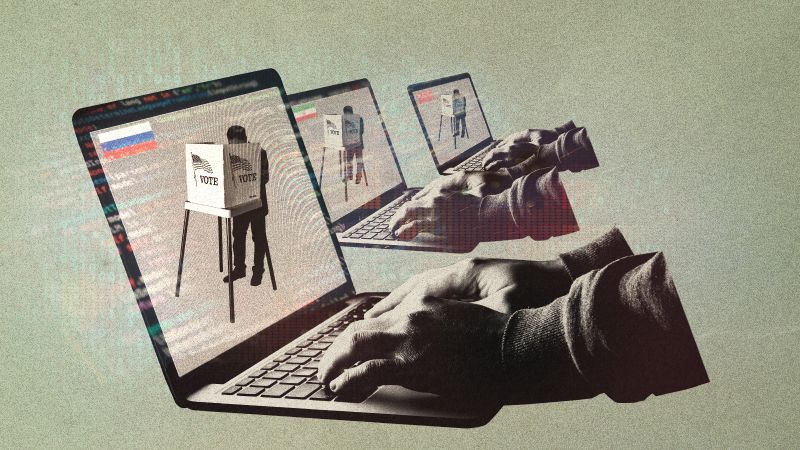
In the weeks leading up to the 2024 presidential election, American military hackers carried out a classified operation targeting Russian troll operations that were spreading disinformation to US voters. From their base at Cyber Command in Fort Meade, Maryland, the military team targeted computer servers and personnel of at least two Russian companies covertly distributing propaganda, according to multiple sources familiar with the operation.
The Russian trolls had been publishing fictitious news stories attacking politicians who supported Ukraine, focusing their efforts on six swing states. Intelligence revealed that one of the companies had conducted “strategy meetings” with Kremlin officials to plan their covert influence campaign targeting American voters.
As part of the operation, Cyber Command hackers planned to disable computer servers located in a European country used by one of the Russian companies. While the Russian trolls continued producing content through Election Day, when Donald Trump defeated Kamala Harris, one source indicated that the operation successfully slowed down their activities.
This previously undisclosed hacking campaign was one component of a broader government effort involving the FBI, Department of Homeland Security, and other intelligence agencies working together to expose and disrupt foreign meddling in the election.
However, one year into Trump’s second term, many government centers previously dedicated to combating foreign influence have been disbanded or significantly downsized, leaving local election officials largely on their own to face future foreign influence campaigns.
The administration has shuttered foreign-influence centers at the Office of the Director of National Intelligence (ODNI), the FBI, and the State Department that had previously warned the public about election-related disinformation from China, Russia, and Iran. The Department of Homeland Security has also drastically reduced its election security teams that had provided intelligence to local election offices and assisted with cyber threat defense.
The Trump administration has justified these cuts by claiming these federal programs were censoring Americans and interfering in domestic elections.
“I find it devastating and deeply alarming for our national security,” said Mike Moser, a former election security specialist at DHS’ Cybersecurity and Infrastructure Security Agency (CISA), who resigned after the agency froze its election work last year. “To see those partnerships unilaterally dismantled is a tragedy. We are losing the human and technological infrastructure that protects our democracy.”
Foreign influence operations continue to target American democratic processes. During New York City’s mayoral election last year, Chinese state-owned media repeatedly amplified Trump’s attacks on Democrat Zohran Mamdani, who eventually won the race. Meanwhile, pro-Iranian influencer accounts pivoted to attacking Mamdani as a “Zionist apologist” after he made overtures to Jewish voters, according to disinformation-tracking firm Alethea Group.
The upcoming 2026 midterms could serve as a test for how foreign adversaries respond to a US government that has become less forceful in publicly combating influence operations.
“We’ve not had a disaster take place because, in many ways, the procedures and policies and tools set up during the first Trump administration helped keep us safe,” Senator Mark Warner of Virginia, the top Democrat on the Senate Intelligence Committee, told CNN. “We’re going into a 2026 election cycle with our guard down.”
Many of the government centers and processes for countering foreign influence that are now being cut were actually established during Trump’s first term, including a dedicated FBI team that tracked counterintelligence threats to elections.
In April, Trump fired General Tim Haugh, the head of Cyber Command and the National Security Agency, who had led numerous operations countering Russian election interference. Far-right activist and Trump confidant Laura Loomer had pushed for Haugh’s removal, publicly calling him “disloyal” to Trump because he had served alongside former Chairman of the Joint Chiefs of Staff General Mark Milley – an allegation Haugh has denied.
“This is just an enormous set of vulnerability for our nation,” Haugh said in his first interview since being fired. “We have shown a decreasing ability to discern truth from fiction as a society.”
The same Russian trolls targeted by Cyber Command in 2024 continue their operations today. A Russian covert influence network focused on undermining Western support for Ukraine has established at least 200 fake websites since last March targeting audiences in the US, France and elsewhere, according to cyber intelligence firm Recorded Future.
Current and former officials worry that the Trump administration’s approach to federal programs aimed at countering such operations has been excessive. They argue that programs could have been downsized rather than abruptly canceled while still meeting the administration’s goal of cutting bureaucratic red tape.
Republican election official Paul Lux of Okaloosa County, Florida, noted that cuts to federal cybersecurity funding for election offices have forced local officials to scramble for alternative resources. Election officials are also uncertain whether the FBI and CISA will continue their longstanding practice of providing classified briefings on election threats.
“Our mission doesn’t change,” Lux emphasized. “It is to provide safe, free and fair elections with as much transparency as possible.”
Trump’s new nominee to lead the NSA and Cyber Command, Lieutenant General Joshua Rudd, has pledged to protect the electoral process from foreign interference. During his Senate confirmation hearing, Rudd stated, “Any foreign attempt to undermine the American process of democracy, and at the center of that is our electoral process, as you all know far better than I do, has got to be safeguarded.”
Despite the cuts to various agencies, some Republican lawmakers remain confident in the government’s ability to counter foreign threats. “I am confident ODNI and the intelligence community will remain poised to assess and warn policymakers of covert and overt foreign influence operations,” said Rick Crawford, the Republican chairman of the House intelligence committee.
According to ODNI’s annual worldwide threat assessment published in March, foreign powers will continue targeting American voters with disinformation, increasingly aided by artificial intelligence. “Reinforcing doubt in the integrity of the U.S. electoral system achieves one of Russia’s core objectives,” the intelligence report states.
Fact Checker
Verify the accuracy of this article using The Disinformation Commission analysis and real-time sources.

7 Comments
While I’m glad to hear the US took steps to counter Russian trolls, it’s concerning that the Trump administration has dismantled some of the election security safeguards. We need robust, nonpartisan measures to ensure fair and secure elections.
You raise a fair point. Consistent, well-funded election security programs are crucial, regardless of which party is in power. Partisan meddling with these safeguards is deeply troubling.
It’s reassuring that the US military took action to disrupt Russian propaganda efforts, but I worry that dismantling safeguards could leave future elections vulnerable. We need a nonpartisan, long-term approach to securing our democratic process.
Interesting to hear that the US military took action to disrupt Russian disinformation efforts ahead of the 2024 election. It’s critical that we protect the integrity of our democratic process from foreign interference.
I agree, safeguarding elections from malicious actors should be a top priority. It’s encouraging to see proactive cyber operations against those trying to sow discord.
This is an important story, but I’d like to know more about the specific tactics and targets of the Cyber Command operation. What were the key vulnerabilities exploited, and how can we build on this to further strengthen election cybersecurity?
I’m curious to learn more about how the military’s cyber operations worked in practice. What kinds of infrastructure and tactics were involved in targeting the Russian troll farms? Transparency around these efforts is important for public understanding.