


Listen to the article
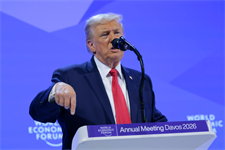
US President Donald Trump made a series of disputed claims about renewable energy during his address at the World Economic Forum in Davos, Switzerland, spreading what environmental experts quickly identified as misinformation about wind power technology and its global adoption.
During his speech to world leaders and business executives gathered at the annual summit, Trump claimed that wind power contributes to economic decline in countries that adopt it while also falsely stating that China, widely recognized as a global leader in renewable energy development, has no wind farms.
These assertions directly contradict established industry data. China has actually led global wind energy installation for several consecutive years, with the Global Wind Energy Council reporting that the country added 23 gigawatts of new wind power capacity in 2022 alone. The nation’s total wind energy capacity now exceeds 365 gigawatts, representing the world’s largest wind power market.
Energy economists also challenge Trump’s claim regarding wind power’s economic impact. Multiple studies from institutions including the International Renewable Energy Agency show that renewable energy development, including wind power, has created millions of jobs worldwide while helping to reduce energy costs in many markets as technology improves and economies of scale develop.
The President’s comments align with his long-standing skepticism toward wind energy, which he has frequently criticized at campaign rallies and other public appearances. Trump has previously made unsubstantiated claims about wind turbines causing cancer and killing birds in large numbers, statements that have been refuted by scientific research.
Environmental policy experts suggest that Trump’s remarks at Davos reflect the administration’s broader energy agenda, which has consistently prioritized fossil fuel development while rolling back regulations designed to combat climate change. Since taking office, the Trump administration has withdrawn the United States from the Paris Climate Agreement and removed numerous environmental protections established under previous administrations.
The timing of these comments is particularly significant as they come amid growing global consensus about the urgency of addressing climate change. Many other world leaders at the Davos forum emphasized the need for accelerated action on climate initiatives, creating a notable contrast with the U.S. position presented by Trump.
Industry analysts point out that despite federal policy positions, renewable energy development continues to accelerate in the United States at the state and local level, driven by falling costs and increasing corporate demand for clean energy. According to the American Wind Energy Association, the U.S. wind industry supports more than 120,000 jobs across all 50 states and represents over $140 billion in private investment.
Trump’s mischaracterization of China’s energy landscape is particularly noteworthy given the country’s massive investments in renewable energy. As part of its latest five-year plan, China has committed to increasing non-fossil fuel sources in its energy mix to 25% by 2030, with significant portions coming from wind power installations both onshore and offshore.
European delegates at the forum, representing countries with significant wind power development such as Denmark, Germany, and Spain, reportedly expressed concern about the potential impact of such high-profile misinformation on global climate action efforts.
Energy security experts note that diversified energy portfolios that include renewable sources like wind actually strengthen economic resilience rather than weakening it, contrary to Trump’s assertions. Countries with developed wind power sectors have demonstrated the ability to reduce dependence on imported fuels while creating domestic manufacturing and installation jobs.
As world leaders continue discussions at Davos about global economic challenges, climate change remains a central topic. Trump’s controversial statements about wind energy highlight the continuing policy divergence between the United States and many of its traditional allies on environmental issues, even as the renewable energy sector continues its global expansion despite political headwinds.
Fact Checker
Verify the accuracy of this article using The Disinformation Commission analysis and real-time sources.

12 Comments
I’m curious to learn more about the reasoning behind Trump’s comments on wind power. While China’s dominance in renewable energy is well-documented, his assertions seem to run counter to the data.
Agreed, it would be helpful to understand the basis for Trump’s claims. Spreading misinformation, even at a high-profile event like Davos, is problematic and undermines fact-based policymaking.
The article provides a good overview of how Trump’s claims about wind power and China’s renewable energy efforts contradict established industry data. It’s important to call out such misinformation, especially from influential figures.
Absolutely. Fact-based dialogue and policymaking should be the goal, rather than political rhetoric that ignores the realities of the energy transition. Transparency and accountability are crucial.
This article highlights the importance of relying on authoritative, impartial data sources when discussing complex energy topics like wind power. Unfounded claims can be misleading and detrimental to policy discussions.
Absolutely. Transparent and evidence-based dialogue is crucial, especially when it comes to energy and environmental issues that have far-reaching impacts.
It’s concerning to see a world leader make inaccurate statements about wind power and China’s renewable energy leadership. Fact-checking and accountability should be a priority, especially on high-profile platforms.
I agree. Spreading misinformation, even inadvertently, can have serious consequences and undermine public trust. Leaders should strive for objectivity and rely on credible data sources.
The article highlights how Trump made inaccurate statements about wind power’s economic impact and China’s wind energy development. It’s concerning to see a leader spread misinformation, especially on important energy topics.
Yes, it’s troubling when political figures make claims that contradict established industry data and research. Fact-checking and transparency are crucial, especially on complex energy issues.
Interesting to see Trump’s misinformation about wind power. China is clearly a global leader in wind energy, with over 365 GW of installed capacity. I wonder what his motivation is for spreading these false claims?
Agreed, the data shows China is a renewable energy powerhouse, not the picture Trump painted. It seems like a political move rather than an objective assessment.