


Listen to the article
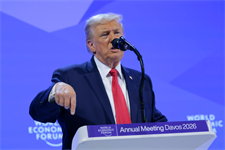
U.S. President Donald Trump delivered remarks containing significant factual inaccuracies about renewable energy during his address at the World Economic Forum in Davos, Switzerland, on Tuesday.
In his speech to global business and political leaders, Trump claimed that wind power negatively impacts national economies and falsely stated that China, the world’s largest renewable energy investor, has no wind farms.
These statements directly contradict established industry data. China has led global wind power development for over a decade, installing more wind capacity than any other nation. According to the Global Wind Energy Council, China added 23 gigawatts of new wind power capacity in 2018 alone, bringing its total installed capacity to approximately 210 gigawatts—more than a third of the global total.
Energy experts were quick to point out the inaccuracies in the President’s remarks. “China not only has wind farms, but they are a global leader in wind energy production and manufacturing of turbines,” said Michael Powers, senior analyst at the International Renewable Energy Association. “Their installed capacity far exceeds that of the United States.”
The comments at Davos represent a continuation of Trump’s pattern of criticizing wind energy. In previous speeches and rallies, he has made disputed claims about wind turbines causing cancer, killing birds, and reducing property values.
Energy industry analysts note that wind power costs have fallen dramatically in recent years, making it increasingly competitive with fossil fuels in many markets. According to Lazard’s annual Levelized Cost of Energy Analysis, wind power is now among the cheapest forms of electricity generation in the United States, even without subsidies.
“The economics of renewable energy have fundamentally shifted,” said Elizabeth Morgan, energy transition specialist at Global Energy Partners. “Wind and solar are now cost-competitive with conventional power sources in most markets worldwide, which is driving their rapid adoption regardless of political positions.”
The Administration’s stance on renewable energy stands in contrast to global market trends. Investment in renewable energy technologies reached $282 billion in 2019, according to Bloomberg New Energy Finance, with wind and solar representing the majority of new power generation capacity added globally.
Trump’s comments also come at a time when several major U.S. corporations, including tech giants and traditional energy companies, have announced ambitious renewable energy procurement targets. Major utilities across the country have accelerated plans to retire coal plants and increase investments in wind and solar projects, citing economic factors rather than environmental concerns.
The timing of these remarks at Davos is particularly notable as climate change and sustainable development featured prominently on the forum’s agenda. Many business leaders at the event emphasized the economic opportunities presented by the transition to low-carbon energy systems rather than viewing environmental sustainability as a cost center.
Market analysts suggest that mischaracterizations of renewable energy economics could potentially mislead investors and policymakers about the sector’s viability. Wind energy stocks have generally outperformed the broader energy market over the past five years, with many manufacturers reporting strong order books and revenue growth.
The U.S. Department of Energy’s own data shows that the wind industry supports more than 100,000 jobs across the country, with particularly strong growth in rural areas where wind resources are abundant.
While debate continues about the optimal energy mix for various economies, the factual inaccuracies in the President’s remarks highlight the increasingly politicized nature of energy policy discussions, even as market forces continue to drive the global energy transition forward regardless of political rhetoric.
Fact Checker
Verify the accuracy of this article using The Disinformation Commission analysis and real-time sources.

12 Comments
While I respect the President, his statements about wind power and China’s renewable energy leadership seem to be inaccurate. It’s important that our leaders provide the public with truthful information, even on complex technical issues.
You’re right, it’s concerning when political figures make claims that are easily refuted by industry data and expert analysis. Fact-based policymaking should be the priority, not partisan rhetoric.
The President’s remarks about wind power and China’s renewable energy capacity are disappointing and contradict the evidence. It’s crucial that our leaders rely on accurate, up-to-date information when discussing these important topics.
I agree, the inaccuracies in Trump’s statements are troubling. As a global leader, it’s important that the US President provides truthful information on energy issues to the international community.
While I appreciate the President’s efforts to promote American industries, his remarks about wind power and China’s renewable energy capacity seem to be at odds with the facts. It’s important that our leaders rely on credible, up-to-date information when discussing these complex issues.
I agree, it’s troubling to see the President making claims that are so easily refuted by industry data and expert analysis. Factual accuracy should be the top priority, especially when it comes to energy policy and the global transition to renewable sources.
This is yet another example of the President making unfounded claims that contradict established industry data and expert analysis. It’s important that the public has access to reliable, fact-based information on energy topics.
I agree, it’s disappointing to see the President spreading misinformation, especially on a global stage. Renewable energy is a critical part of the transition to a sustainable future.
It’s concerning to see the President making false claims about renewable energy, especially wind power and China’s global leadership in this sector. Fact-checking and relying on expert analysis should be the standard for public discourse on these topics.
You’re absolutely right. Spreading misinformation, even inadvertently, can have real consequences when it comes to energy policy and the transition to a sustainable future. Our leaders need to be more accountable for the accuracy of their statements.
Trump’s claims about wind power seem to be at odds with the facts. China is clearly a global leader in wind energy, having installed far more capacity than the US. Renewable energy experts have quickly refuted his statements as inaccurate.
It’s concerning to see the President making demonstrably false claims about renewable energy, especially at an international forum like Davos. Accurate information is crucial on these important issues.