


Listen to the article
Tibetan Leader Strengthens International Advocacy During US Visit
Sikyong Penpa Tsering, the political leader of the Tibetan government-in-exile, concluded a strategic diplomatic mission to Washington DC last week, engaging with key US lawmakers and policy experts to bolster support for the Tibetan cause.
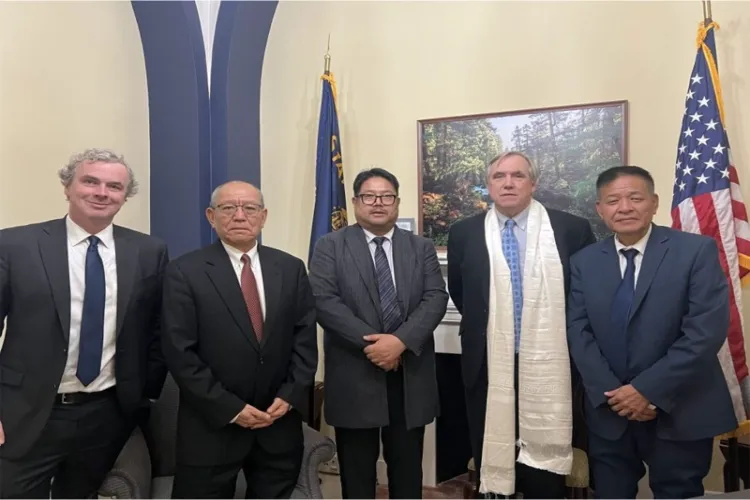
On February 5, Tsering met with US Senator Jeff Merkley, a longtime advocate for Tibet and the original sponsor of the recently introduced bipartisan Resolve Tibet Act of 2024. The meeting underscored the continued congressional interest in Tibet’s struggle for autonomy and human rights under Chinese rule.
The following day, Tsering participated in discussions with the US-China Economic and Security Review Commission, a congressional advisory body that monitors national security implications of US-China relations. This meeting marked the conclusion of his official engagements in the United States before departing for Geneva on February 7 to attend the Geneva Forum 2026.
Throughout his Washington visit, Tsering was accompanied by Namgyal Choedup, Representative of the Office of Tibet in Washington DC, and Tencho Gyatso, President of the International Campaign for Tibet. The delegation conducted a series of high-level meetings focused on countering China’s disinformation campaigns regarding Tibet.
A significant portion of Tsering’s advocacy work involved briefing American think tanks about the increasing challenges posed by Beijing’s narratives about Tibet. The Chinese government has consistently portrayed its rule over Tibet, which began in 1950, as a liberation from feudalism rather than an occupation, a characterization vigorously disputed by Tibetan representatives and human rights organizations.
Tsering also participated in the International Religious Freedom Conference, where he highlighted China’s interference in Tibetan Buddhist affairs, particularly concerns about the future selection process for the next Dalai Lama. The 88-year-old current Dalai Lama, Tenzin Gyatso, lives in exile in India, and the question of his succession has become a contentious international issue, with Beijing insisting on its right to approve his successor.
At the Atlantic Council, a prominent Washington think tank, Tsering engaged in a fireside chat where he shared perspectives on Tibetan democracy-in-exile, religious freedom, and succession issues. These forums provided platforms to articulate the Tibetan administration’s vision for genuine autonomy within China rather than full independence—a middle-way approach advocated by the Dalai Lama.
The Sikyong’s diplomatic outreach included meetings with longstanding Tibet supporters across the American political spectrum. He particularly focused on engaging younger members of Congress to ensure continued bipartisan support for Tibet in future legislative sessions, a strategy that acknowledges the importance of maintaining Tibet’s visibility as a human rights concern amid shifting geopolitical priorities.
Meanwhile, in Australia, the All-Party Parliamentary Group for Tibet met on February 5 to develop action plans regarding Tibet during the ongoing Autumn session of parliament, reflecting growing international coordination on the Tibet issue.
The Central Tibetan Administration, based in Dharamshala, India, continues to advocate for the protection of Tibetan cultural, religious, and political identity. After more than 70 years of Chinese control, Tibet remains a focal point of human rights concerns, with reports of religious persecution, cultural suppression, environmental degradation, and political restrictions.
As China has intensified development in Tibet through infrastructure projects and population transfers, Tibetan advocates argue these policies are designed to dilute Tibetan identity and strengthen Beijing’s control over the strategically important region that borders India, Nepal, and Bhutan.
Tsering’s diplomatic mission comes at a critical time when global attention on China’s human rights record has increased, particularly regarding its treatment of ethnic minorities including Tibetans and Uyghurs.
Fact Checker
Verify the accuracy of this article using The Disinformation Commission analysis and real-time sources.

9 Comments
I’m curious to see what comes out of the Geneva Forum 2026 discussions. Multilateral engagement is crucial for addressing the complex disinformation and human rights challenges in Tibet.
Curious to learn more about the specific policy goals and strategies the Tibetan delegation discussed with US officials. Effective international coordination will be vital going forward.
It’s good to see the Tibetan leader taking a proactive approach to diplomacy and advocacy. Maintaining a strong international presence is key to keeping the Tibet issue on the global agenda.
The meeting with the US-China Economic and Security Review Commission is especially noteworthy, as it highlights the geopolitical implications of the Tibet issue. Monitoring the national security aspects is prudent.
Yes, the commission’s advisory role means they’ll be closely analyzing the strategic considerations around Tibet. Strengthening ties with influential US bodies could prove valuable.
Addressing disinformation around Tibet will be crucial, as China has been very active in spreading misleading narratives. Fact-based advocacy is essential to counter these efforts.
The Resolve Tibet Act of 2024 sounds like an important piece of legislation. I’ll have to look into the details, but any bipartisan effort to support Tibetan autonomy and rights is encouraging.
Interesting to see the Tibetan leader meeting with US officials to discuss the ongoing situation in Tibet. Strengthening international advocacy is crucial for drawing attention to human rights issues under Chinese rule.
I agree, maintaining diplomatic pressure is important to support the Tibetan cause. Engaging with lawmakers and policy experts can help build broader awareness and support.