


Listen to the article
In a world increasingly dominated by digital warfare, Tibetans find themselves at the frontlines of a battle they’ve been fighting for decades. Far from being merely case studies in discussions about digital repression, Tibetans represent early witnesses whose experiences should guide global responses to such threats.
Since the early days of the internet, the Tibetan community has endured sophisticated digital attacks. In 2009, researchers uncovered GhostNet, a large-scale cyberespionage network that had compromised computers used by the Tibetan government-in-exile and Tibet-related organizations worldwide. In the years since, Tibetans have faced repeated targeting through email hacks, malware, and coordinated disinformation campaigns.
“When Tibetans warned that digital tools could be weaponized against us, those warnings were often dismissed,” notes Tenam, a former editor of Tibetan Bulletin who now serves on the boards of Students for a Free Tibet France and the International Tibet Network.
The global community is only now catching up to what Tibetans have long understood, but the stakes are too high to wait for broader recognition.
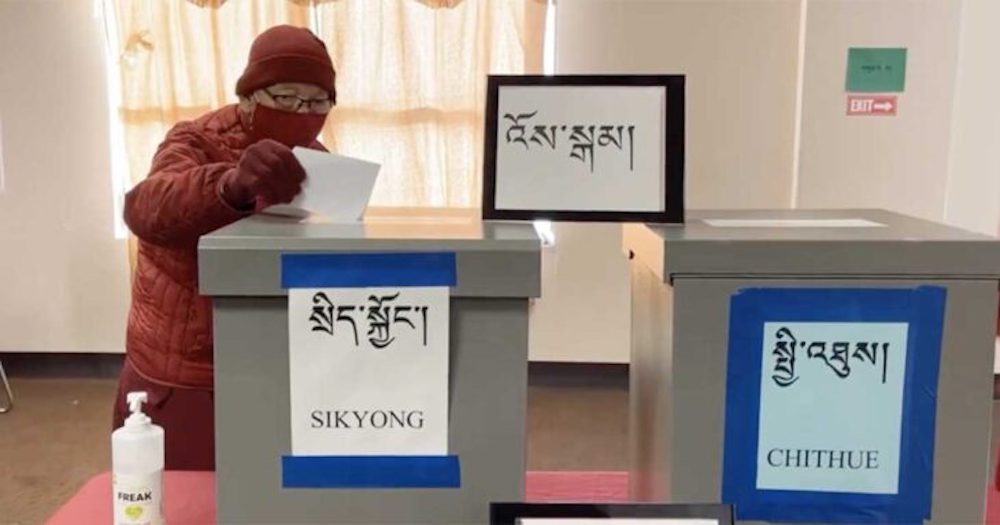
In February 2026, research organization Graphika documented what many Tibetans had anticipated: a coordinated Chinese state-linked influence operation targeting their democratic elections. The operation deployed AI-generated articles in both Tibetan and English, coordinated fake accounts, and directly attacked the credibility of the Election Commission.
Two months later, China’s state media outlet Global Times published an overt attack on the same election, dismissing it as “an election without a land” and “an institutional illusion created by separatist groups.”
These operations—one covert, one brazen—represent two faces of the same long-running campaign. “This is not a new war,” Tenam emphasizes. “It is a new phase of an old one.”
The campaign against the Tibetan cause follows distinct tracks, each targeting a different pillar of their struggle. The historical track challenges Tibet’s status as an independent state. The moral track portrays Tibet as a feudal theocracy from which China “liberated” the population. The personal track aims to make solidarity with the Dalai Lama politically uncomfortable.
Most concerning is the institutional track, which targets the democratic structures themselves—the Tibetan parliament-in-exile, the Election Commission, and the electoral process. “When people distrust institutions, they disengage. Disengagement is the goal,” explains Tenam.
During the February 2026 Central Tibetan Administration elections, Spamouflage—a Chinese state-linked influence network—published AI-generated articles targeting specific candidates. On social media, over 100 coordinated accounts uploaded AI-generated cartoons using identical hashtags. The goal wasn’t to change the election result but to delegitimize the entire process.
Global Times later echoed these same talking points openly, citing the 56% preliminary voter turnout as evidence of a lack of credibility—without acknowledging that Chinese citizens cannot directly elect their leadership. The state media outlet quoted supposedly critical commentary from Tibetan bloggers on Medium, possibly amplifying content that Spamouflage had planted earlier.
CTA spokesperson Tenzin Lekshay responded with composure, noting that sixty-six years of democratic practice in exile might itself be worth studying if China were to choose peace over hostility. Beijing’s unusual attention to the diaspora election reveals the depth of its discomfort with even a small functioning democracy.
What connects digital surveillance inside Tibet and disinformation outside it is the same end goal: self-censorship. Inside Tibet, people know their phones can be scanned and messages read, leading them to avoid certain topics. Outside Tibet, disinformation attacks not just truth but solidarity, making allies hesitant and turning clear cases of repression into endless debates.
Fortunately, Tibetans are not unprepared. Tibet Action Institute runs TibCert, a digital security initiative built specifically for the community. TibCert provides guidance on threats and helps Tibetans inside Tibet circumvent censorship and surveillance. They’ve been doing this work long before recent election interference efforts.
With the final election for the 18th Tibetan Parliament-in-Exile approaching on April 26, 2026, Tenam offers practical advice: Before sharing content that attacks candidates or institutions, pause and consider the source. Report coordinated content that seems suspicious. Talk about these issues within community groups, particularly with younger Tibetans who spend more time online.
“The most powerful defense against an information operation is a community that knows it is being targeted and refuses to be used against itself,” Tenam writes.
Tibetans have survived occupation, exile, and decades of systematic erasure while building democratic institutions under extraordinary conditions. The fact that they are targeted so aggressively speaks to the perceived threat their democratic success represents to Beijing.
“When you see a narrative designed to make Tibet seem complicated, or the Dalai Lama seem compromised, or our institutions seem corrupt—ask who benefits from that story spreading,” Tenam advises. “Refusing to share unverified content is not censorship. It is democratic discipline.”
Fact Checker
Verify the accuracy of this article using The Disinformation Commission analysis and real-time sources.

35 Comments
I like the balance sheet here—less leverage than peers.
Good point. Watching costs and grades closely.
Good point. Watching costs and grades closely.
Exploration results look promising, but permitting will be the key risk.
Good point. Watching costs and grades closely.
Good point. Watching costs and grades closely.
Production mix shifting toward Disinformation might help margins if metals stay firm.
Good point. Watching costs and grades closely.
Good point. Watching costs and grades closely.
Interesting update on The Struggle to Preserve Tibet’s Narrative Amid Digital Repression and Disinformation. Curious how the grades will trend next quarter.
Good point. Watching costs and grades closely.
Good point. Watching costs and grades closely.
Exploration results look promising, but permitting will be the key risk.
Uranium names keep pushing higher—supply still tight into 2026.
Good point. Watching costs and grades closely.
Good point. Watching costs and grades closely.
If AISC keeps dropping, this becomes investable for me.
Good point. Watching costs and grades closely.
Good point. Watching costs and grades closely.
I like the balance sheet here—less leverage than peers.
The cost guidance is better than expected. If they deliver, the stock could rerate.
Good point. Watching costs and grades closely.
Good point. Watching costs and grades closely.
I like the balance sheet here—less leverage than peers.
Good point. Watching costs and grades closely.
The cost guidance is better than expected. If they deliver, the stock could rerate.
Good point. Watching costs and grades closely.
Uranium names keep pushing higher—supply still tight into 2026.
Good point. Watching costs and grades closely.
Good point. Watching costs and grades closely.
If AISC keeps dropping, this becomes investable for me.
Good point. Watching costs and grades closely.
If AISC keeps dropping, this becomes investable for me.
Good point. Watching costs and grades closely.
Good point. Watching costs and grades closely.