


Listen to the article
Along Peru’s southern coast, where wind-sculpted desert meets the Pacific Ocean, lies Paracas National Reserve, one of the country’s most treasured natural sanctuaries. Visitors regularly witness sea lions lounging on sun-drenched rocks, penguins navigating cold waters, and dolphins leaping through ocean currents in this pristine environment.
This idyllic scene, however, faces mounting threats. The National Fishing Society of Peru has filed a legal appeal that could potentially allow destructive industrial fishing vessels inside Paracas and all other marine protected areas in the country. Industrial fishing is already permitted within Nazca Ridge National Reserve, Peru’s largest marine reserve.
The controversy surrounding Paracas and Nazca Ridge exemplifies the growing tension between conservation efforts and commercial fishing interests. As these protected areas’ futures hang in the balance, a sophisticated disinformation campaign has emerged, apparently aimed at swaying public opinion and policy decisions.
In early April 2025, just weeks after a Lima court heard Oceana’s case to determine whether industrial vessels could continue fishing in Nazca Ridge, a series of industry-friendly articles appeared in Peruvian media. The business daily Gestión published a piece headlined “Coexistence Between Industrial Fishing and Protected Natural Areas: Experts Support It,” citing a statement allegedly signed by 430 “fisheries stakeholders” who claimed industrial activity posed no significant threat to marine protected areas.
What went unreported was that at least 300 of these signatures belonged to crew members working for Peru’s seven largest anchovy companies, all affiliated with the National Fisheries Society. Other signatories included individuals employed by or closely tied to the industrial fishing sector. The same statement later appeared as a two-page spread in Perú 21, reportedly costing over $30,000 in advertising value.
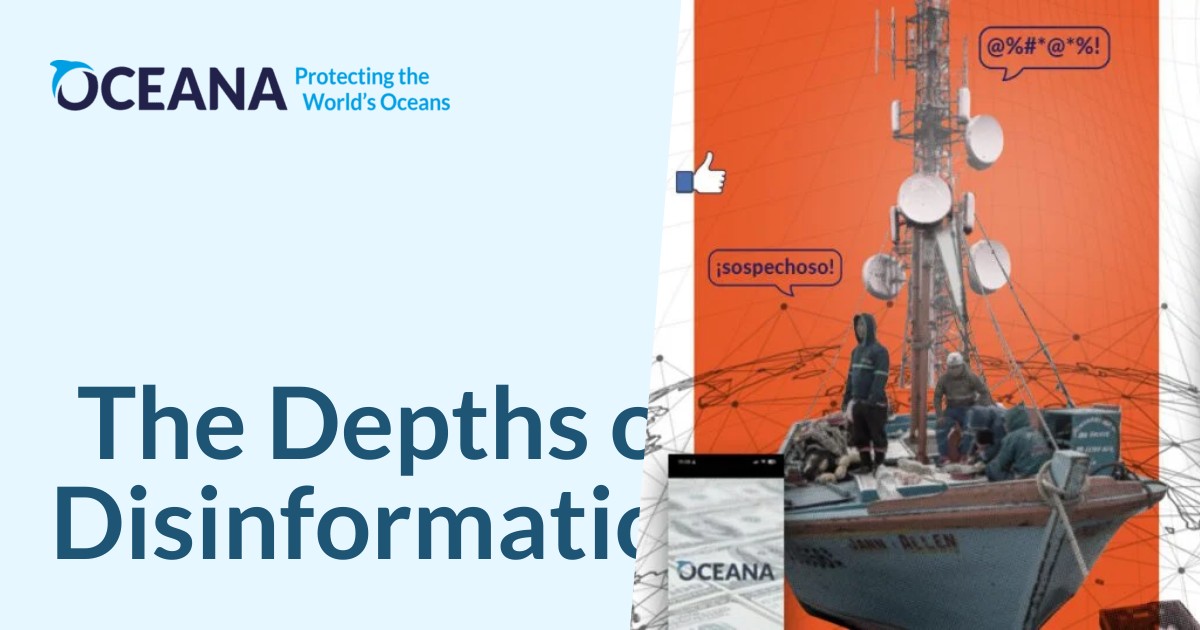
The campaign soon escalated beyond promoting dubious claims about marine protected areas to directly targeting conservation organizations, particularly Oceana. On April 15, new social media accounts named “Anchoveteros del Perú” (Anchovy Fishers of Peru) launched simultaneously across TikTok, Instagram, Facebook, X, and YouTube. These accounts posted professionally produced videos featuring fishers accusing Oceana and its leadership of working against Peruvian interests.
“We, the anchovy fishermen, respond to the lies of the NGO Oceana…What they want is to destroy us and favor others,” claimed one video. Comment sections quickly filled with attacks from suspicious accounts targeting Oceana and its staff. Far-right groups like La Resistencia amplified these messages, declaring support for the fishers against “caviar NGOs.”
From April through July, Oceana’s Peru team faced an overwhelming barrage of hostile messages. “Every day, we received new notifications. Thousands of tweets, posts, and comments attacking Oceana,” recalled one team member. “Every Sunday night, they’d post a new video on TikTok and pay to promote it. And every time, the message was the same: Oceana is a threat to Peru.”
The digital attacks grew increasingly personal, targeting Daniel Olivares, Oceana’s Vice President for Peru and former congressman, whose political background made him vulnerable to character assassination. “They shifted from misinformation to attacking Daniel’s character,” said a team member. “They accused him of corrupt interests and began pushing this idea that Oceana was a foreign NGO threatening Peru’s national sovereignty.”
Despite these provocations, Oceana maintained focus on the core issue: protecting marine reserves from industrial fishing. In response to the disinformation campaign, more than 70 scientists signed a public statement highlighting the ecological dangers of industrial fishing in protected waters, while 30 artisanal fishing organizations released their own statement opposing industrial fishing in these reserves.
By July, the campaign had intensified to alarming levels, with Oceana staff receiving death threats from anonymous accounts. This prompted increased security measures and led Olivares to fly to Peru to address the situation directly.
Surprisingly, when Olivares arrived, he discovered that most mainstream journalists were unaware of the online attacks. By refocusing media attention on the scientific and policy issues at stake, Oceana secured coverage in Peru’s leading news outlets. The disinformation campaign, despite its aggressive tactics and apparent financial backing, had largely remained contained within a social media bubble.
Carmen Heck, Oceana’s Deputy Vice President in Peru, observed that the campaign’s failure stemmed from its lack of credibility. “People didn’t believe them,” she said. “It appeared to be a high-budget production, and it was obvious the ‘Anchoveteros of Peru’ account wasn’t run by real fishers.”
This campaign reflects a broader global trend of social media manipulation. An Oxford report has documented nearly $60 million spent on firms deploying bots and other tactics to create the appearance of genuine political messaging.
The challenges facing conservation efforts in Peru have been further complicated by new legislation passed in 2025 that severely restricts international NGOs’ operations. The law prohibits such organizations from taking legal action against the Peruvian state or assisting others in doing so. “Our lawsuit against the Peruvian government to stop industrial fishing in the Nazca Ridge was filed in 2023 — but today, such a case would be impossible to pursue,” Heck explained.
This legislative shift mirrors a global trend, with more than 50 countries now having laws restricting foreign NGOs or funding. For Oceana’s team in Peru, these developments necessitate careful, strategic campaigning focused on scientific evidence and public education rather than organizational identity.
“A key lesson from this disinformation campaign is that our strategies should always be focused on the underlying issues we seek to resolve, never on Oceana as an organization,” Heck concluded. “Build your campaign around the real problem and the science behind it so that attacks against your organization don’t distract from what truly matters.”
Fact Checker
Verify the accuracy of this article using The Disinformation Commission analysis and real-time sources.

10 Comments
It’s disheartening to see how quickly misinformation can spread and influence important policy decisions. I hope Oceana’s investigation can shed light on the mechanisms behind this disinformation campaign and help strengthen the case for preserving these protected marine areas.
Agreed. Rigorous, independent research and fact-checking will be crucial to countering the industry-friendly narratives and upholding science-based conservation policies.
The tension between commercial interests and environmental protection is an age-old challenge. I’m glad to see organizations like Oceana stepping up to investigate misinformation and advocate for evidence-based policies that prioritize the health of these critical marine habitats.
Well said. Robust public dialogue and transparent, data-driven policymaking will be crucial to ensuring a balanced approach that safeguards both the environment and sustainable economic development.
This is a concerning story about the threats facing Peru’s marine protected areas. It’s critical that we rely on sound science and evidence-based policymaking to protect these vital ecosystems, rather than letting misinformation campaigns sway decisions.
Absolutely. Maintaining the integrity of marine conservation efforts is crucial, especially in the face of commercial interests that may prioritize profits over environmental protection.
I’m curious to learn more about the specific tactics being used in this disinformation campaign. Understanding how these misleading narratives are being spread can help us develop more effective strategies to counter them.
Good point. Transparency and public awareness are key to combating such coordinated efforts to undermine environmental safeguards. Rigorous fact-checking and source verification will be essential.
This is a complex issue with high stakes for Peru’s marine ecosystems. I appreciate Oceana’s efforts to uncover the truth and hold decision-makers accountable. Maintaining the integrity of protected areas is essential for long-term sustainability.
The balance between commercial fishing and conservation is always challenging, but in cases like this, the long-term health of the marine ecosystem should take priority. Protecting Paracas and Nazca Ridge is vital for Peru’s biodiversity and coastal communities.