


Listen to the article
A deadly incident in the town of Zaidal has triggered a wave of sectarian violence in Homs, Syria, with Alawite civilians facing targeted attacks despite having no connection to the original crime, according to a new investigation by Syrians for Truth and Justice (STJ).
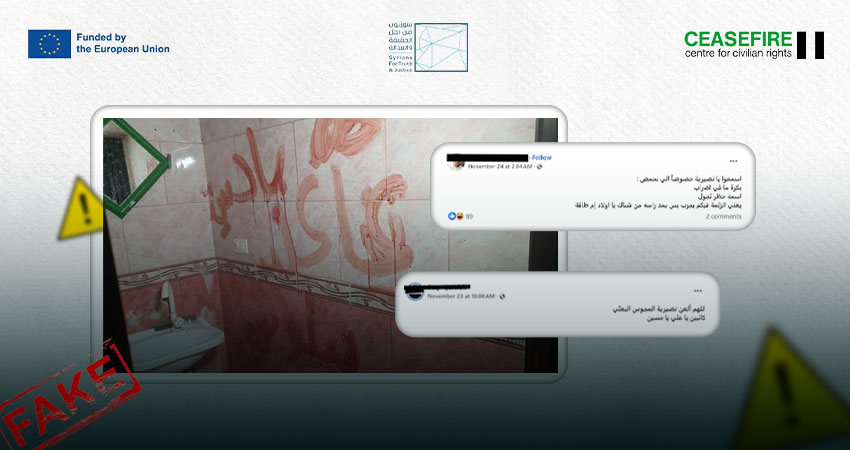
The violence, which erupted on November 23, 2025, appears to have been fueled by a campaign of disinformation and sectarian hate speech that spread rapidly following a homicide in Zaidal. What began as an isolated criminal incident—later determined to have non-sectarian motivations—escalated into coordinated attacks against Alawite communities across various neighborhoods in Homs.
Eyewitness accounts collected by STJ describe disturbing scenes of indiscriminate gunfire, property destruction, and attempted home invasions targeting Alawite civilians. The violence included the burning and looting of private property, with armed individuals reportedly moving through neighborhoods specifically seeking out Alawite residents.
“They were shouting sectarian slurs while firing into the air,” said one witness who asked to be identified only as Ahmed. “When they reached the eastern section of our neighborhood where several Alawite families live, they started trying to break down doors and smash windows.”
The STJ investigation raises serious questions about the response of security forces during the critical early hours of the violence. Multiple witnesses reported delays in intervention that allowed the attacks to spread and intensify. Whether this represented a failure of capacity or a deliberate lack of action remains unclear, though the report suggests potential negligence may have played a role.
“We called the emergency numbers repeatedly, but no one came for nearly three hours,” said another witness from a neighborhood in eastern Homs. “By then, three homes had been completely burned and families were fleeing with whatever they could carry.”
The incident highlights the fragile nature of sectarian relations in post-conflict Syria, where the country’s transitional authorities face significant challenges in maintaining social cohesion. The STJ report specifically calls on these authorities to implement more effective preventive measures to protect vulnerable groups and to develop stronger mechanisms for countering dangerous disinformation.
Syria’s complex sectarian landscape has been a historical flashpoint, with the decade-long civil war exacerbating divisions between various religious and ethnic communities. The Alawite minority, to which former President Bashar al-Assad belongs, has faced particular scrutiny and, at times, reprisal attacks despite many Alawites having no connection to the regime’s actions.
The STJ investigation involved seven in-depth interviews with witnesses from the affected areas. Six of these interviews were conducted during the attacks themselves, providing immediate first-hand accounts of the unfolding violence, while one additional interview took place several days later. All witnesses requested anonymity due to fear of potential reprisals against themselves or their families.
Regional security analysts note that such incidents demonstrate the ongoing challenges facing Syria’s transition. “These episodes of sectarian violence threaten to undermine already fragile reconciliation efforts,” said Dr. Marwan Ibrahim, a specialist in post-conflict stabilization at the Middle East Institute. “The ability of disinformation to trigger actual violence shows just how delicate the situation remains.”
The complete 14-page report provides detailed documentation of the attacks, including chronologies of events across multiple neighborhoods and analysis of the patterns of violence. It represents one of the most comprehensive investigations into sectarian violence in the region since the formal cessation of major hostilities in the Syrian conflict.
Local human rights organizations have called for an independent judicial inquiry into both the original criminal incident in Zaidal and the subsequent sectarian attacks in Homs, emphasizing that accountability is essential to preventing future cycles of violence.
Fact Checker
Verify the accuracy of this article using The Disinformation Commission analysis and real-time sources.

32 Comments
Production mix shifting toward Disinformation might help margins if metals stay firm.
Good point. Watching costs and grades closely.
Good point. Watching costs and grades closely.
Interesting update on Syria Violence: Disinformation and Sectarian Tensions Fuel Attacks on Civilians in Zaidal and Homs. Curious how the grades will trend next quarter.
Good point. Watching costs and grades closely.
Good point. Watching costs and grades closely.
Production mix shifting toward Disinformation might help margins if metals stay firm.
Good point. Watching costs and grades closely.
Good point. Watching costs and grades closely.
Uranium names keep pushing higher—supply still tight into 2026.
Good point. Watching costs and grades closely.
Uranium names keep pushing higher—supply still tight into 2026.
The cost guidance is better than expected. If they deliver, the stock could rerate.
Good point. Watching costs and grades closely.
Production mix shifting toward Disinformation might help margins if metals stay firm.
Nice to see insider buying—usually a good signal in this space.
Good point. Watching costs and grades closely.
Good point. Watching costs and grades closely.
If AISC keeps dropping, this becomes investable for me.
Good point. Watching costs and grades closely.
Good point. Watching costs and grades closely.
If AISC keeps dropping, this becomes investable for me.
Good point. Watching costs and grades closely.
The cost guidance is better than expected. If they deliver, the stock could rerate.
Good point. Watching costs and grades closely.
Good point. Watching costs and grades closely.
Uranium names keep pushing higher—supply still tight into 2026.
Good point. Watching costs and grades closely.
Good point. Watching costs and grades closely.
Exploration results look promising, but permitting will be the key risk.
Nice to see insider buying—usually a good signal in this space.
Good point. Watching costs and grades closely.