


Listen to the article
Disinformation Surge Threatens Bangladesh Election as Voters Head to Polls
Voters in Bangladesh will elect a new government on February 12 amid warnings from analysts that a coordinated surge of disinformation threatens to undermine the democratic process. Experts have traced much of the false information to neighboring India, raising concerns about external influence on the election outcome.
The upcoming vote marks Bangladesh’s first election since a student-led uprising in 2024 toppled longtime leader Sheikh Hasina, who fled to India where she has since been hosted by the Hindu-nationalist government. With approximately 170 million people—most of them Muslim—Bangladesh now finds itself caught in a complex web of domestic politics and regional tensions.
Authorities have reported that online manipulation has reached unprecedented levels, featuring sophisticated AI-generated images and videos designed to sway voter opinion. The problem has become so severe that Bangladesh has established a special unit dedicated to identifying and curbing false content.
Interim leader and Nobel Peace Prize winner Muhammad Yunus addressed the issue in January, telling UN rights chief Volker Turk that a “flood of misinformation surrounding the elections” was flowing from both foreign and local sources. Yunus’s administration has sought international assistance to combat the problem.
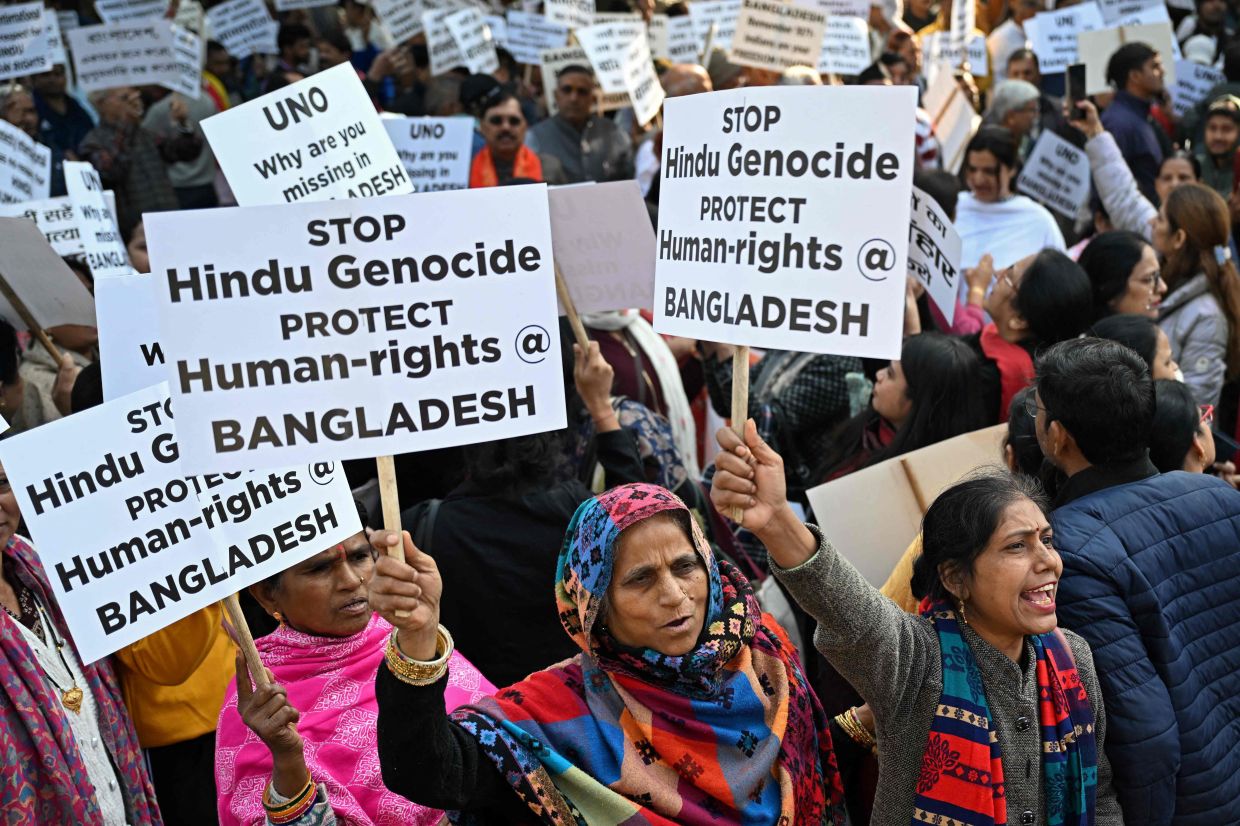
Much of the disinformation campaign centers around alleged attacks against Bangladesh’s minority populations, particularly Hindus, who make up a significant portion of the country’s non-Muslim population of approximately 10 percent. Social media platforms have seen mass posting of claims that Hindus are under attack, often using the inflammatory hashtag “Hindu genocide.”
These claims appear largely unfounded. According to police statistics released in January, only 12 percent of the 645 reported incidents involving members of minority groups in 2025 were classified as having a sectarian motive.
The U.S.-based Center for the Study of Organized Hate has tracked more than 700,000 posts from over 170,000 accounts on X (formerly Twitter) making claims of a “Hindu genocide” between August 2024 and January 2026.
“We have tracked coordinated Indian disinformation online, falsely alleging large-scale violence against Hindus in Bangladesh,” said Raqib Naik, head of the think tank. “More than 90 percent of this content originated from India, with the remainder linked to associated Hindu nationalist networks in the UK, US, and Canada.”
AFP Fact Check has debunked numerous examples of false information, some shared tens of thousands of times. These include AI-created videos featuring a woman who allegedly lost her arm appealing to voters not to support the Bangladesh Nationalist Party (BNP), which many consider a frontrunner in the election.
The proliferation of AI-generated content poses a particular challenge. Hundreds of computer-generated videos documented by fact-checkers on platforms like YouTube, Facebook, TikTok, and Instagram lack AI disclaimers, making it difficult for users to distinguish between real and fabricated content.
“We are noticing a huge amount of fake information compared to other times,” said Miraj Ahmed Chowdhury, head of the Dhaka-based research organization Digitally Right. He noted that free AI tools have made creating sophisticated fakes easier and more accessible.
The disinformation campaign has had real-world consequences. In India, social media outrage by Hindu fundamentalists about the lone Bangladeshi cricket player in India’s domestic IPL league resulted in his club cancelling his contract—a controversy that escalated to Bangladesh’s national team withdrawing from this month’s T20 World Cup in India.
While analysts point to India as the origin for much of the disinformation, there is no evidence directly linking the Indian government to these coordinated campaigns. New Delhi’s foreign ministry has stated they have recorded a “disturbing pattern of recurring attacks on minorities” by “extremists in Bangladesh,” while also emphasizing their support for “free, fair, inclusive and credible elections.”
Bangladesh’s Election Commission has partnered with Meta and established a monitoring unit to track and respond to misleading social media posts. “If our team detects any content as harmful and misleading, we instantly announce it as fake information,” said commission spokesman Md. Ruhul Amin Mallik.
Election expert Jasmine Tuli, a former election commission official, highlighted why AI-generated images pose a particular risk in Bangladesh. Despite high smartphone penetration—more than 80 percent of urban households and nearly 70 percent of rural areas have at least one device—many users lack the digital literacy needed to verify information.
“It is a big threat for a country like Bangladesh, since people don’t have much awareness to check the information,” Tuli warned. “Due to AI-generated fake visuals, voters get misguided in their decision.”
Fact Checker
Verify the accuracy of this article using The Disinformation Commission analysis and real-time sources.

14 Comments
As a Nobel Peace Prize winner, Muhammad Yunus’ concerns about the disinformation threat carry significant weight. His engagement with the UN human rights chief underscores the gravity of the situation.
It’s concerning to see the regional tensions and external influences playing out in Bangladesh’s domestic politics. The country’s authorities will need to strike a delicate balance to ensure a free and fair election amid these complex dynamics.
Absolutely. The establishment of a special unit to combat disinformation is a positive step, but more comprehensive strategies may be needed to address the full scope of the challenge.
The regional tensions and external influences mentioned in the article are particularly troubling. Bangladesh must remain vigilant and assert its sovereignty in the face of these attempts to interfere in its democratic process.
Absolutely. The interim government’s establishment of a special unit to curb false content is a step in the right direction, but more comprehensive strategies may be needed to safeguard the integrity of the upcoming election.
The article’s mention of the interim leader’s engagement with the UN human rights chief is a promising sign that the issue of disinformation is being taken seriously at the highest levels. Continued international attention and support may be crucial in the weeks leading up to the election.
The article’s mention of sophisticated AI-generated content used to sway voter opinion is particularly concerning. Combating this type of advanced manipulation will require innovative approaches and close collaboration between the government, tech companies, and civil society.
Agreed. The use of AI to spread disinformation is a growing threat that demands urgent attention. Strengthening digital literacy and empowering citizens to critically evaluate online content will be key to mitigating this challenge.
This is a concerning development. Disinformation campaigns can undermine the democratic process and erode public trust. Careful monitoring and rapid response will be critical to ensure a free and fair election in Bangladesh.
Agreed. The use of AI-generated content to sway voter opinion is particularly alarming. Strengthening digital literacy and fact-checking efforts will be crucial to combat this threat.
The student-led uprising that toppled the previous government in Bangladesh adds an intriguing layer to this story. The upcoming election will be a crucial test of the country’s democratic resilience in the face of external interference.
The surge in disinformation campaigns is a troubling sign that bad actors are seeking to influence the outcome of the upcoming election in Bangladesh. Vigilance and a robust response from the authorities will be crucial.
The article highlights the complex geopolitical dynamics at play, with Bangladesh caught between domestic politics and regional tensions. Navigating this landscape while preserving democratic freedoms will be a delicate balancing act.
Absolutely. Bangladesh must remain steadfast in its commitment to democracy and resist any attempts to undermine the will of its people, regardless of the source of the interference.