


Listen to the article
Istanbul Summit Addresses Global Instability as Middle East Conflict Escalates
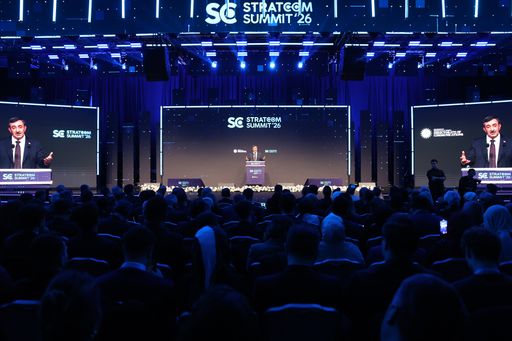
The International Strategic Communication Summit (Stratcom Summit) 2026 commenced Friday in Istanbul, gathering high-ranking officials from 38 countries to address the ongoing Middle East conflict and widespread challenges threatening global stability.
Hosted by Türkiye’s Communications Directorate, the two-day forum features participation from Turkish Vice President Cevdet Yilmaz, Foreign Minister Hakan Fidan, and National Intelligence Organisation Director Ibrahim Kalin. The summit has attracted eleven ministers from ten different countries, among more than 60 senior officials in attendance.
Under the theme “Disruption in the International System: Crises, Narratives and the Search for Order,” the summit aims to examine fundamental disruptions in global governance structures and explore regional approaches to restoring international stability.
In his opening address, Vice President Yilmaz highlighted how increasing global instability, armed conflicts, and widespread disinformation are transforming the landscape of international politics, emphasizing strategic communication’s growing role in effective governance.
“The post-World War II order faces unprecedented strain as shifting power balances outpace our institutional frameworks,” Yilmaz stated. He noted that overlapping crises in security, economic stability, climate change, and migration have become persistent features of today’s global political environment.
Yilmaz identified the Israel-US conflict with Iran as a significant threat to both regional and global stability, citing humanitarian and economic consequences that extend well beyond the immediate region. He emphasized that Türkiye continues pushing for an immediate ceasefire through diplomatic initiatives led personally by President Recep Tayyip Erdogan.
The Turkish Vice President also delivered sharp criticism of Israel’s military actions across multiple fronts, including Gaza, the occupied West Bank, Lebanon, and Syria. He specifically condemned restrictions imposed at Al-Aqsa Mosque in occupied East Jerusalem, calling for stronger international opposition to what he described as clear violations of international law.
The summit comes at a critical juncture in Middle Eastern geopolitics, with escalating tensions threatening to expand regional conflict. Türkiye has positioned itself as a diplomatic intermediary, leveraging its relationships with various regional actors to advocate for de-escalation.
Security analysts note that Türkiye’s geographic position and diplomatic relations with both Western powers and Middle Eastern nations give it unique standing to facilitate dialogue. The country has historically maintained communication channels with parties across regional conflicts, even during periods of heightened tension.
Yilmaz also addressed the growing challenge of information warfare, warning that modern conflicts are increasingly shaped by sophisticated disinformation campaigns and AI-generated content. He noted that restricted media access in conflict zones further complicates the international community’s ability to access reliable information—a challenge directly relevant to the summit’s focus on strategic communication.
The gathering in Istanbul represents one of the largest diplomatic forums focused on communication strategy in recent years. Experts suggest that beyond addressing immediate crises, the summit reflects growing recognition that effective international communication frameworks are essential to managing complex global challenges.
As the summit continues through Saturday, participants are expected to develop practical approaches for improving international communication during crises and explore mechanisms for countering deliberate disinformation campaigns that undermine peace initiatives.
The Stratcom Summit’s diverse participation underscores the widespread concern about current global instability and recognition that resolving these challenges requires coordinated international effort across traditional geopolitical divisions.
Fact Checker
Verify the accuracy of this article using The Disinformation Commission analysis and real-time sources.

20 Comments
Interesting that the summit is being hosted by Türkiye, given its strategic location and involvement in the regional dynamics. I wonder what unique perspectives the Turkish officials will bring to the table.
Yes, Türkiye’s role as the host gives them an opportunity to shape the agenda and highlight their concerns. It will be insightful to see how they frame the challenges and propose solutions.
Strategic communication is clearly critical in an age of widespread disinformation. I hope the summit can identify practical ways for countries to collaborate and counter false narratives more effectively.
Agreed, the proliferation of disinformation poses a serious threat to global stability. Effective strategic communication will be key to restoring public trust and promoting accurate information.
The theme of ‘Disruption in the International System’ captures the turbulent global landscape we’re facing. I’m curious to see how the summit participants grapple with the complex geopolitical and security challenges.
Absolutely, the summit’s focus on regional approaches to restoring stability is crucial. Collaborative solutions will be essential to address the interconnected nature of these disruptive forces.
This summit sounds like a critical forum for addressing the global challenges of information warfare and regional conflicts. I’m curious to hear how the participating nations plan to strengthen strategic communication and restore stability.
Agreed, the escalating tensions and disinformation campaigns globally make this an important event. I’ll be interested to see what concrete steps emerge from the discussions.
Strategic communication is crucial in an era of widespread information warfare. I’m hopeful the summit can develop effective frameworks for countries to counter false narratives and promote accurate, trustworthy information.
That’s an excellent point. Restoring public trust in institutions and official information sources will be key to mitigating the destabilizing effects of disinformation campaigns. I look forward to seeing the summit’s proposals in this area.
As a major geopolitical player, Türkiye’s role in hosting this summit is noteworthy. I wonder what unique insights they can provide given their involvement in regional dynamics and efforts to maintain stability.
That’s a good point. Türkiye’s location and relationships in the region could give them valuable perspectives to share. Their leadership in convening this critical dialogue is commendable.
The Middle East conflict is a significant driver of global instability, so I’m glad to see it being addressed at this summit. Exploring regional approaches will be key to finding durable solutions.
Absolutely, the Middle East has been a hotspot for conflict and disinformation campaigns. Collaborative strategies to manage these crises and counter false narratives will be crucial.
The summit’s focus on ‘Disruption in the International System’ underscores the profound challenges we’re facing globally. I hope the discussions can identify pragmatic ways to restore stability and order.
Agreed, the current state of global affairs is deeply concerning. Collaborative, evidence-based solutions will be essential to address the complex web of crises and disinformation campaigns.
It’s encouraging to see high-level government officials from diverse countries coming together to tackle these critical issues. Effective strategic communication will be vital to de-escalating tensions and promoting peace.
Agreed, the participation of senior officials from so many nations underscores the gravity of the situation. I hope the summit can chart a path forward that brings greater stability and security globally.
The participation of senior officials from 38 countries underscores the global significance of the challenges being addressed at this summit. I’m curious to see how they coordinate a unified, multilateral response.
Absolutely, a coordinated, international approach will be critical. The summit’s ability to foster productive dialogue and consensus-building on these complex issues will be a key measure of its success.