


Listen to the article
Somali Journalists Train for Election Coverage as Banadir Regional Vote Approaches
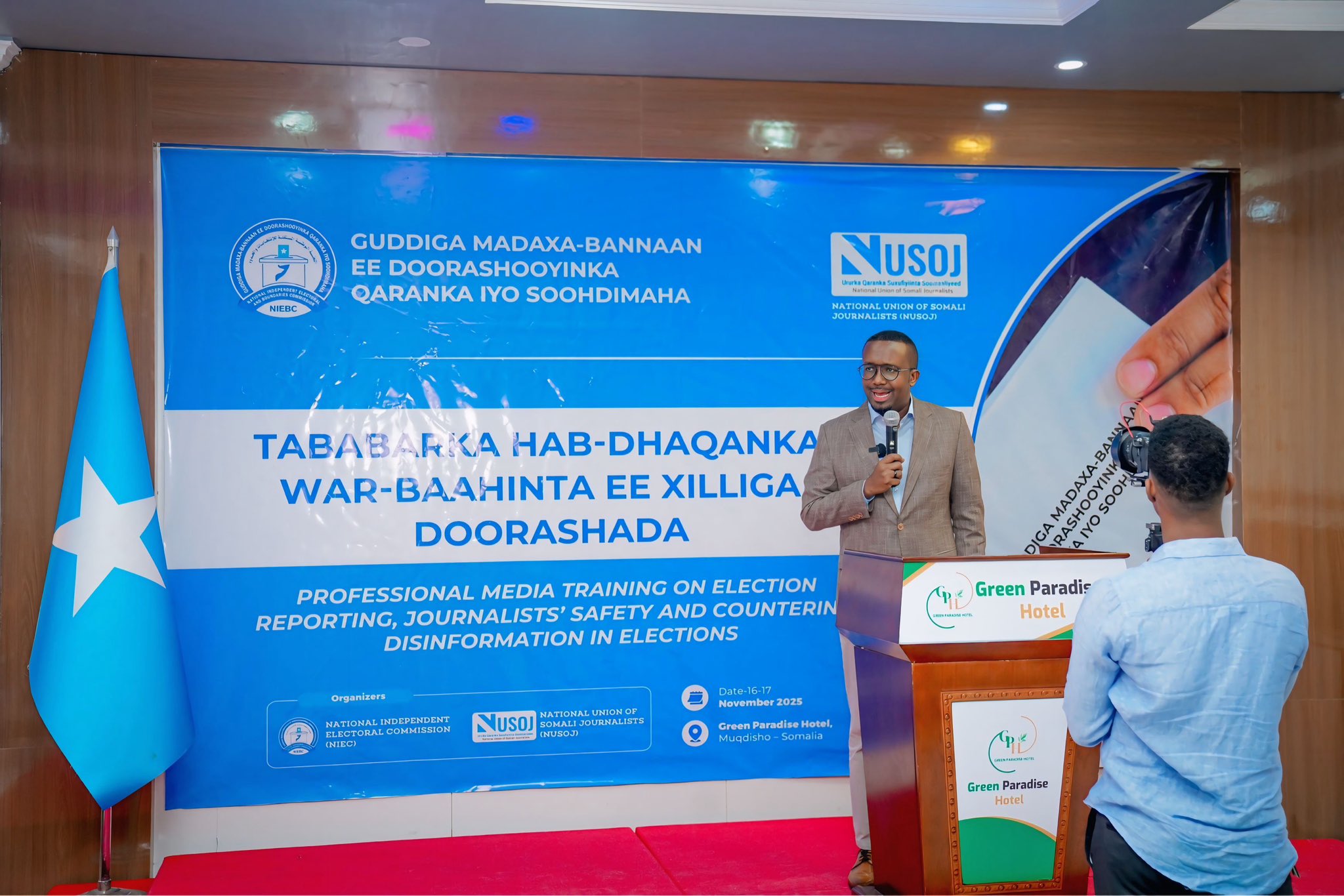
In preparation for the upcoming Banadir Regional Council elections, 102 Somali journalists have completed specialized training on professional election coverage, safety protocols, and strategies to combat misinformation. The two-day program, held December 16-17, brought together media professionals from 27 accredited news organizations in Mogadishu.
The National Union of Somali Journalists (NUSOJ) organized the training in partnership with Somalia’s National Independent Electoral Boundaries Commission (NIEBC), providing a rare opportunity for direct engagement between electoral officials and the media. Participants included reporters and editors from both private and state-owned outlets who will be covering the pivotal regional vote scheduled to begin Thursday.
“When major newsworthy events are taking place and journalists are actively preparing to cover them, it is essential to strengthen their professional capacity, enhance their safety awareness, and equip them with skills to detect and counter disinformation,” said NUSOJ Secretary General Omar Faruk Osman, emphasizing the timeliness of the initiative.
The training curriculum focused on three critical areas: electoral process coverage, journalist safety, and combating false information. Commission officials provided firsthand briefings on electoral guidelines and procedures, allowing journalists to gain deeper understanding of how the process will unfold on the ground.
Safety sessions addressed the unique challenges faced by media workers during election periods, which historically present elevated risks in Somalia’s complex security environment. Discussions covered both the responsibilities of authorities in protecting journalists and strategies for media professionals to minimize personal risk while reporting.
The program also equipped participants with practical tools to identify and verify information amid the expected surge of election-related content. These skills are particularly relevant in Somalia, where social media and messaging platforms can rapidly spread unverified claims that potentially undermine electoral integrity.
In a notable development just days before the training, NUSOJ leadership and representatives from the Somali Media Women Association (SOMWA) met with NIEBC Chairperson Abdikarim Ahmed Hassan to advocate for journalist protections during the election period. The discussion yielded concrete commitments from electoral and security officials.
Following this meeting, Hassan held a press conference alongside the Somali Federal Police Commissioner and the Banadir Regional Police Commissioner, where they publicly guaranteed journalist safety and promised unrestricted access throughout the electoral process – critical assurances in a country where press freedom has faced significant challenges.
The Banadir Regional Council elections represent an important step in Somalia’s ongoing efforts to rebuild democratic institutions after decades of conflict. However, the process has not been without controversy. The country’s main opposition coalition, the Somali Salvation Forum, has voiced strong objections to the elections, characterizing them as neither free nor fair.
Opposition leaders have accused the current administration of orchestrating what they describe as a “one-sided, one-party exercise,” raising questions about the vote’s legitimacy despite the government’s assurances of transparency.
The training of journalists comes at a crucial moment for Somalia’s media landscape, which has struggled with safety concerns, political pressures, and resource limitations. By strengthening the capacity of local journalists to cover elections professionally and safely, the initiative aims to support more informed civic participation.
“Journalists must be able to independently and fairly reflect diverse and even opposing views without fear or interference,” Osman noted, highlighting the essential role of access to accurate and timely information in Somalia’s democratic development.
As Mogadishu prepares for Thursday’s vote, the newly trained journalists will face the challenge of delivering balanced coverage amid political tensions, applying their enhanced skills in what promises to be a significant test for both Somalia’s electoral system and its media institutions.
Fact Checker
Verify the accuracy of this article using The Disinformation Commission analysis and real-time sources.

20 Comments
It’s great to see Somali journalists from across the industry spectrum coming together for this training. A unified, professional media is key to ensuring fair and accurate election coverage.
Absolutely. Bridging divides between private and state-owned outlets is an important step towards building public trust in the media’s role as a democratic watchdog.
It’s encouraging to see Somali media outlets, both private and state-owned, coming together for this training. A unified, professional media landscape is essential for fair and transparent elections.
Interesting to see the focus on both practical aspects like safety protocols and the more nuanced challenge of combating misinformation. Journalists need a diverse skillset to navigate the complexities of reporting on elections.
Absolutely, covering elections is about more than just the logistics. Journalists have to be equipped to identify and debunk false narratives that could undermine the integrity of the process.
The partnership between NUSOJ and the electoral commission is an encouraging sign of collaboration between the media and government to strengthen democratic institutions in Somalia. Transparent and accountable elections are vital for the country’s stability.
Agree, this type of cross-sector cooperation is essential. The media plays a crucial watchdog role, but also needs support from electoral authorities to fulfill that function effectively.
With the Banadir regional vote on the horizon, this training couldn’t have come at a better time. Equipping journalists with the skills to navigate the challenges of election coverage is crucial.
It’s encouraging to see the Somali media and electoral authorities collaborating on this initiative. Fostering transparency and trust between these institutions is crucial for the country’s democratic development.
Kudos to the organizers for including strategies to combat disinformation in the training. In today’s media landscape, that’s an essential skill for journalists covering elections.
The collaboration between the media and electoral authorities is a positive sign. It suggests a shared commitment to transparency and accountability in the upcoming Banadir elections.
Exactly. This kind of partnership helps build public trust in the electoral process, which is so important for the integrity of Somali democracy.
With the Banadir regional vote coming up, this training on election coverage, safety, and disinformation could not be more timely. Kudos to the organizers for prioritizing these critical journalism skills.
Kudos to the NUSOJ and NIEBC for providing this valuable training. Strengthening the capacity of Somali journalists to cover elections is an important step towards bolstering democratic institutions.
Agreed. Empowering the media to fulfill its watchdog role is key to ensuring the public has access to accurate, impartial information about the electoral process.
With the Banadir regional vote coming up, this training program is well-timed. Strengthening the capacity of Somali journalists to report accurately and safely is key to upholding the integrity of the electoral process.
Agreed. Responsible, impartial election coverage by a professional media is essential for a healthy democracy. This training should help Somali journalists fulfill that vital role.
Glad to see Somali journalists receiving specialized training on election coverage and combating disinformation. This is crucial for ensuring accurate and unbiased reporting during the upcoming Banadir regional vote.
Absolutely. Equipping journalists with the right skills and tools to identify and counter misinformation is so important for upholding the integrity of the electoral process.
The focus on both practical skills and the challenge of combating misinformation seems well-balanced. Equipping journalists with a diverse toolkit is crucial for election coverage.