


Listen to the article
In Moldova’s Fight for Media Freedom, Digital Platforms and AI Present New Challenges
The small Eastern European country of Moldova is battling Russian threats and disinformation while preparing for EU accession, raising urgent questions about how journalism can thrive in the digital age.
In Chișinău, Moldova’s capital, life continues with a semblance of normalcy. Near the parliament building, citizens browse market booths selling pies, clothes, and wine, while scrolling through their phones like people worldwide. But beneath this ordinary surface lies an extraordinary media landscape shaped by geopolitical tensions.
This former Soviet Republic of 2.4 million people, situated between EU member Romania and war-torn Ukraine, faces unique challenges. With a significant Russian-speaking minority and under constant pressure from Moscow, Moldova’s journalists operate in an information battleground where foreign influence campaigns compete with domestic reporting.
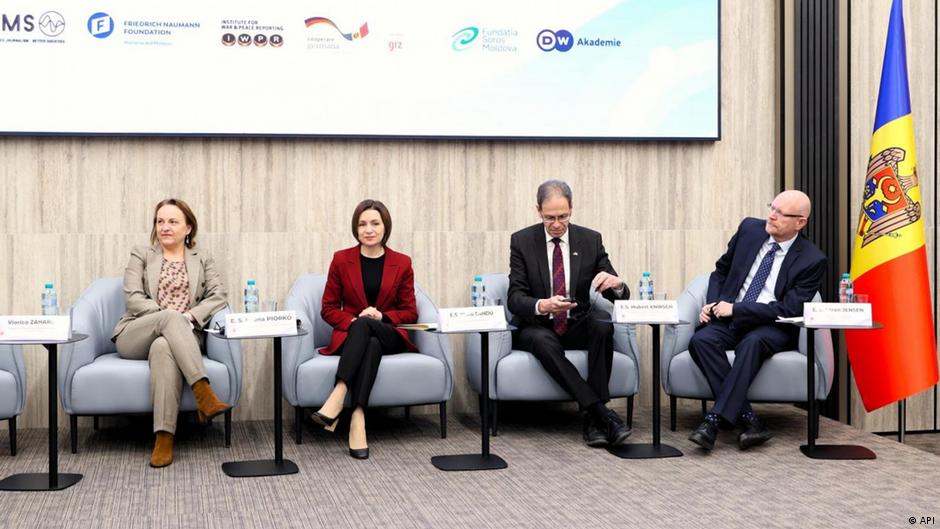
These challenges prompted unprecedented discussions at Chișinău’s Urban Business Center in December 2025, where experts and politicians gathered during Moldova’s Media Forum to examine how digital platforms and artificial intelligence are reshaping the media environment. The event drew 230 participants from journalism, government, civil society, and international organizations.
The timing is critical. Moldova received EU candidate status in 2022 and has consistently affirmed its pro-European path through democratic processes. President Maia Sandu won re-election in 2024, and the pro-European PAS-party secured a parliamentary victory in October 2025.
While the country has made significant democratic progress in recent years, including strengthening freedom of expression and independent media, these gains remain vulnerable to external manipulation. In this precarious environment, the policies of digital platforms have outsized influence on Moldova’s information space.
Julia Haas, Advisor to the OSCE Representative on Freedom of the Media, framed the discussions around three critical issues highlighted in a recent policy manual: journalist safety, media visibility, and financial viability—all increasingly threatened in the digital ecosystem.
Cornelia Cozonac, President of the Center for Investigative Journalism of Moldova, detailed alarming trends: fake accounts impersonating reporters, cyberattacks targeting newsrooms, and coordinated personal attacks online. “The safety of journalists, including in the online environment, remains a serious problem,” she warned, noting that the anonymity of online harassment complicates government intervention.
The diminishing visibility of journalistic content emerged as another major concern. “Even though we like to believe that journalists set the public agenda, we are aware that this is no longer the case,” said Anastasia Antoceanu, Editor-in-Chief of online outlet Agora.md. She emphasized that opaque platform algorithms increasingly determine what content reaches audiences, directly impacting the public’s right to information.
Ruslan Mihalevschi from Moldova’s Audiovisual Council described this phenomenon as a “structural capture” of the media space, noting that “We can now speak about the existence of a hate-based economy that harms quality journalism.” Algorithms that prioritize divisive content over public-interest reporting are undermining the media’s democratic function.
Financial challenges compound these problems. Digital platforms have absorbed the majority of advertising revenue that once sustained independent media. Beyond these direct losses, outlets face “additional costs for promotion and are forced to adapt content to what platforms tolerate,” according to Antoceanu.
The forum generated several practical recommendations that could strengthen media resilience in Moldova and potentially serve as a model for other countries facing similar challenges.
Moldova has already taken steps to enhance online safety for journalists. Mihalevschi explained that amendments to the Audiovisual Services Code introduced in August 2025 established a “trusted notifier” concept, allowing journalists to report threats directly to the Audiovisual Council. Michelle Iliev, State Secretary for Digitalization, suggested that a Cyber Incident Registry could further strengthen rapid government response to online risks.
Financial support mechanisms were also proposed, including an innovation fund open to media businesses that could provide small grants to help local outlets compete in the digital environment without becoming dependent on global platforms.
Regulatory approaches present particular challenges. While Moldova is aligning its media legislation with EU frameworks like the Digital Services Act and AI Act, enforcement remains problematic since the country is not yet an EU member and platforms often lack legal representation within Moldova. “This is why we rely on the support of the European Commission when dealing with Big Tech platforms, while enforcing Moldovan law on domestic platforms,” Iliev noted.
Participants also discussed “must-carry” regulations that could require digital platforms to deliver certain public interest journalism to audiences, potentially counterbalancing algorithm-driven content distribution.
As Moldova continues its democratic journey toward EU integration while facing persistent interference campaigns, the resilience of its media sector remains crucial. The discussions in Chișinău demonstrated that sustainable solutions will require cooperation between journalists, government, civil society, and the platforms themselves—a model of engagement that has relevance far beyond Moldova’s borders.
Fact Checker
Verify the accuracy of this article using The Disinformation Commission analysis and real-time sources.

13 Comments
Fascinating to learn about the challenges facing Moldova’s media sector. The interplay of digital platforms, AI, and geopolitical dynamics is a complex issue without easy solutions.
Agreed, this is an area that will require ongoing dialogue and collaboration between stakeholders to find the right balance.
The article highlights some important nuances around the media landscape in Moldova – the Russian-speaking minority, pressure from Moscow, and the need to balance geopolitical tensions. This will require a multi-faceted approach.
This article highlights the delicate balancing act Moldova must perform in shaping its media landscape amid geopolitical tensions. Ensuring press freedoms and media diversity will be crucial for the country’s future.
Absolutely, this is an important issue that deserves ongoing attention and support from international partners as Moldova charts its course.
This is an important issue for Moldova as it navigates the digital landscape and media landscape amid geopolitical tensions. Maintaining media freedom and balanced reporting will be crucial for Moldova’s democratic development.
Agreed, the role of digital platforms and AI in shaping the media environment is a critical challenge that requires thoughtful policymaking.
The article raises important questions about the future of journalism in the digital age, particularly for countries like Moldova facing unique geopolitical pressures. Fostering media pluralism and resiliency will be key.
Well said. This is a complex issue that deserves careful consideration and policy solutions tailored to Moldova’s specific context.
Moldova’s position as a small nation between EU and Russia makes its media landscape especially fraught. Protecting press freedoms while combating foreign interference will be crucial.
It’s concerning to hear about the foreign influence campaigns competing with domestic journalism in Moldova. Strengthening media literacy and source verification will be key to combating disinformation.
Absolutely, supporting independent and ethical journalism is vital for Moldova as it works towards EU accession.
Interesting to learn about the challenges facing Moldova’s media sector as it navigates EU integration and Russian influence. Maintaining an independent, ethical press will be vital for the country’s democratic development.