


Listen to the article
UK Minister Visits Estonia to Learn About Tackling Online Misinformation in Schools
In a snow-covered district of Tallinn, Estonia, UK Children and Families Minister Josh MacAlister recently stood before a class of teenagers in what could have been any secondary school classroom – except for the -8C temperature outside and deep snow drifts surrounding the Soviet-era building.
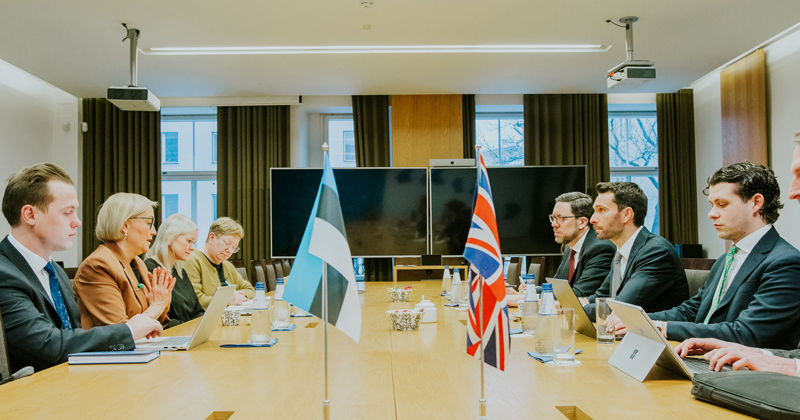
“We’ve got a lot to learn from Estonia,” MacAlister told the students, explaining why he and a delegation including British ambassador Ross Allen had traveled to this small Baltic nation of just 1.4 million people.
The three-day research trip, organized by the Commission into Countering Online Conspiracies in Schools, aimed to understand how Estonia tackles the growing problem of misinformation and disinformation among young people – an issue that has become increasingly urgent in the UK.
Estonia ranks high in international education league tables and has decades of experience defending against Russian propaganda campaigns. Perched beside Russia, the country has embedded resilience to misinformation into its education system, making it a natural case study for British officials.
“We are also, in the UK, at times attacked by Russia: cyber warfare, misinformation, disinformation, and attempts to interfere with our political processes,” MacAlister told students. “So there’s lots for us to learn about what you’re doing in classrooms.”
A Growing Problem in British Schools
Research by the Commission, run by Public First and the Pears Foundation, suggests over half of young people in England have encountered someone in class or online who believes in conspiracy theories. Meanwhile, half of teachers reported being at least moderately worried about pupils expressing belief in conspiracies.
The impact can be significant. In 2024, online misinformation helped fuel far-right protests and riots across the UK following the Southport stabbings, with over 1,500 people arrested, many of them children.
An Ofcom report last spring found the proportion of English teens who feel confident judging what is real or fake online has fallen from 82 percent in 2022 to just three-quarters.
Estonia’s Integrated Approach
The delegation visited several schools, including Pelgulinna Riigigümnaasium, a striking timber-built upper secondary school in western Tallinn that resembles a modern art museum more than an educational institution.
“We have been in the information war since at least the 2000s,” explained principal Indrek Lillemägi. “Misinformation, the Kremlin influence – it has been here I think longer than in most European societies.”
Since 2010, all Estonian upper secondary students have taken a compulsory “media and influence” course, teaching them about different media outlets, how to differentiate fact from fiction, and to engage with information critically.
Media literacy teacher Gertrud Kasemaa described teaching pupils “about different media genres… how to spot misinformation, how to recognize fake news.” Estonian media organizations actively participate by visiting schools and hosting student visits, creating mutually beneficial relationships.
Beyond this dedicated course, “digital competence” is one of eight key competencies that teachers are expected to incorporate across all subjects in the Estonian national curriculum.
Practical Classroom Approaches
At Rae Gümnaasium in Jüri, history and social science teacher Roman Kasak demonstrated how this works in practice. Each lesson, a different student finds a media article relevant to the topic being covered, then analyzes “its credibility… who is the author, what’s their background, and how can this influence what they’re saying.”
One student described how her Estonian language class used ChatGPT to write intentionally misleading articles about a classic Estonian film: “But everything was wrong about it, the characters, the plot,” she explained. “It is so easy to give misleading information.”
Another student mentioned how his science class had practically tested the “plastic snow” conspiracy theory that recently made headlines in the US, where people claimed snow charred rather than melted when burned, supposedly proving it was artificial.
Implementation Challenges
The success of Estonia’s approach appears to depend significantly on individual teachers’ enthusiasm and knowledge. One teacher noted younger educators seem “more open to it,” while veteran teachers who have “worked in their subjects for 20 years” might be less adaptable, though they are “trying to integrate it.”
This resonates with UK research showing that while teachers are considered well-positioned to address conspiracy theories, many feel ill-equipped to do so. One young Estonian teacher acknowledged the difficulty of managing classrooms with diverse beliefs without imposing personal opinions.
Estonia has recently established an association of media literacy teachers to support colleagues in integrating these skills across subjects.
However, a significant difference from the UK approach is Estonia’s high level of autonomy and low accountability. When asked how the government verifies media literacy implementation, Principal Lillemägi simply replied: “It is not checked… We just trust schools.”
Results and Student Confidence
Despite the hands-off approach, students at the schools visited demonstrated confidence in their ability to identify misinformation.
“I think it’s our skill right now that we can identify the disinformation,” one student said. “We are taught to check the facts, find the data,” added her classmate.
While the students acknowledged they can’t always spot fake content, they approach information with appropriate skepticism, whether from social media, advertisements, or news sources.
Implications for England
Following the trip, the Department for Education noted it was “interesting” that Estonia has “little public debate regarding phones in schools or social media use,” contrasting with heated discussions in the UK.
Estonia’s Education Minister Kristina Kallas explained how the country built resilience over 20 years, adapting to evolving challenges from the 2007 “Bronze Soldier” riots to COVID-19 misinformation and the impact of AI.
However, implementing similar approaches in England, with approximately 50 times as many schools and a more rigid curriculum, would require a different strategy than Estonia’s autonomous model.
MacAlister stated after the trip: “Our updated curriculum will ensure every child learns to identify mis- and disinformation from an early age, and our Educate Against Hate website continues to provide schools and parents with free, high-quality resources as part of the government’s wider work to build social cohesion.”
Currently, media literacy in England is covered across citizenship, RSHE, computing, English, and optional GCSE media studies. Recent curriculum review recommendations accepted by the government include adding citizenship to the primary national curriculum and better specifying media literacy throughout primary and secondary education.
Fact Checker
Verify the accuracy of this article using The Disinformation Commission analysis and real-time sources.

14 Comments
As a nation on the frontlines of Russian information warfare, Estonia has developed sophisticated strategies to protect its citizens, especially the younger generation. The UK’s interest in learning from their experience is well-placed.
Absolutely. Safeguarding youth from the corrosive effects of online propaganda should be a top priority for all democratic states. Estonia’s education-based approach is an intriguing model worth deeper examination.
Given Estonia’s proximity to Russia and long history of dealing with Kremlin disinformation campaigns, their insights are invaluable. The UK would be wise to closely study their education-focused counter-measures.
Kudos to the UK government for seeking out best practices from Estonia, a country that has grappled with Russian disinformation campaigns for decades. Equipping students with critical thinking skills to spot and resist online manipulation is an invaluable investment.
Absolutely. Proactive media literacy education is essential to empower young people and safeguard democracy from the corrosive effects of disinformation.
Fascinating to see how Estonia is leading the way in countering online misinformation. Building resilience in youth is critical as fake news and propaganda become more sophisticated. The UK has a lot to learn from their experience on the frontlines.
Kudos to the UK government for recognizing the value of Estonia’s experience in this domain. Strengthening defenses against online manipulation should be a top priority for all democratic societies.
The UK’s effort to learn from Estonia’s anti-disinformation measures is a prudent move. Equipping the next generation with critical thinking skills to navigate the digital landscape is essential for maintaining a healthy democracy.
It’s encouraging to see international collaboration on this important issue. Sharing knowledge and strategies across borders can help strengthen defenses against malicious actors seeking to sow division and undermine public trust.
Agreed. Tackling the global challenge of online misinformation requires a coordinated, multinational approach. Estonia’s expertise could provide valuable insights for the UK and other nations.
Fascinating to see how Estonia has embedded resilience to misinformation into its education system. With the growing threat of foreign propaganda, this kind of innovative, whole-of-society approach is vital.
It’s encouraging to see international cooperation on tackling online misinformation, a global challenge that threatens democratic societies. Estonia’s frontline experience provides valuable insights the UK can leverage.
As a nation bordering Russia, Estonia has hard-earned expertise in combating Kremlin propaganda. Their education-based approach to building digital resilience is an interesting model that deserves closer examination.
The UK’s effort to learn from Estonia’s anti-disinformation measures is a smart move. Proactive investment in critical thinking and media literacy skills for young people is essential to safeguard democracy in the digital age.