


Listen to the article
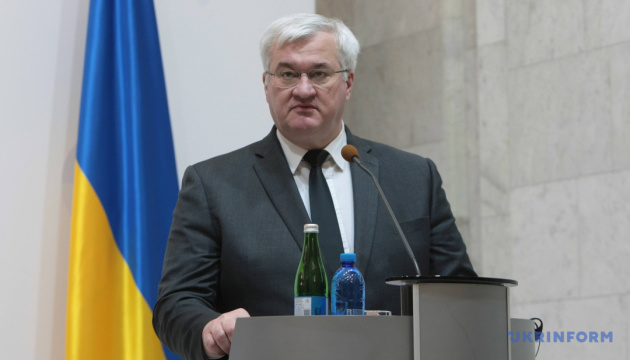
Russian disinformation campaigns have emerged as Moscow grows increasingly concerned about Ukraine’s strengthening diplomatic and defense ties with Gulf states, according to Ukraine’s Foreign Minister Andrii Sybiha.
In a statement posted on social media platform X, Sybiha highlighted Russia’s apparent frustration with Ukraine’s growing influence in the region, particularly in the aftermath of what he termed “Iranian air terror.” The foreign minister suggested that Ukraine’s battle-tested experience against drone and missile attacks has significantly elevated its strategic importance to Gulf nations.
“Moscow is extremely upset with Ukraine’s rapid strengthening of ties with the Gulf countries,” Sybiha stated, noting that Russia has resorted to propaganda tactics in response. These efforts reportedly include spreading false information about Ukrainian military experts being targeted and claims that Ukraine has failed to fulfill its obligations to regional partners.
The disinformation campaign appears timed to undermine recent diplomatic initiatives. Sybiha predicted that similar false narratives would continue to emerge in the coming weeks but expressed confidence that such tactics would ultimately prove ineffective.
“Partners in the Gulf are well aware of Ukraine’s support for the development of modern, high-tech, and cost-effective defense systems,” the foreign minister said, emphasizing the practical value Ukraine brings to security cooperation in the region.
Ukraine’s emergence as a defense technology partner for Gulf states represents a significant shift in regional dynamics. Since the full-scale Russian invasion began in February 2022, Ukrainian forces have developed considerable expertise in countering various aerial threats, including Iranian-made drones that Russia has deployed extensively throughout the conflict.
This expertise has become increasingly valuable to Gulf nations, many of which face similar threats in their volatile regional security environment. The Ukrainian defensive experience offers these countries practical insights into countering drone threats at a fraction of the cost of traditional air defense systems.
President Volodymyr Zelensky recently visited the region to capitalize on this growing interest, laying what Sybiha described as “a solid foundation for multi-year mutually beneficial cooperation.” The presidential diplomatic mission appears to have yielded tangible results, prompting the Russian reaction.
For Ukraine, developing stronger ties with Gulf states serves multiple strategic objectives. Beyond creating new security partnerships, these relationships help Ukraine diversify its international support beyond traditional Western allies and potentially access new sources of investment for its war-torn economy and eventual reconstruction.
The Russian disinformation campaign suggests Moscow views these developing relationships as a threat to its own influence in the Middle East, a region where Russia has invested considerable diplomatic capital in recent years through its military intervention in Syria and energy partnerships with several states.
“We take this Russian disinformation campaign as proof that Moscow admits Ukraine’s success and its own failure,” Sybiha concluded, framing Russia’s reaction as validation of Ukraine’s diplomatic strategy.
Security analysts note that this development represents yet another front in the information war that has run parallel to the physical conflict. Russia’s apparent concern about Ukraine’s growing regional influence underscores the multidimensional nature of the ongoing confrontation, where diplomatic and information battles complement military operations.
As Ukraine continues to leverage its hard-earned expertise in modern warfare, its role as a security partner may continue to expand beyond its immediate neighborhood, potentially reshaping security cooperation frameworks in regions previously dominated by traditional powers.
Fact Checker
Verify the accuracy of this article using The Disinformation Commission analysis and real-time sources.

31 Comments
The cost guidance is better than expected. If they deliver, the stock could rerate.
Good point. Watching costs and grades closely.
Exploration results look promising, but permitting will be the key risk.
I like the balance sheet here—less leverage than peers.
Good point. Watching costs and grades closely.
If AISC keeps dropping, this becomes investable for me.
Good point. Watching costs and grades closely.
Good point. Watching costs and grades closely.
Silver leverage is strong here; beta cuts both ways though.
If AISC keeps dropping, this becomes investable for me.
Good point. Watching costs and grades closely.
The cost guidance is better than expected. If they deliver, the stock could rerate.
The cost guidance is better than expected. If they deliver, the stock could rerate.
Good point. Watching costs and grades closely.
Good point. Watching costs and grades closely.
Production mix shifting toward Disinformation might help margins if metals stay firm.
Good point. Watching costs and grades closely.
Good point. Watching costs and grades closely.
Uranium names keep pushing higher—supply still tight into 2026.
Good point. Watching costs and grades closely.
Good point. Watching costs and grades closely.
Nice to see insider buying—usually a good signal in this space.
Good point. Watching costs and grades closely.
Good point. Watching costs and grades closely.
Uranium names keep pushing higher—supply still tight into 2026.
Good point. Watching costs and grades closely.
Good point. Watching costs and grades closely.
The cost guidance is better than expected. If they deliver, the stock could rerate.
Good point. Watching costs and grades closely.
Interesting update on Russia’s Disinformation Campaign Reflects Ukraine’s Diplomatic Gains in Gulf States. Curious how the grades will trend next quarter.
Good point. Watching costs and grades closely.