


Listen to the article
Russia’s Covert Influence Operation Expands Global Reach, Leaked Documents Reveal
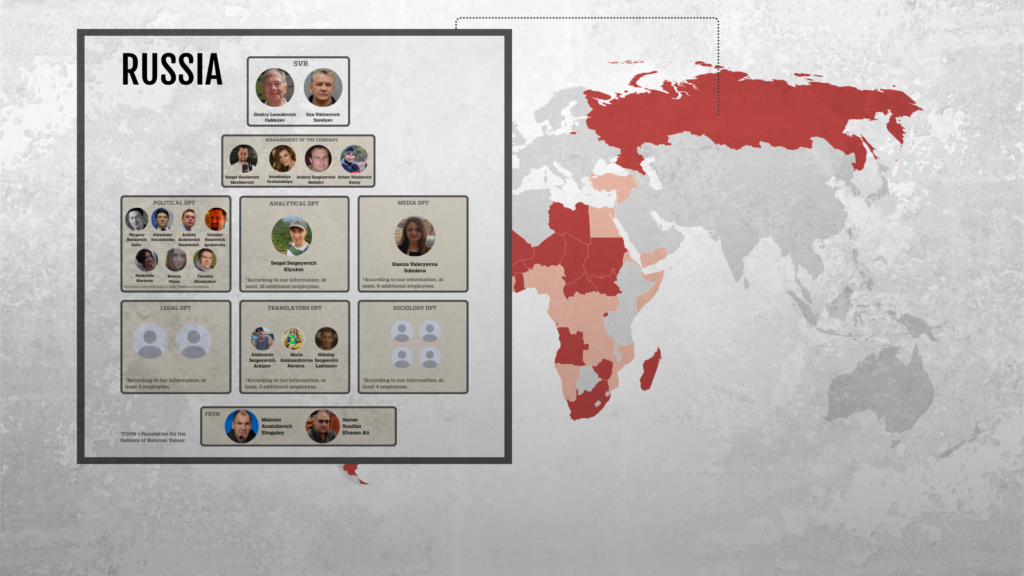
A sophisticated Russian influence operation, known internally as the “Company,” has established a growing network of operatives and digital assets across Africa, South America, and beyond, according to confidential documents obtained by Forbidden Stories.
The organization employs 34 specialists who work under Klyukin’s supervision, monitoring and analyzing political situations in 15 countries. These individuals, described variously as “sociologists” or “political technologists,” produce briefing notes and conduct extensive telephone surveys with thousands of respondents. Recent polling operations included 1,133 respondents in the Democratic Republic of the Congo in June 2024 and 1,024 in Mali in August.
Beyond intelligence gathering, the “Company” has developed specialized teams dedicated to online manipulation campaigns. These efforts appear to build upon the infamous Lakhta Project troll factory, which intelligence officials have previously identified as a Russian influence operation. Internal invoices from August 2024 reveal that an operative named Ksenia Valeryevna Soboleva, using the pseudonym “sobolevaksenia31,” ordered the creation of fake Facebook accounts with specific African identities.
“Please create accounts with these names. Profiles of women: Aminata Djerma, Mariam Barka… and men: Oumar Koudou, Ali Barka… And for another man, if possible, (write the name) directly in Arabic,” Soboleva wrote in her order.
Financial records indicate that Soboleva and colleague Dina Trumm made payments to pro-Russian Telegram accounts, including one operated by journalist Abbas Djuma. By August 2024, Djuma’s account had amassed 61,175 followers, and he had been sanctioned by the United States for his role in Russian disinformation campaigns. Sources familiar with the operation confirm that Soboleva has since been promoted to head the “Company’s” media department.
The operation’s digital arsenal includes sophisticated website spoofing. One example is the creation of a fake version of the Lobito Corridor website, with an almost identical URL missing only a single letter “R” (lobitocoridor.org versus the legitimate lobitocorridor.org). This deception targets a strategically vital railway linking Angola’s port of Lobito to the Democratic Republic of Congo, a critical infrastructure project for transporting minerals that has attracted significant European and American investment.
The deceptive website appears designed to undermine Western interests in the region through targeted disinformation, potentially threatening economic and diplomatic relations in this resource-rich area.
On the ground, the “Company” maintains physical presences across multiple continents. The leaked documents reveal that in 2024 alone, Russian operatives established offices in Mali, Libya, South Africa, and Rwanda, in addition to previously known facilities in Bolivia. These locations serve as operational bases for field agents working to advance Russian interests.
The operation has also leveraged cultural fronts, with documents mentioning the establishment of four new “Russian Houses” in 2024. Unlike official Russian Houses affiliated with the Ministry of Foreign Affairs, these unofficial cultural centers in Niger, Angola, Chad, and Guinea appear to function as covers for intelligence gathering and influence operations.
This expanding network represents a significant evolution in Russia’s approach to projecting soft power and conducting influence operations in regions traditionally dominated by Western interests. The sophisticated combination of polling, social media manipulation, digital deception, and physical presence suggests a coordinated strategy to reshape narratives and influence political outcomes across Africa and beyond.
As Western nations continue investing in development projects across the Global South, these revelations highlight the increasingly complex information environment in which such initiatives must operate, with multiple actors competing to shape local perceptions and international relations.
Fact Checker
Verify the accuracy of this article using The Disinformation Commission analysis and real-time sources.

12 Comments
The scale and sophistication of Russia’s covert influence network is alarming. I hope international bodies can take effective action to disrupt these operations and hold the perpetrators accountable.
That’s a good point. Decisive intervention and robust accountability measures are needed to deter and dismantle these insidious influence campaigns.
The expansion of Russia’s covert influence network across Africa, South America, and beyond is a significant cause for concern. Robust international cooperation and information-sharing will be key to disrupting these malign activities.
I agree. Multilateral efforts to expose and disrupt these operations, as well as support for independent journalism, are crucial steps in the fight against global disinformation.
Interesting details on the expanding reach of Russia’s covert influence operations. It’s concerning to see them leveraging sophisticated tactics to sway political narratives globally. I wonder how authorities are working to expose and counter these disinformation campaigns.
Indeed, these influence operations appear to be highly coordinated and pervasive. Transparency and public awareness are key to mitigating their impact on democratic processes.
This report highlights the need for increased global scrutiny and cooperation to address the threat of foreign interference. Rigorous fact-checking and public education around these manipulative tactics will be crucial.
I agree. Combating disinformation requires a multifaceted approach involving both government and civil society efforts. Strengthening information integrity is essential for safeguarding democratic institutions.
This report highlights the need for a comprehensive, coordinated global response to address the threat of foreign influence operations. Strengthening democratic resilience and information integrity should be a top priority.
Well said. Tackling the complex challenge of disinformation requires a united, multifaceted approach involving governments, tech companies, and civil society.
This report sheds light on the troubling reality of state-sponsored disinformation. It’s crucial that we remain vigilant and support initiatives to counter these manipulative tactics that undermine democratic processes.
Absolutely. Strengthening media literacy and critical thinking skills among the public is vital to build resilience against such coordinated influence efforts.