


Listen to the article
Russian Disinformation Campaign Targets Hungarian Opposition Leader
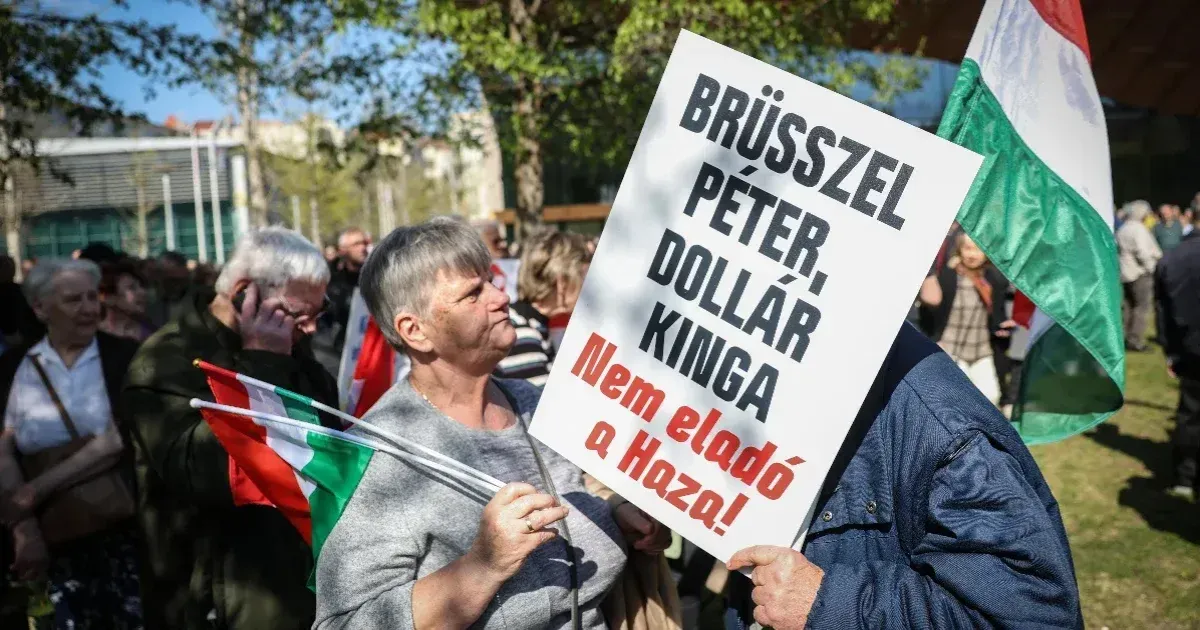
A sophisticated Russian-style disinformation operation has emerged targeting Péter Magyar, president of Hungary’s opposition Tisza Party. The campaign centers on allegations that Magyar was involved in smuggling money from Ukraine to Great Britain—claims that quickly fall apart under scrutiny.
The allegations appeared in an article published by the supposed “European Center for Investigative Journalism” (ECIJ), claiming Magyar’s humanitarian trip to Kyiv in July 2024 was a cover for transferring $16.7 million in misappropriated European loan funds to London on behalf of Ukrainian President Volodymyr Zelensky’s inner circle.
Intelligence expert and former national security officer Péter Buda analyzed the text, concluding it shows clear hallmarks of a fabricated disinformation operation. “This is a conspiratory piece written by fictional authors with the intention of misleading the public,” Buda explained.
Several red flags immediately stand out. The ECIJ claims to have operated since 2019, but its website was only created in January 2026 and has no digital footprint prior to that date. The article targeting Magyar is significantly longer than other content on the site, which consists mainly of brief abstracts likely generated by artificial intelligence. Despite being registered in January, the site backdated its articles to appear as if published months earlier.
The narrative itself contains logical inconsistencies that undermine its credibility. As Buda points out, “Who would believe that the Ukrainians would—completely unnecessarily—put themselves in a position where they could be blackmailed by a foreign politician, to whom they even reveal that the money in question is from stolen EU funds?”
The article’s authorship appears to have Hungarian connections. Despite claiming to be a Brussels-based English-language outlet, it cites a Hungarian-language Telex article as a source for international events. It also employs emotional language characteristic of character assassination rather than fact-based reporting.
This operation fits into a broader pattern of Russian interference in Hungarian politics. Last August, the Russian Foreign Intelligence Service (SVR) issued a statement claiming the European Commission was trying to engineer a power transition in Hungary from Viktor Orbán to Péter Magyar. The Hungarian state news agency MTI published this claim without context or critical analysis.
In another incident, Russian Foreign Ministry spokeswoman Maria Zakharova cited a dubious article from pro-government website Pesti Srácok accusing Zelensky of ordering sabotage operations in Romania and Poland to frame Russia—claims for which no evidence could be found.
While Prime Minister Viktor Orbán has repeatedly accused Ukraine of election interference, he has notably avoided mentioning Russia’s role in the ongoing war. “Viktor Orbán has been constantly lashing out at the party under attack and those rushing to its defense, but has never so much as uttered Putin’s name,” Buda noted.
Intelligence experts warn that these disinformation efforts may be just the beginning of a more aggressive campaign. The strategy appears designed to create an association between the Hungarian opposition and Ukraine in the public mind. This groundwork could potentially enable more dangerous operations, including false flag attacks against Hungarian infrastructure that could be blamed on Ukraine and, by extension, the opposition.
During the investigation into this disinformation campaign, news broke that several Hungarian schools and government offices had received bomb threats written in Ukrainian, potentially signaling an escalation in these influence operations.
Buda emphasized that while defamatory articles might be produced locally, physical sabotage or more serious influence operations would likely require the backing of Russian intelligence services, which have a documented history of interfering in foreign elections.
The scale and sophistication of such operations may depend on the outcome of Hungary’s political situation. A strong opposition mandate with Western support could make interference more difficult, while political instability would create more favorable conditions for continued disinformation campaigns.
Fact Checker
Verify the accuracy of this article using The Disinformation Commission analysis and real-time sources.

18 Comments
This is a classic example of the kind of sophisticated disinformation campaigns we’ve seen Russia deploy in various contexts. It’s important that we approach these claims with a critical eye and scrutinize the sources and evidence (or lack thereof) to expose the true nature of these efforts.
This is a disturbing escalation of Russian efforts to interfere in the internal affairs of other countries. Careful scrutiny of the sources and claims made in this alleged ‘investigation’ is essential to exposing the disinformation campaign for what it is.
Absolutely. Transparency and accountability must be the cornerstones of any legitimate journalistic endeavor. Anything less should be viewed with the utmost skepticism.
The use of Russian-style disinformation tactics against the Hungarian opposition is extremely concerning. We need to be proactive in identifying and debunking these false narratives before they can gain traction and undermine the democratic process.
The use of fabricated allegations and conspiracy theories to discredit political opponents is a concerning tactic that must be exposed and condemned. Rigorous fact-checking and a commitment to truth-telling are essential in countering these kinds of malicious efforts.
Well said. Maintaining a strong, independent media that is dedicated to uncovering the truth, rather than spreading disinformation, is crucial for the health of any democracy.
Disinformation operations targeting political opposition are a serious threat to democratic integrity. We must remain vigilant and committed to exposing these fabricated narratives through thorough, impartial analysis and fact-based reporting.
Agreed. Shining a light on the origins and tactics of these campaigns is crucial to preventing their spread and maintaining public trust.
Disinformation operations targeting political opponents are a serious threat to democratic processes. We must remain vigilant and continue to call out these tactics wherever they emerge, in order to protect the integrity of our institutions and safeguard the public’s trust.
I agree. Maintaining a strong, independent media that is dedicated to uncovering the truth is crucial for the health of any democracy.
Absolutely. Fact-based reporting and a commitment to transparency are essential in countering the spread of these malicious narratives.
The escalation of Russian disinformation campaigns targeting the Hungarian opposition is deeply concerning. We must redouble our efforts to identify and debunk these fabricated narratives, in order to protect the democratic process and uphold the principles of truth and transparency.
It’s concerning to see Russia ramping up its disinformation efforts, especially in Hungary where the political situation is already quite fragile. We need to stay alert and call out these propaganda tactics wherever they surface.
Absolutely. Maintaining transparency and fact-based reporting is key to protecting democratic processes from malicious interference.
This is a worrying development, as Russian disinformation campaigns can have very real and damaging impacts on democratic institutions. Rigorous fact-checking and public awareness are vital to combat these sorts of coordinated efforts to mislead and manipulate.
Disinformation campaigns targeting political opposition are a serious threat to democratic societies. It’s crucial that we remain vigilant and continue to call out these tactics whenever they emerge, in order to protect the integrity of our electoral processes.
This appears to be a classic Russian disinformation tactic – fabricating claims and conspiracy theories to discredit political opponents. It’s worrying to see these tactics escalating, especially targeting Hungary’s opposition. We need to be vigilant in exposing these lies and maintaining democratic integrity.
Agreed, the hallmarks of a fabricated story are clear. Digging into the dubious sources and lack of credible evidence is crucial to counter these kinds of smear campaigns.