


Listen to the article
International Conference in Chișinău Tackles Growing Threat of Disinformation
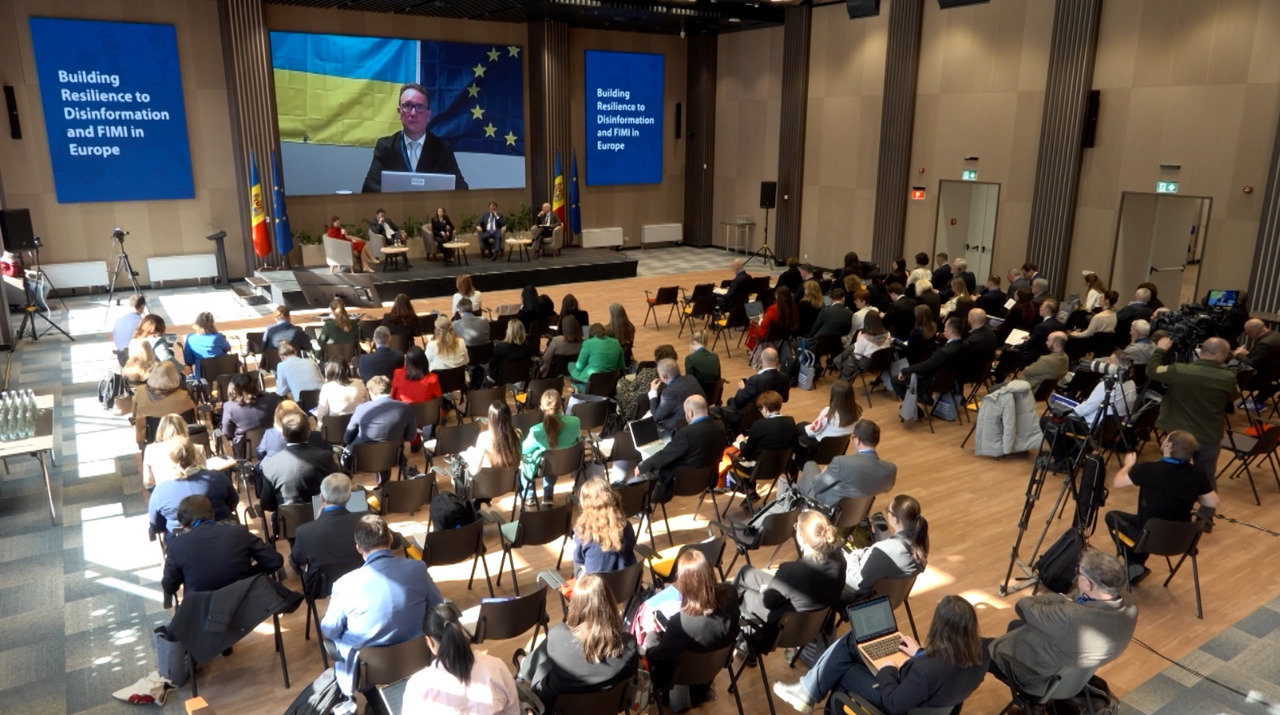
High-level representatives from across Europe gathered in Chișinău on Friday to address the mounting challenges of disinformation, information manipulation, and foreign interference at a conference jointly organized by the Council of Europe and the Audiovisual Council of Moldova.
The event, which comes amid increasing concerns about information warfare throughout Eastern Europe, brought together government officials, regulatory bodies, and civil society organizations to develop coordinated strategies against what participants described as a persistent and evolving threat to democratic institutions.
Council of Europe Secretary General Alain Berset emphasized the fundamental connection between information integrity and democratic security during his address. “When facts and lies come to people’s attention, the truth does not always win,” Berset noted. “To change this, we need to go back to basics, invest in fact-checking, support quality journalism, and help people build resilience against manipulation. The Republic of Moldova shows us the path we need to follow.”
Moldova, situated at a geopolitical crossroads between the European Union and Russia and bordering war-torn Ukraine, has become a focal point for disinformation campaigns. President Maia Sandu highlighted this reality in her remarks, drawing direct connections between information manipulation and broader geopolitical strategies.
“Cognitive warfare is not an episode, but a permanent state,” President Sandu told conference attendees. “It does not only affect the Republic of Moldova. Throughout Europe, we see the same patterns: attempts to divide societies, weaken trust in institutions, and influence political choices from the outside.”
Sandu specifically identified Russia’s actions as exemplifying this approach, stating: “Russia’s war against Ukraine is the clearest example. In addition to military aggression, there is also a parallel effort to manipulate perceptions in Europe.”
The conference occurs against a backdrop of heightened tensions in the region, with Moldova pursuing European integration while facing what officials describe as Russian interference campaigns. Just last year, Moldovan authorities accused Moscow of orchestrating a sophisticated disinformation operation aimed at destabilizing the country ahead of key electoral events.
Ukrainian representation at the conference underscored the transnational nature of the challenge. Yuliia Yanchuk, Deputy Director of Ukraine’s Department of Strategic Communication, shared insights from her country’s ongoing efforts to counter Russian information operations amid the continuing military conflict.
“We have several information centers and strategic communication structures in the country, which work to counter Russia’s information influence,” Yanchuk explained. “I want to emphasize that this is a major challenge for our country, and we need to join forces in this information area.”
Romanian and Moldovan media regulatory officials echoed these sentiments, emphasizing how disinformation erodes public trust in institutions and threatens democratic processes. Valentin Jucan, president of Romania’s Audiovisual Council, described the gravity of the situation: “The fact that we are reaching a point where society says it no longer knows what to believe—that is a point where our opponent has won a first stage.”
Liliana Vițu, who heads Moldova’s Audiovisual Council, framed the issue in stark terms about democratic preservation. “It targets the electoral processes themselves, the existence of democratic processes and democratic institutions,” she said. “Democracy is not a given. Democracy must be protected, and if you want to live well in a democratic country, you must fight for it.”
The conference represents part of a broader initiative by the Council of Europe to develop coordinated responses to disinformation threats. Experts from member states have prepared a feasibility study that will be presented to foreign ministers during the Committee of Ministers session scheduled for May in Chișinău.
The outcomes of this conference are likely to influence policy approaches throughout Europe as governments and civil society organizations work to safeguard information ecosystems while preserving freedom of expression—a balance that participants acknowledged remains challenging but essential for democratic resilience.
Fact Checker
Verify the accuracy of this article using The Disinformation Commission analysis and real-time sources.

8 Comments
While this is a complex challenge, I’m encouraged to see Moldova taking a proactive stance. Building societal resilience against manipulation and foreign interference should be a top priority for all democratic nations.
The growing threat of disinformation is a concerning global trend that undermines public trust and democratic processes. I hope the Chișinău conference leads to meaningful progress in protecting information integrity and strengthening democratic institutions.
You make a good point. Disinformation can have far-reaching consequences, which is why a coordinated international response is so critical. Fact-based, transparent communication is essential.
I’m curious to learn more about the specific strategies and initiatives discussed at the Chișinău conference. Combating disinformation requires a nuanced, multi-pronged effort that addresses both the supply and demand sides of the issue.
This is a concerning issue that requires a coordinated international response. Disinformation is a serious threat to democratic institutions, and Moldova is on the frontlines. I hope the conference yields concrete strategies to combat this persistent challenge.
You’re right, the integrity of information is crucial for maintaining a healthy democracy. Fact-checking and media literacy initiatives will be key to building societal resilience.
It’s good to see the Council of Europe and Moldovan authorities taking this issue so seriously. Disinformation warfare is a complex problem, but strengthening democratic institutions and supporting quality journalism are important steps.
Absolutely, this is not a problem that can be solved by any one country or organization. A unified, multi-stakeholder approach is required to effectively counter foreign interference and manipulation.