


Listen to the article
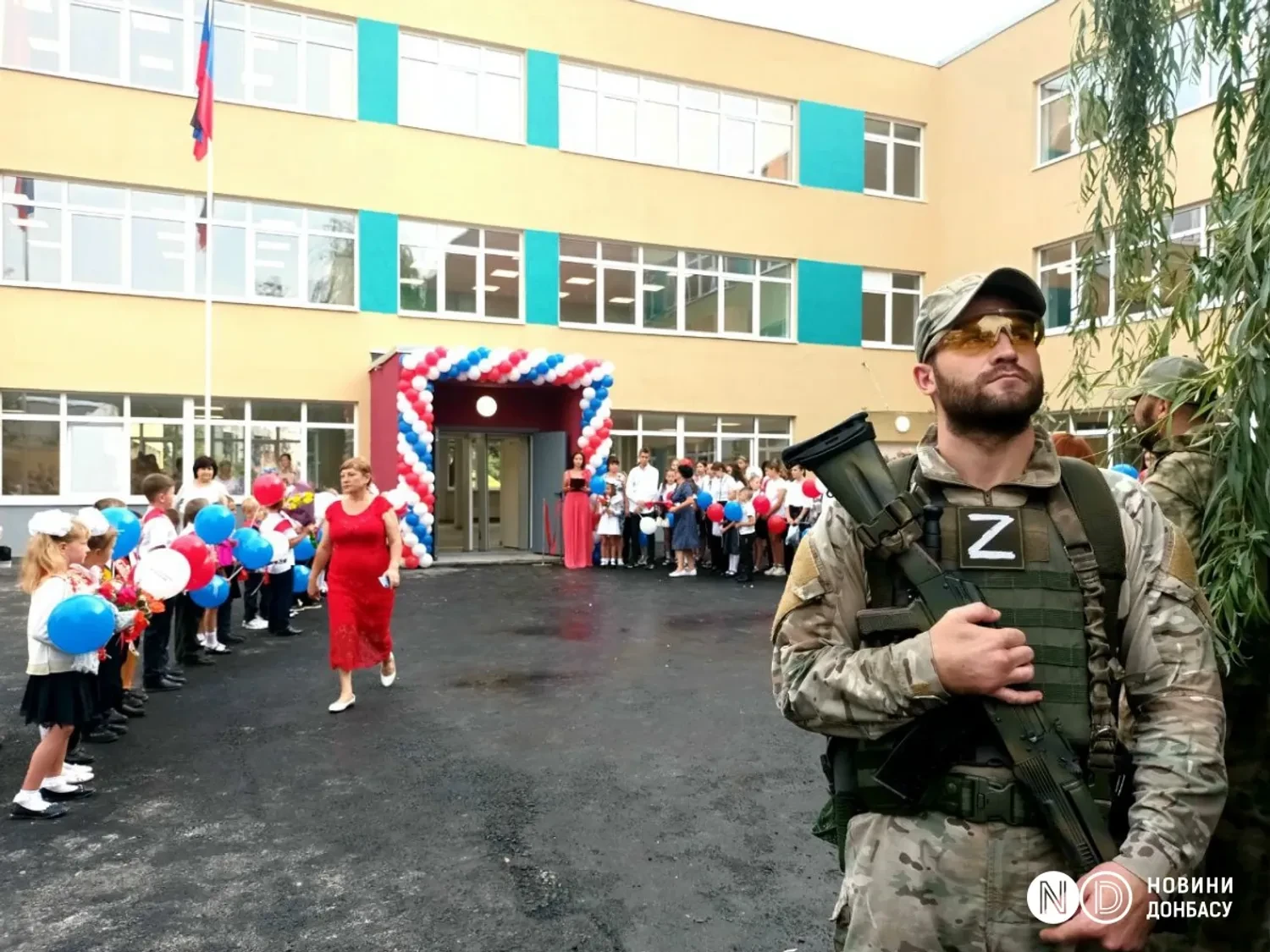
Russian authorities in occupied Donetsk are systematically using cultural events to militarize Ukrainian children, according to a new report by the Center for Countering Disinformation (CCD).
Officials recently organized a song contest that required children and teenagers between 8 and 18 years old to perform “patriotic” songs, including pieces celebrating “heroes of the Great Patriotic War” — the Soviet term for World War II. The event reflects a broader strategy to normalize military conflict among young people in occupied territories.
The competition was jointly organized by occupation administrators, pro-Kremlin cultural figures, and representatives from “Dvizheniye Pervykh” (First Movement), a youth organization sanctioned by Ukraine’s National Security and Defense Council. Analysts describe this group as a modern equivalent of the Soviet-era Pioneer Organization, which indoctrinated generations of children into communist ideology.
In a calculated move to legitimize the ongoing conflict, organizers included a participant of Russia’s so-called “special military operation” on the jury panel. The CCD emphasized that this deliberate inclusion serves to present military service and the current war as normal and admirable to impressionable young minds.
“This is not an isolated event, but an element of the Kremlin’s systemic strategy to militarize children’s minds and form a society loyal to the war,” the CCD stated. “Such ‘cultural’ events are deliberately turned into an instrument of psychological influence, where the cult of war is presented as a norm and a ‘correct’ model of behavior.”
Child militarization in occupied territories has become a growing concern for Ukrainian authorities and international human rights organizations. Since Russia’s full-scale invasion in February 2022, numerous reports have emerged of Russian authorities implementing education programs in occupied areas that distort Ukrainian history and promote Russian military narratives.
Educational experts warn that these tactics mirror historical precedents where authoritarian regimes used youth organizations and cultural events to foster loyalty and prepare future generations for military service. The psychological impact on children can be particularly severe, as they are exposed to conflict normalization during crucial developmental stages.
The United Nations Convention on the Rights of the Child explicitly protects children’s rights during armed conflicts, including protection from military indoctrination. However, enforcement mechanisms remain limited in territories under Russian occupation.
Ukrainian officials have documented these practices as part of broader evidence collection for potential future war crimes investigations. Children’s rights advocates argue that the systematic militarization of youth constitutes a violation of international humanitarian law and could have long-lasting consequences for post-conflict reconciliation.
In parallel intelligence findings, the CCD also reported that Russian forces appear to be preparing for continued conflict in Ukraine through at least autumn 2024, suggesting that the militarization of children in occupied areas may intensify as part of a long-term strategy.
The situation in Donetsk exemplifies Russia’s comprehensive approach to occupation, which extends beyond military control to reshaping cultural and educational institutions. By targeting children through seemingly innocuous cultural events, occupation authorities aim to create generational support for Russian political objectives.
Ukrainian human rights organizations continue to document these activities while developing programs to help children reintegrate into Ukrainian society after liberation of occupied territories. Psychologists specializing in war trauma emphasize that addressing militarized indoctrination will be a critical component of post-war recovery efforts.
As the conflict continues into its third year, the battle for Ukraine’s future increasingly includes the struggle for the hearts and minds of its youngest citizens.
Fact Checker
Verify the accuracy of this article using The Disinformation Commission analysis and real-time sources.

14 Comments
The Russian authorities’ efforts to normalize military conflict among Ukrainian youth in occupied areas are deeply concerning. Forcing children to celebrate the ‘Great Patriotic War’ is a blatant attempt to rewrite history and justify the invasion.
Agreed, this is a troubling development that deserves widespread condemnation. Weaponizing cultural events to militarize children is a cynical tactic that must be called out.
The Russian authorities’ systematic use of cultural events to militarize Ukrainian children in occupied areas is a deeply concerning development. Forcing young people to celebrate war and military service is a calculated attempt to normalize conflict and justify the invasion.
I agree, this is a clear example of Russia’s disregard for the wellbeing of the local population. Weaponizing cultural institutions to indoctrinate children is a deplorable abuse of power.
This report highlights the Russian government’s reprehensible efforts to indoctrinate Ukrainian children in occupied territories. Exploiting cultural events to push pro-Russian military propaganda is a gross violation of human rights.
Absolutely, this is a disturbing example of how Russia is attempting to cement its control over the region by targeting the most vulnerable members of the population.
This is a disturbing report. Exploiting children for military propaganda is unethical and harmful. Normalizing conflict in occupied Ukraine is a tactic to further Russian influence, not support the wellbeing of local communities.
I agree, this is a concerning development. Using cultural events to indoctrinate and militarize children is a cynical abuse of power by the Russian authorities.
This report highlights the Russian government’s cynical disregard for human rights in occupied Ukrainian territories. Manipulating cultural events to militarize children is a disgraceful abuse of power.
I’m shocked but not surprised to see Russia resorting to these tactics. Indoctrinating the next generation is a way to cement their control over the region long-term.
The Russian government’s actions in occupied Ukraine are alarming. Forcing children to perform ‘patriotic’ songs celebrating war is a transparent attempt to inculcate pro-Russian sentiment and justify the invasion.
Absolutely, this is a clear violation of children’s rights. Exploiting young people in this way is a disturbing tactic to exert control over the local population.
This report highlights the lengths to which the Russian government will go to exert control over occupied Ukrainian territories. Exploiting cultural events to militarize children is a disturbing tactic that deserves widespread condemnation.
Absolutely, this is a blatant attempt to indoctrinate the next generation and cement Russia’s influence in the region. Forcing children to celebrate war and military service is a gross violation of human rights.