


Listen to the article
Russian Intelligence Network Runs Covert Anti-Ukraine Campaigns in Ivory Coast
A sophisticated Russian disinformation operation has targeted Ukraine’s newly established diplomatic presence in Ivory Coast through a series of covert campaigns, according to an extensive investigation by international media outlets.
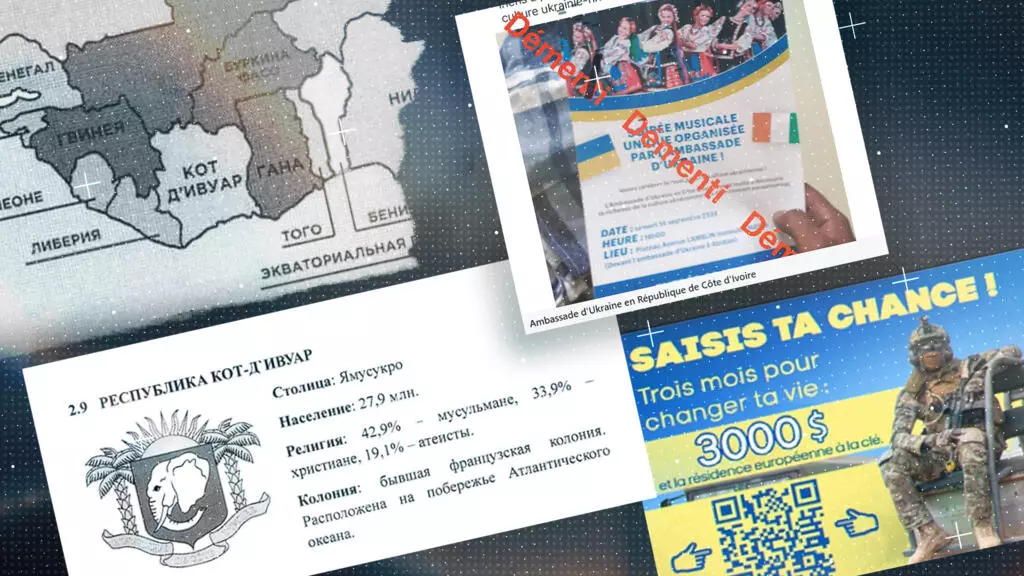
Known as “the Company,” the Russian network conducted four separate influence operations in Ivory Coast between May and September 2024, with three specifically aimed at undermining Ukraine’s embassy in Abidjan. The operations included distributing fake army recruitment materials, fabricating cultural events, and placing hundreds of paid articles in West African media.
The operation was exposed through 76 leaked internal documents analyzed by an international consortium of investigative outlets, including France 24 Observers, The Continent, Forbidden Stories, All Eyes On Wagner, and RFI.
Originally founded by the late Yevgeny Prigozhin, the Wagner Group financier who died in a plane crash in August 2023, the Company now operates under Russia’s SVR foreign intelligence service. Based in St. Petersburg, the organization employs approximately 90 specialists and conducts influence operations in nearly 30 countries throughout Africa and Latin America.
According to a 2023 internal strategy document titled “Africa Project,” the Company specifically identified Ivory Coast as a “promising country in which to launch operations.” The document cited Ivory Coast’s alignment with the European Union “on all international resolutions concerning the Ukrainian question” as the primary justification for targeting the West African nation.
The network’s stated objective was to discredit French and American influence in the region while shifting local public opinion against Ukraine – part of Russia’s broader strategy to replace Western influence across Africa. This builds upon the foothold previously established by the Wagner Group in the Central African Republic, Mali, and Sudan.
Ukraine’s embassy in Abidjan opened in April 2024, and the first disinformation campaign began less than a month later. Between May and September, the Company launched four distinct operations, with three explicitly targeting the Ukrainian diplomatic mission.
The first campaign, launched in May 2024, falsely claimed Ukraine’s embassy was recruiting Ivorian citizens to fight in Ukraine. Yellow-and-blue flyers circulated online and, according to the Company’s internal documents, appeared in Abidjan offering a $3,000 signing bonus and European residency. Ukraine’s embassy promptly denied any involvement and stated it had not seen these flyers in the city.
In July 2024, Ghanaian news site GhanaWeb published an article claiming the recruitment flyers had been spotted in Abidjan’s streets. Financial records from the leaked documents reveal the Company paid $700 for this placement – more than double GhanaWeb’s standard $250 rate for promotional content.
By September, a fake invitation to a “music evening organized by the Embassy of Ukraine in Côte d’Ivoire” was circulating widely on Facebook and WhatsApp. The embassy confirmed the document was fraudulent.
Beyond these specific campaigns, the Company systematically paid for the placement of 49 articles targeting Ivorians across 22 media outlets between May and October 2024. Internal documents show this effort was part of “Project Magadan” – an operation dating back to the Prigozhin era – and cost $39,800 in total, averaging about $631 per article.
The broader leaked dataset reveals nearly 650 articles placed in 35 West African French-language outlets between June and October 2024, with placement fees ranging from $250 to $700 per article. Some outlets received direct payments, while others were given pre-written content through intermediaries.
One Ivorian journalist who published 18 of the Company’s articles told investigators he had no idea the content originated from a Russian intelligence operation. Marc-André Boisvert, an analyst with Cronos Europe, explained that this model works effectively in Ivory Coast because some local newspapers accept outside articles to fill pages once they’ve covered their preferred political topics.
Despite the scale of these operations, experts interviewed by the investigative consortium questioned their effectiveness. Ivorian fact-checker Mohamed Kebe noted that while the fake recruitment story generated significant online attention, he never observed the alleged recruitment flyers on Abidjan’s streets.
Boisvert suggested the operations drew “very little reaction” and had “no significant impact on Ivorian opinion,” indicating they might have been aimed more at neighboring Sahel states than at Ivorians themselves – perhaps to portray Ivory Coast’s government as following an undesirable political path.
As Russia continues to expand its information warfare across Africa, these operations highlight Moscow’s strategic focus on the continent as it seeks to counter Western influence and build new geopolitical alliances in regions it considers receptive to anti-Western messaging.
Fact Checker
Verify the accuracy of this article using The Disinformation Commission analysis and real-time sources.

12 Comments
This is a concerning development, but not entirely surprising given Russia’s history of using disinformation as a tool of foreign policy. It will be important to closely monitor these campaigns and their impacts.
Agreed, Russia’s use of covert influence operations is well-documented. Maintaining a clear-eyed, fact-based response will be crucial to mitigating the damage from these kinds of campaigns.
I’m curious to learn more about the specific goals and tactics of these Russian influence campaigns in Ivory Coast. Undermining Ukraine’s diplomatic presence there seems to be a key objective.
Absolutely, understanding the motivations and methods behind these operations is critical. It will be important for the Ivorian government and its international partners to develop effective counter-strategies.
The use of fake army recruitment materials and fabricated cultural events is a classic disinformation tactic. It’s concerning to see Russia ramping up these kinds of covert influence campaigns in Africa.
Yes, it’s important that the international community stays vigilant and continues to expose these kinds of operations. Transparency and fact-checking are crucial to combating the spread of misinformation.
Interesting that Russia is targeting Ivory Coast with these disinformation campaigns. I wonder what their strategic interests are in that region and how effective these operations have been so far.
Agreed, it’s concerning to see Russia engaging in this kind of covert influence operation. I hope the Ivorian government and international community can work to counter these efforts and uphold the truth.
I’m curious to learn more about the specific tactics and messaging used in these Russian influence campaigns. Undermining Ukraine’s diplomatic presence seems to be a key goal, but what other objectives might they have?
That’s a good question. Sowing discord, eroding trust in institutions, and advancing Russia’s geopolitical interests are likely other motivations behind these campaigns. Careful analysis of the content and narratives will be important.
The scale and sophistication of this Russian disinformation network is troubling. Distributing fake materials and planting hundreds of paid articles is a significant undertaking.
Yes, the level of coordination and resources devoted to these operations highlights how much of a priority this is for the Russian government. Combating this will require a concerted international effort.