


Listen to the article
Kremlin-Linked Operation Doppelgänger Reveals Modern Cognitive Warfare Tactics
A significant Russian influence operation known as “Operation Doppelgänger” ran from 2022 to 2024, orchestrated by the Social Design Agency (SDA), a Kremlin-affiliated entity. The operation created fabricated versions of legitimate news websites to spread pro-Russian narratives across Western information spaces.
While Western governments contained much of the initial disinformation, experts note that Doppelgänger’s real success came through secondary effects. As Western media reported on the operation and politicians raised alarms, Russia effectively controlled the narrative about its information warfare capabilities, normalizing the idea of Russian penetration into democratic information ecosystems.
“Russia’s primary victory wasn’t in the initial spread of fake news, but in how Western reporting about the operation amplified their message,” said a senior intelligence analyst familiar with the operation who requested anonymity. “Each time we discussed Doppelgänger, we inadvertently extended its reach.”
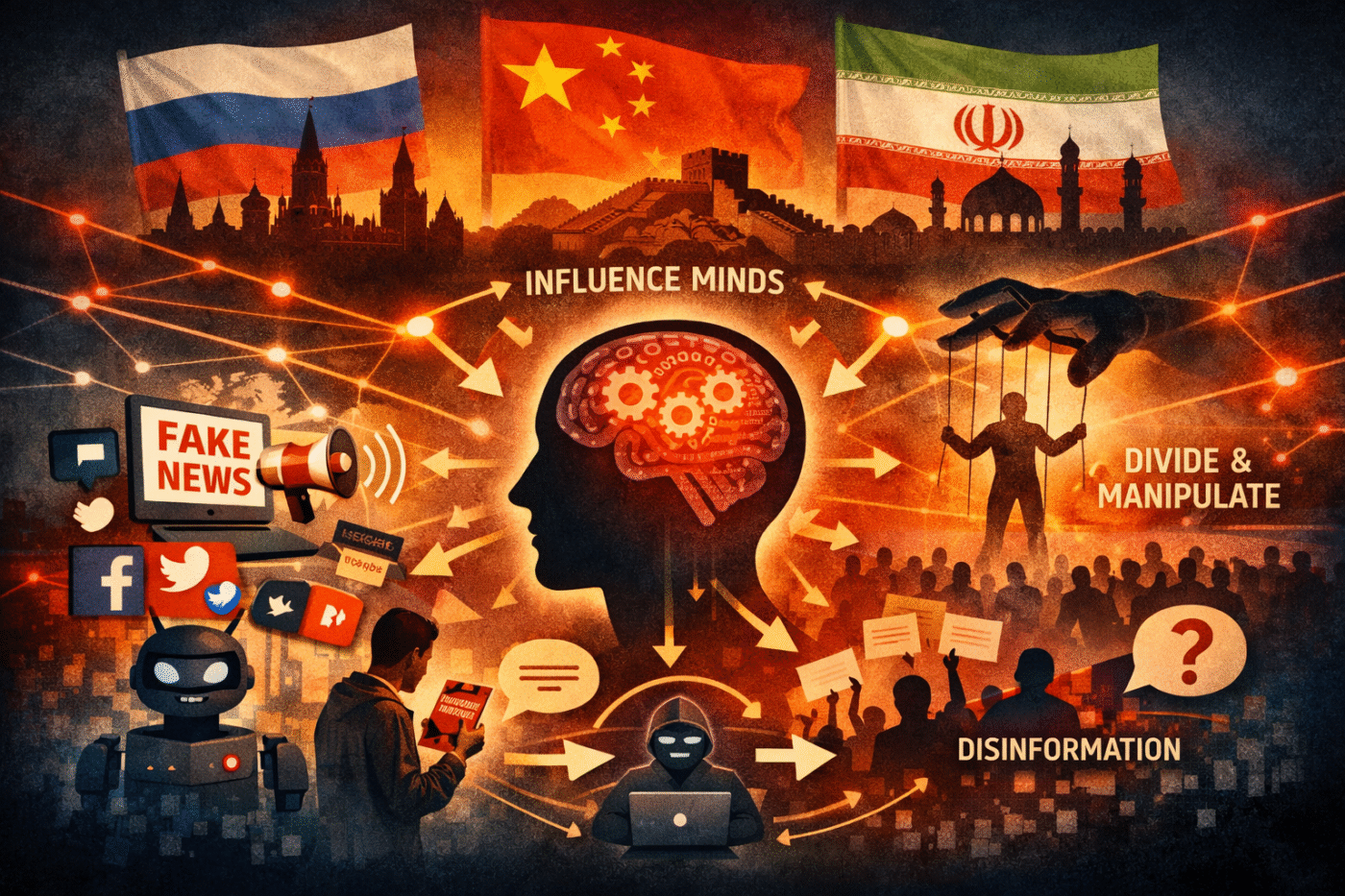
This case exemplifies how Russia, Iran, and China are increasingly employing sophisticated cognitive warfare strategies to modify the international balance of power. These authoritarian states recognize that in an era of information saturation, manipulating human perception and behavior through weaponized narratives offers significant strategic advantages.
Recent developments in the Middle East have highlighted cognitive warfare’s central role in modern conflict. Iran, for instance, has leveraged artificial intelligence to flood social media with manipulated content during recent tensions with the United States and Israel. Iranian-linked accounts have disseminated AI-generated videos of high-rise buildings ablaze and doctored satellite images falsely showing destroyed U.S. Navy facilities in Bahrain.
Security experts note that defensive technologies are struggling to keep pace. The BBC reports that even advanced AI-detection systems like X’s Grok have failed to identify Iranian AI-generated content posted to social media platforms.
Russia’s approach to cognitive warfare builds upon Soviet-era “Active Measures” – campaigns designed to alienate Western allies and attack social cohesion. A notable historical example occurred between 1959 and 1960 when the USSR executed the “red swastika” operation targeting latent antisemitism in West Germany to drive wedges between NATO allies.
In contemporary operations, Russia employs state media, proxies, and government actors in coordinated campaigns that make truth difficult to discern. Following the 2018 attempted assassination of Sergei and Yulia Skripal in Salisbury, UK, Russian media outlets like RT and Rossiya, alongside social media accounts including the Russian Embassy in London, flooded information channels with conflicting narratives and conspiracy theories – 46 different stories in total.
China has taken a different approach, focusing primarily on controlling its public image and influencing the Chinese diaspora abroad. Beijing has invested billions in building a global network of media agencies to promote positive views of Chinese culture, history, and governance.
The Chinese Communist Party (CCP) has established surveillance outposts worldwide to monitor Chinese communities overseas, while initiatives like Confucius Institutes – ostensibly cultural centers attached to universities – have functioned as extensions of Chinese government influence, hiring based on political loyalty and censoring topics unfavorable to the regime.
“China’s approach successfully intertwines actions in the physical domain with weaponized narratives to minimize dissent and maintain narrative control,” explains Dr. Michael Raska, a security specialist at Singapore’s S. Rajaratnam School of International Studies.
Western nations have recognized the escalating threat. The U.S. Army recently created an information warfare branch, while NATO has begun emphasizing cognitive warfare’s role in modern competition. However, analysts stress that Western democratic systems remain vulnerable to these tactics, which exploit open information environments.
As the global order becomes increasingly multipolar, authoritarian regimes will likely continue deploying cognitive warfare as a central element of statecraft and regime survival. Security experts recommend that democracies expand narrative-based resilience measures through whole-of-government approaches that protect information integrity without compromising democratic values.
Fact Checker
Verify the accuracy of this article using The Disinformation Commission analysis and real-time sources.

20 Comments
The notion of adversaries controlling the narrative about their own information warfare operations is concerning. We must find ways to report on these issues without unintentionally amplifying the underlying messaging.
Agreed. Responsible and nuanced reporting, combined with public education, will be key to navigating this complex landscape.
This is a concerning development in modern information warfare tactics. While containing the initial disinformation is critical, we must be mindful of how our responses can inadvertently amplify the underlying narratives. Careful and nuanced reporting is essential to avoid further spreading harmful messaging.
You raise a good point. Cognitive warfare is a complex challenge that requires a nuanced approach to information management. Maintaining transparency while limiting unintended amplification of adversarial narratives is key.
The use of fabricated news sites to spread pro-Russian narratives is a concerning tactic that exploits the public’s trust in media. Strengthening media literacy and fact-checking efforts could help build resilience against such campaigns.
Absolutely. Empowering citizens to critically evaluate online information is crucial to safeguarding democratic discourse.
The use of fabricated news sites to spread pro-Russian propaganda is a worrying tactic. It underscores the need for robust media literacy and fact-checking initiatives to help the public navigate the information landscape.
Absolutely. Empowering citizens to critically evaluate online content is crucial to building resilience against such disinformation campaigns.
The idea of adversaries controlling the narrative about their own information warfare operations is deeply troubling. We must find ways to report on these issues without inadvertently amplifying the underlying messaging.
Agreed. A balanced and nuanced approach to reporting, combined with public education initiatives, will be key to addressing this challenge.
The idea of adversaries controlling the narrative about their own information warfare operations is deeply troubling. We must find ways to report on these issues without inadvertently amplifying the underlying messaging.
Agreed. A balanced and nuanced approach to reporting, combined with public education initiatives, will be key to addressing this challenge.
This case exemplifies the growing sophistication of cognitive warfare tactics employed by Russia, Iran, and China. Maintaining vigilance and adapting our countermeasures is essential to protect the integrity of our information ecosystems.
While containing initial disinformation is important, this case highlights the need for a more comprehensive strategy to address the broader impacts of cognitive warfare tactics. Understanding and mitigating secondary effects should be a priority.
While containing initial disinformation is important, this case illustrates the need for a more holistic approach to addressing the broader impacts of cognitive warfare tactics. Understanding and mitigating secondary effects should be a priority.
The use of fabricated news sites to spread pro-Russian narratives is a concerning tactic that exploits public trust in media. Strengthening media literacy and fact-checking efforts could help build resilience against such campaigns.
Agreed. Responsible reporting and public education will be key to addressing this challenge.
Absolutely. Empowering citizens to critically evaluate online information is crucial to safeguarding democratic discourse.
This case highlights the evolving sophistication of cognitive warfare tactics employed by Russia, Iran, and China. Maintaining vigilance and adapting our countermeasures is essential to protect democratic discourse and decision-making processes.
This case highlights the growing sophistication of cognitive warfare tactics employed by Russia, Iran, and China. Maintaining vigilance and adapting our countermeasures is essential to protect the integrity of our information ecosystems.