


Listen to the article
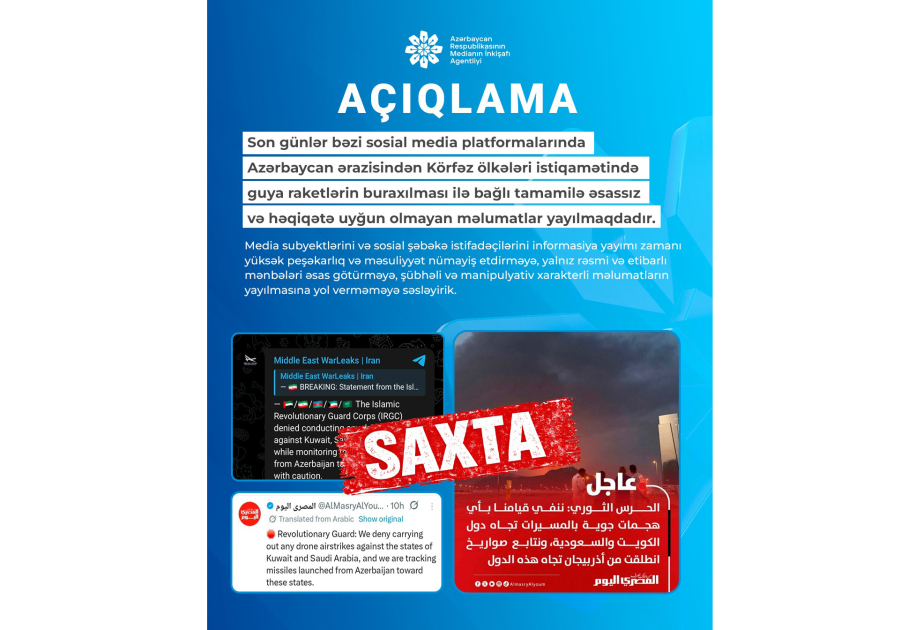
Azerbaijan’s Media Development Agency has issued a firm rebuttal against false claims circulating on social media platforms that suggest rockets were launched from Azerbaijani territory toward Gulf countries. The agency characterized these allegations as completely unfounded and deliberately misleading.
“Against the backdrop of existing regional tensions, the dissemination of unverified and inaccurate information on social media serves to mislead public opinion and constitutes deliberate disinformation. We strongly condemn such attempts,” the agency stated in an official release from Baku on Wednesday.
The statement comes amid heightened tensions across the Middle East, particularly following recent hostilities between Iran and Israel. Social media platforms have become fertile ground for the rapid spread of unverified information during such sensitive geopolitical periods, often exacerbating tensions and creating unnecessary alarm.
The Media Development Agency emphasized that modern surveillance technology would make it impossible to conceal such military activities. “In modern technological conditions, determining the direction from which rockets or other aerial objects are launched is not difficult,” the statement noted, adding that Gulf states possess sophisticated radar and surveillance systems capable of accurately identifying the origin and trajectory of any airborne objects.
The agency suggested that the false information was either deliberately provocative or stemmed from irresponsible reporting without factual basis. This kind of misinformation is particularly dangerous in a region where military conflicts and territorial disputes have been frequent and where misunderstandings could potentially escalate into serious diplomatic or military confrontations.
Azerbaijan’s strategic location in the South Caucasus region makes it a significant geopolitical player, sharing borders with Russia, Georgia, Armenia, Iran, and the Caspian Sea. The country has worked to maintain balanced relationships with various regional powers, including Gulf states, with whom it has developed economic ties, particularly in the energy sector.
The statement reinforced Azerbaijan’s commitment to international law and regional stability: “The Republic of Azerbaijan remains committed to the principles of international law, respect for the sovereignty of states, and the preservation of regional stability.” This declaration aligns with Azerbaijan’s broader foreign policy approach, which emphasizes sovereignty and territorial integrity—principles that have been central to its stance on the Nagorno-Karabakh issue.
Media experts note that the proliferation of false information during times of crisis has become a growing challenge for governments and media organizations worldwide. The speed at which unverified claims can spread across social media platforms often outpaces traditional fact-checking mechanisms, creating information vacuums that can be filled with speculation and propaganda.
The Media Development Agency called on all parties, including media outlets and social media users, to exercise greater responsibility when sharing information. “We urge media outlets and social media users to demonstrate a high level of professionalism and responsibility when sharing information, to rely solely on official and trustworthy sources, and to avoid the spread of misleading or manipulative content,” the statement concluded.
This incident highlights the ongoing challenge of information integrity in an era of instant global communication, where false narratives can rapidly take hold and potentially influence international relations before they can be properly verified or refuted.
Fact Checker
Verify the accuracy of this article using The Disinformation Commission analysis and real-time sources.

7 Comments
This is concerning news about the deliberate spread of misinformation on social media fueling regional tensions. It’s crucial that governments and media work together to counter false claims and provide accurate, verified information to the public during sensitive geopolitical periods.
This is an important issue that extends far beyond just the current tensions in the Middle East. Combating the deliberate spread of misinformation on social media needs to be a global priority to protect public discourse and maintain stability.
The rise of social media has made it all too easy for unverified information to spread rapidly and sow discord. It’s troubling to see this occurring during a sensitive geopolitical period in the Middle East. Fact-checking and accountability are crucial to counter these trends.
Absolutely. Social media platforms need to take stronger actions to curb the spread of misinformation, in coordination with government and media efforts to provide reliable, verified information to the public.
I appreciate the Azerbaijani government’s swift response to rebut the false claims circulating online. With modern surveillance capabilities, it would indeed be very difficult to conceal any military activities, so the misinformation appears to be a deliberate attempt to mislead public opinion.
Agreed. Cracking down on the sources of this kind of disinformation should be a priority to prevent further escalation of tensions.
I’m curious to learn more about the specific tactics being used to spread this disinformation. Understanding the methods and motivations behind it could help develop more effective countermeasures.