


Listen to the article
Pop Fascism: How Dictators Are Normalized in Digital Culture
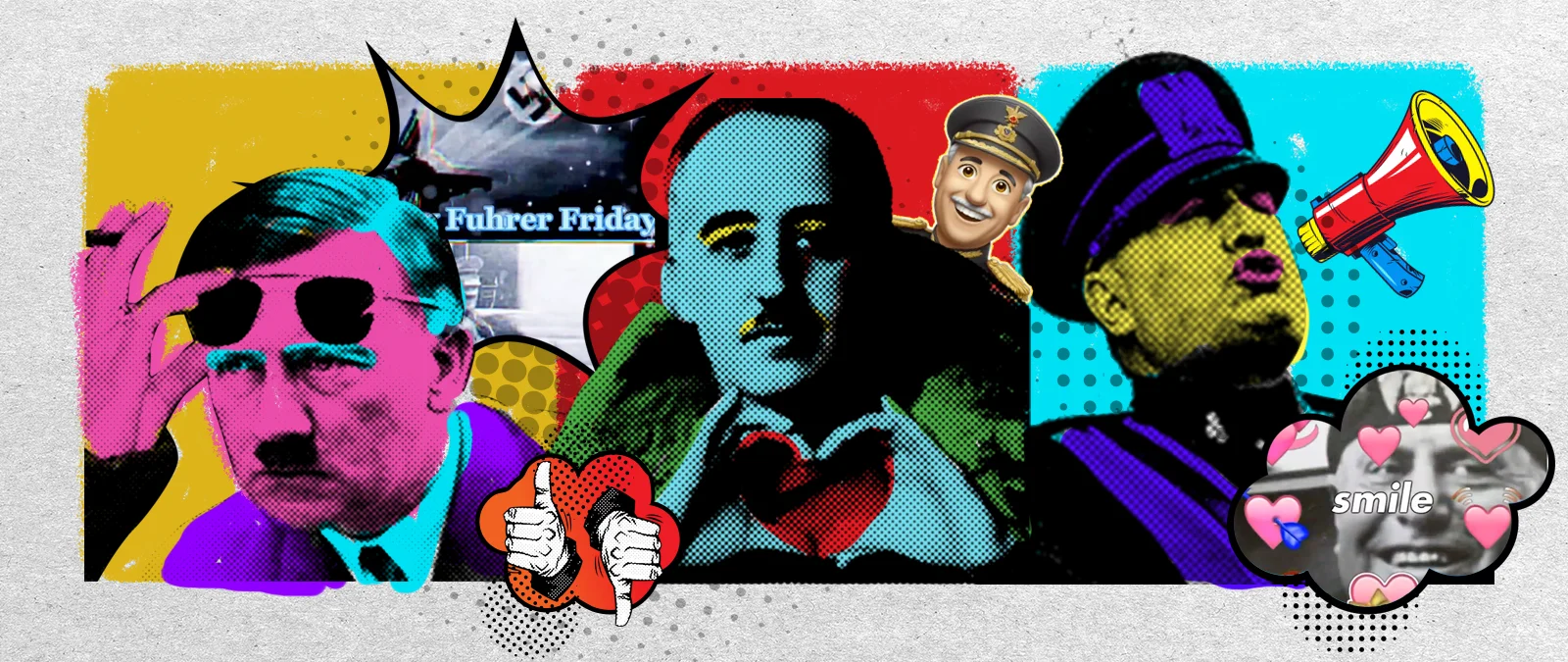
Franco wearing bright pink sunglasses, Mussolini waving from a balcony to the soundtrack of Adele’s “Someone Like You,” Hitler mimicking Cristiano Ronaldo’s goal celebration – these jarring juxtapositions represent the new face of fascism online. A video showing bees being exterminated plays with the “Erika March,” a song closely associated with Nazi military ceremonies, featured in over 24,500 TikTok videos.
This is the first stage of what experts call “pop fascism” – the normalization of fascist ideologies through pop culture references, memes, and social media content that blends historical dictators with contemporary aesthetics.
On platforms from TikTok to Telegram, content glorifying Franco, Mussolini, and Hitler proliferates alongside Holocaust denial and disinformation about the supposed achievements of these dictatorial regimes. The messaging transforms from normalization to acceptance and finally idolization, operating through a sophisticated blend of humor, nostalgia, and historical revisionism.
“Users who engage with these icons see these dictators as omnipotent figures who radically changed the societies they lived in, defying the norms of their time,” explains Matilde Eiroa, professor and author of “Franco, from hero to comic figure of contemporary culture.” She notes that these figures become “idols young people can cling to in order to show their rebellion against society.”
The Soundtrack of Digital Fascism
The musical component of this phenomenon spans numerous genres, adapting historical fascist anthems for modern platforms. Manipulated videos showing popular artists like Aitana, Quevedo, and DJ David Guetta supposedly performing “Cara al Sol” – the anthem of the Spanish Falange adopted during Franco’s regime – circulate widely, despite being fake.
Even soccer players aren’t immune, with manipulated videos showing French-Spanish player Le Normand playing the Francoist anthem on piano. These deceptive videos introduce fascist music to youth circles under the guise of content from their favorite celebrities.
Meanwhile, RAC (Rock Against Communism) music – a movement linked to neo-Nazi ideology that emerged in the UK in the late 1970s – maintains a strong presence on major streaming platforms. The Spanish group Toletum’s 2001 song “División Azul” has been used in more than 1,700 TikTok videos and has over 27,000 monthly listeners on Spotify.
In Italy, popular songs provide the backdrop for Mussolini footage, while AI-generated videos show animated Mussolini avatars dancing to catchy original songs with lyrics like “M like Mussolini / everyone likes me / mothers and children.”
From Speeches to “Franco Fridays”
Beyond music, speeches by fascist figures like José Antonio Primo de Rivera and Blas Piñar circulate as audio clips exalting their image and political ideals. One TikTok audio featuring the Francoist slogan “Spain, one, great, and free” has been used in nearly 400 videos.
Social media users have also created dedicated days celebrating dictators. Mussolini’s regime established “Fascist Saturdays” in 1935, a tradition some users continue to revive 90 years later. Similarly, “Führer Friday” commemorates Hitler, while “Franco Friday” has gained traction since 2021, with influential figures like Jack Posobiec promoting it to thousands of followers.
The content often features fascist symbols like the Cuelgamuros Valley (formerly the Valley of the Fallen) where Franco and Primo de Rivera were buried until their recent exhumations, or the Spanish flag used during Franco’s dictatorship featuring the eagle of Saint John.
This glorification is amplified through disinformation narratives praising supposed achievements of these regimes, comparing Franco’s policies on housing or infrastructure favorably to current governance, despite historical evidence to the contrary.
Memes and Visual Culture
Perhaps most insidious is the use of memes, which have a greater emotional impact than text alone and can reach even highly educated audiences who may not immediately recognize their extremist origins.
Franco reimagined as Pepe the Frog, Hitler playing football, Mussolini dancing – these visual representations make fascist content more accessible and seemingly harmless. As Kye Allen, researcher at the University of Oxford, points out, such content can “convince young groups of a revisionist historical narrative.”
Italian journalist Leonardo Bianchi explains that “irony is a crucial tool in today’s far-right propaganda because it allows for plausible deniability: racist, anti-Semitic, or extremist things are said, but at the same time the person denies having done so by hiding behind the screen of a joke.”
Some memes promote conspiracy theories like the “Great Replacement” or the “Kalergi Plan,” often using slogans like “Save Europe” to present the continent as “besieged by migration, liberalism, and so-called globalist elites,” according to Allen.
Pop Culture Infiltration
Fascist content also piggybacks on mainstream cultural touchpoints. When 18-year-old Argentine footballer Franco Mastantuono signed with Real Madrid, social media users exploited the name coincidence to reference Francisco Franco, joking about stadium crowds chanting Franco’s name or the player wearing number 39 (the year the Spanish Civil War ended).
Even classic cartoons originally produced as anti-fascist propaganda during World War II, such as Disney’s “Der Führer’s Face” and Warner Bros’ “The Ducktators,” are now repurposed as pro-fascist content, stripped of their original critical context.
Cross-Platform Networks
This content proliferates across multiple platforms, adapting to each one’s specific features and user behaviors. While some spreads organically through individual accounts, researchers have identified more coordinated networks.
Maldita.es has found over 70 groups and channels targeting Spanish-speaking audiences on Telegram and X. In Italy, Facta identified the “Mattonisti” network – hundreds of Italian accounts that coordinate through Telegram to push hashtags into trending topics, using current events to amplify reactionary content and normalize fascist symbols.
A 2024 report by the Institute for Strategic Dialogue uncovered a TikTok network of more than 200 accounts “openly supporting Nazism.” Spanish far-right activist Isabel Peralta, who was sentenced to prison for hate crimes, maintains a significant following across platforms and connects with international actors like RadioGenoa, the Nordic Resistance Movement, and Germany’s Die Dritte Weg.
On Telegram channels, users can easily download audiobook versions of “Mein Kampf” and Holocaust denial content that questions not only the death toll of six million Jews but the existence of gas chambers themselves, despite overwhelming historical evidence.
As these networks continue to evolve, the blending of fascist ideology with contemporary digital culture presents a significant challenge for platforms, educators, and society at large – particularly as new generations encounter this content without the historical context to recognize its dangerous ideological underpinnings.
Fact Checker
Verify the accuracy of this article using The Disinformation Commission analysis and real-time sources.

6 Comments
While the use of pop culture references may seem innocuous, the underlying goal is to whitewash the atrocities committed by these dictatorships. We cannot let this insidious propaganda take hold.
Deeply concerning to see how fascist ideologies are being normalized through social media. We must remain vigilant against historical revisionism and the glorification of dictatorships.
Normalizing fascist ideologies through memes and social media is a dangerous path. We must actively counter this ‘pop fascism’ with facts, empathy, and a firm commitment to democratic values.
The blending of fascist figures with contemporary pop culture is a sinister tactic to desensitize and indoctrinate. We cannot allow this ‘pop fascism’ to gain a foothold.
Agreed. Platforms need to crack down on this content before it spreads further. Educating the public on recognizing and rejecting such propaganda is critical.
This is a disturbing trend that undermines our understanding of history and the horrific realities of fascism. We must be alert to these manipulative tactics and call them out.