


Listen to the article
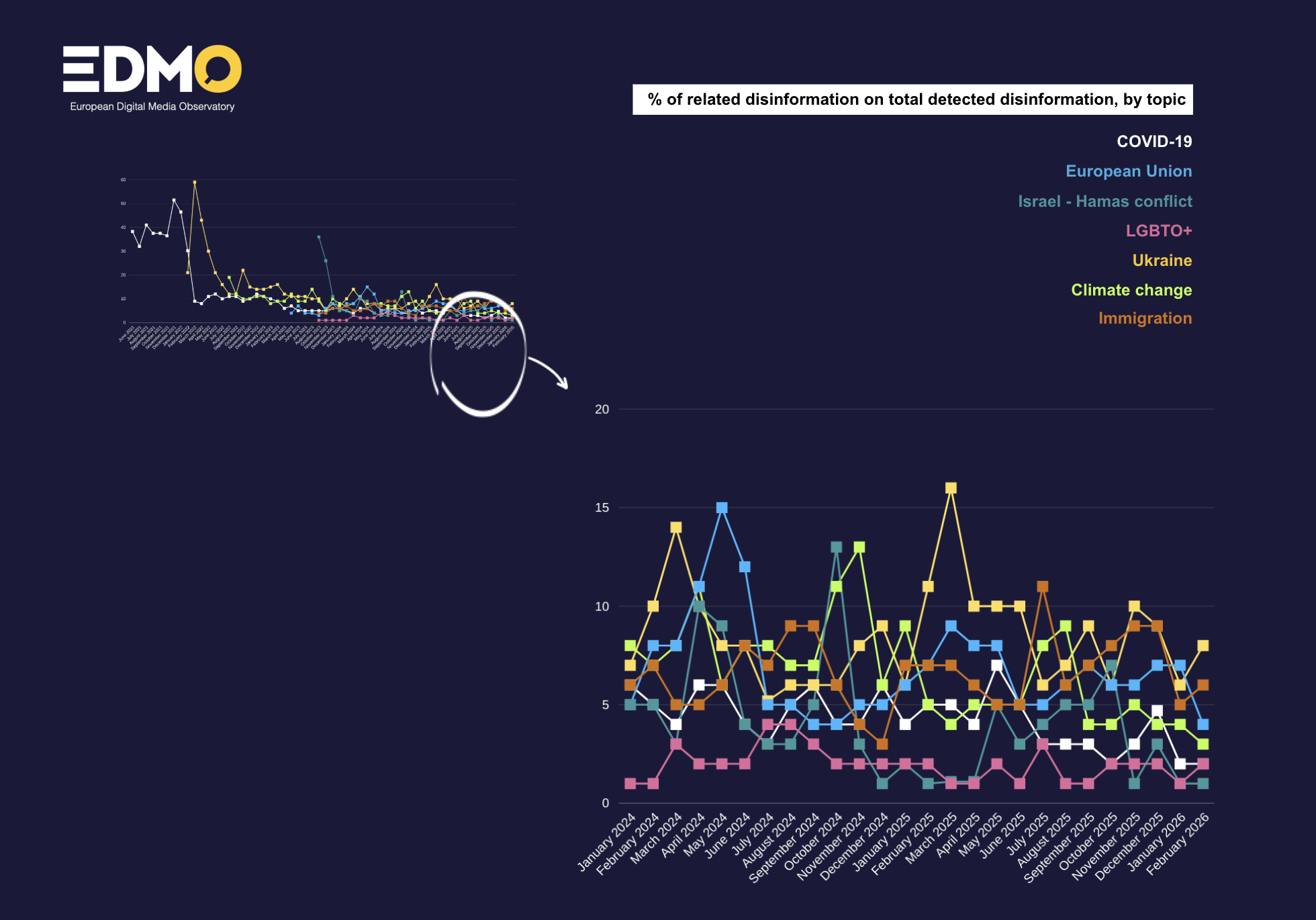
European fact-checkers have identified Ukraine war and immigration as the primary targets of disinformation campaigns in February, according to the latest analysis from the European Digital Media Observatory (EDMO) fact-checking network.
The network, comprising 32 organizations across Europe, published 1,253 fact-checking articles last month, with Ukraine-related disinformation accounting for 8% of the total, marking a two percentage point increase compared to January. Immigration-related falsehoods followed closely at 6%, while disinformation targeting EU institutions dropped three percentage points to 4%.
Other monitored topics showed minimal fluctuation, with climate change misinformation accounting for 3% of fact-checks, LGBTQ+ and gender issues at 2%, COVID-19 at 2%, and the Gaza crisis at just 1%.
The Winter Olympics in Milan-Cortina provided fertile ground for pro-Russian disinformation actors to spread anti-Ukrainian narratives. False claims circulated that Ukrainian athletes were segregated from other delegations and that many had defected rather than return home after the games. These fabrications represent a continuation of disinformation efforts that have persisted throughout the four years since Russia’s invasion of Ukraine.
Artificial intelligence tools were heavily deployed in creating this Olympic-themed disinformation, with threat actors generating fake images and videos of athletes and impersonating trusted European news organizations to lend credibility to false narratives.
Beyond sports, traditional anti-Ukrainian themes persisted across European information spaces. Disinformation campaigns falsely attributed a train crash in Spain and an apartment fire in Poland to Ukrainian refugees, perpetuating negative stereotypes about displaced Ukrainians. In multiple countries, fabricated stories claimed that a Ukrainian teenager had been spotted at several different funeral ceremonies, pushing the conspiracy theory that he was a “crisis actor” staging emotional scenes.
AI was also leveraged to create fictitious scenarios of pro-Russian protests in Ukrainian cities and fabricated footage of Ukrainian military surrenders to Russian forces, attempting to create a false impression of waning Ukrainian resistance.
The prevalence of AI in generating disinformation remains significant despite a slight three-point decrease from January levels. Of the 1,253 fact-checked articles, 211 (17%) addressed content that was either created or manipulated using artificial intelligence tools.
Beyond the Ukraine conflict, AI technologies were prominently employed to fabricate content linking political figures and celebrities to the Jeffrey Epstein case. Anti-immigration narratives also relied heavily on synthetic media, including a fabricated video purporting to show immigrant schoolchildren harassing a teacher in France.
Other AI-generated content aimed at stoking security fears included a falsified video depicting humanoid robots carrying automatic weapons at a military training facility in China.
The continued high proportion of AI-generated disinformation highlights the growing challenge facing fact-checkers and media literacy advocates. As these technologies become more accessible and sophisticated, distinguishing between authentic and synthetic content grows increasingly difficult for average media consumers.
The EDMO report underscores the persistent nature of certain disinformation narratives, particularly those focusing on geopolitical tensions, immigration, and topics that can trigger emotional responses or exacerbate existing societal divisions. The data suggests that while the specific examples may change, the underlying themes and targets of disinformation campaigns remain relatively consistent across Europe.
Fact Checker
Verify the accuracy of this article using The Disinformation Commission analysis and real-time sources.

14 Comments
It’s disturbing to see the Olympics being exploited for political propaganda. We must remain vigilant and rely on authoritative sources to combat these false narratives.
Well said. Fact-checking is crucial in preserving the integrity of major events like the Olympics, which should be about unity and sportsmanship, not division.
The Olympics should be a celebration of sportsmanship and unity, not a battleground for political propaganda. I hope the fact-checkers can effectively counter these false narratives.
Absolutely. The Olympics are meant to bring people together, not divide them. Fact-checking is vital to maintaining the integrity of these events.
The use of the Olympics for anti-Ukrainian disinformation is disappointing but not surprising. Fact-checkers play a vital role in exposing these malicious efforts.
Agreed. It’s important to call out these false claims and ensure that the public has access to accurate, reliable information.
It’s disappointing to see the Olympics being used as a platform for disinformation campaigns. We need to remain vigilant and rely on trusted sources of information.
Agreed. Fact-checking efforts are crucial in exposing and debunking these false narratives, especially around major international events.
The increase in Ukraine-related disinformation is concerning, especially as it targets the Olympics. Fact-checkers play a vital role in combating these malicious efforts.
Absolutely. Reliable information is essential, especially during times of heightened geopolitical tensions. Kudos to the fact-checking organizations for their work.
The rise in Ukraine-related disinformation is worrying, especially as it targets major events like the Olympics. It’s crucial that we stay informed and rely on authoritative sources.
Agreed. Disinformation can have real-world consequences, so it’s important to be vigilant and call out false claims whenever they arise.
Interesting to see how the Olympics are being used as a vector for anti-Ukrainian disinformation. This highlights the need for vigilance and fact-checking, especially around major events.
Yes, it’s concerning to see these false narratives spreading. Fact-checkers play a crucial role in combating disinformation campaigns.