


Listen to the article
Despite Trump Administration Roadblocks, Offshore Wind Projects Make Significant Gains
Another offshore wind victory is tipping the balance in favor of renewable energy, despite concerted efforts to stymie its progress. Vineyard Wind and Revolution Wind are now delivering clean electricity to New England communities, marking major milestones in the region’s transition to sustainable energy sources.
The Trump administration has actively worked to impede offshore wind development. In late 2025, it issued a stop-work order on Vineyard Wind and four other offshore wind projects, followed by a freeze on new permits in January 2025. During a September United Nations appearance, Trump urged world leaders to reject climate change initiatives and green energy, while declaring the US would see “no new windmills.”
Michael E. Mann, director of the Penn Center for Science, Sustainability, and the Media, argues these actions reveal a deeper agenda. “Trump’s assault on wind — in both word and deed — is best seen as a quid pro quo to the fossil fuel interests, plutocrats, and petrostate actors who helped return him and enabling congressional Republicans to power,” Mann notes.
The opposition follows “a well-worn disinformation playbook,” according to L. Delta Merner, lead scientist at the Union of Concerned Scientists’ Science Hub for Climate Litigation. What appears as local resistance often masks “a coordinated, well-resourced campaign to preserve fossil fuel dependence,” with voices claiming to represent local interests actually embedded in networks of fossil fuel-aligned think tanks and dark money donors, as documented in a 2023 Brown University report.
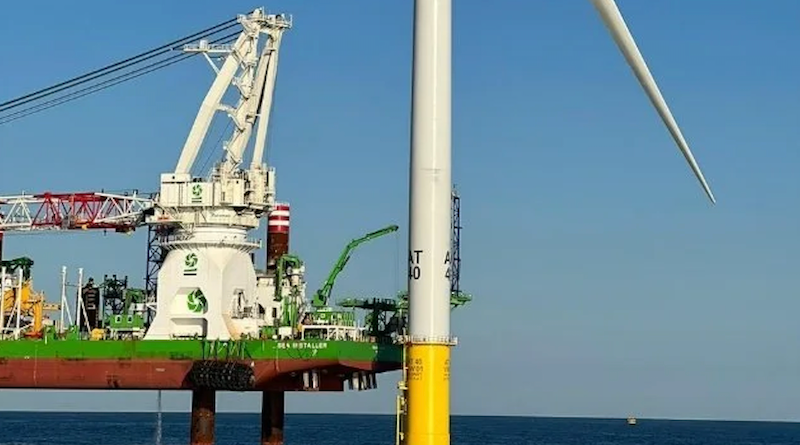
Despite these challenges, offshore wind projects continue to advance. Vineyard Wind successfully challenged the Interior Department’s December 22 suspension, obtaining a preliminary stay on January 27 that allowed construction to resume. By March 13, the company had installed the last three blades on its 62nd turbine, completing the physical installation of the wind farm, though some turbines still require commissioning and testing.
On the same day, Ørsted announced that Revolution Wind had begun delivering power to New England’s electric grid. This project will power 350,000 homes in Connecticut and Rhode Island, strengthening the region’s energy supply and helping reduce costs for consumers.
Amanda Dasch, chief development officer at Ørsted, highlighted the significance of this achievement: “Built by local, highly skilled union workers, Revolution Wind is a testament to states tapping their energy resources to strengthen regional energy security.”
Kate Sinding Daly of the Conservation Law Foundation emphasized the broader impacts: “Offshore wind lowers and stabilizes energy bills… it slashes electricity prices and toxic, planet-warming pollution. It costs a fraction of what gas and oil did, especially during blizzards, snowstorms, and bitterly cold weather.”
These developments are particularly important for Massachusetts, which aims to halve its greenhouse gas emissions by 2030 and achieve net-zero emissions by 2050. Senator Ed Markey (D-MA) celebrated the resilience of the Vineyard Wind project: “Donald Trump tried to kill this project last year. The courts stopped him, unionized workers finished the job, and now this offshore energy will bring costs down for Massachusetts families.”
Beyond regional benefits, renewable energy offers global advantages in an era of geopolitical tension. Rana Adib, executive director of REN21, points out that the latest Middle East conflicts expose the inherent volatility of fossil fuel markets. “What is clear from this crisis is that simply switching suppliers does not eliminate the vulnerability of fossil fuel-based systems,” Adib notes.
A transition to renewable energy provides multiple benefits: reduced exposure to geopolitical shocks, stabilized long-term energy costs, strengthened domestic value creation and job growth, and enhanced resilience to external crises.
According to the Rhodium Group’s “Taking Stock 2025” report, despite Trump administration roadblocks, the US is still projected to reduce greenhouse gas emissions by 26%-41% by 2040 compared to 2005 levels. This underscores an inescapable reality: wind remains one of the least expensive and fastest ways to add new power to the grid, even without subsidies.
As New England’s offshore wind projects demonstrate, the renewable energy transition continues to gain momentum, driven by economic advantages and climate imperatives that transcend political obstacles.
Fact Checker
Verify the accuracy of this article using The Disinformation Commission analysis and real-time sources.

13 Comments
The claim that Trump’s actions are a ‘quid pro quo’ to fossil fuel interests is quite damning. It suggests a deeper agenda at play beyond just ideological opposition to renewable energy.
Yes, that’s a troubling allegation. It raises questions about the real motivations behind the administration’s efforts to undermine offshore wind development.
The claim that Trump’s actions are a quid pro quo to fossil fuel interests is quite alarming. It suggests there may be deeper, more nefarious motives at play beyond just ideological opposition to wind power.
I agree, that’s a very serious allegation. It’s troubling to think the administration may be actively working to undermine renewable energy for the benefit of fossil fuel companies.
Interesting to see the political headwinds facing the offshore wind industry. Seems like there’s a concerted effort to stall progress on renewable energy. Curious to hear more about the specific challenges and how the industry is adapting.
Definitely a tricky situation with the administration actively working against offshore wind. Will be important to see how the industry navigates the political roadblocks.
The offshore wind industry’s progress despite the political opposition is encouraging. Renewable energy is crucial for addressing climate change, so it’s good to see projects moving forward despite the headwinds.
It’s disappointing to see the political obstacles the offshore wind industry is facing. Renewable energy development is so crucial, and it’s troubling to see the administration taking steps to impede its progress.
I appreciate the gains the offshore wind industry has made despite the political opposition. Transitioning to sustainable energy sources is crucial, so it’s good to see projects like Vineyard Wind and Revolution Wind moving forward.
You’re right, the Trump administration’s hostility towards wind power is concerning. Hopefully the industry can continue to make progress despite the political headwinds.
It’s disappointing to see the Trump administration actively working to impede offshore wind projects. This seems to be part of a broader pattern of prioritizing fossil fuel interests over renewable energy initiatives.
Interesting to see the political dynamics at play here. Curious to learn more about the specific challenges the offshore wind industry is facing and how they’re navigating the political landscape.
Definitely a concerning situation. It will be important to follow how this plays out and whether the industry can overcome the political obstacles.