


Listen to the article
NASA Combats AI-Generated Deepfakes as Artemis II Mission Continues
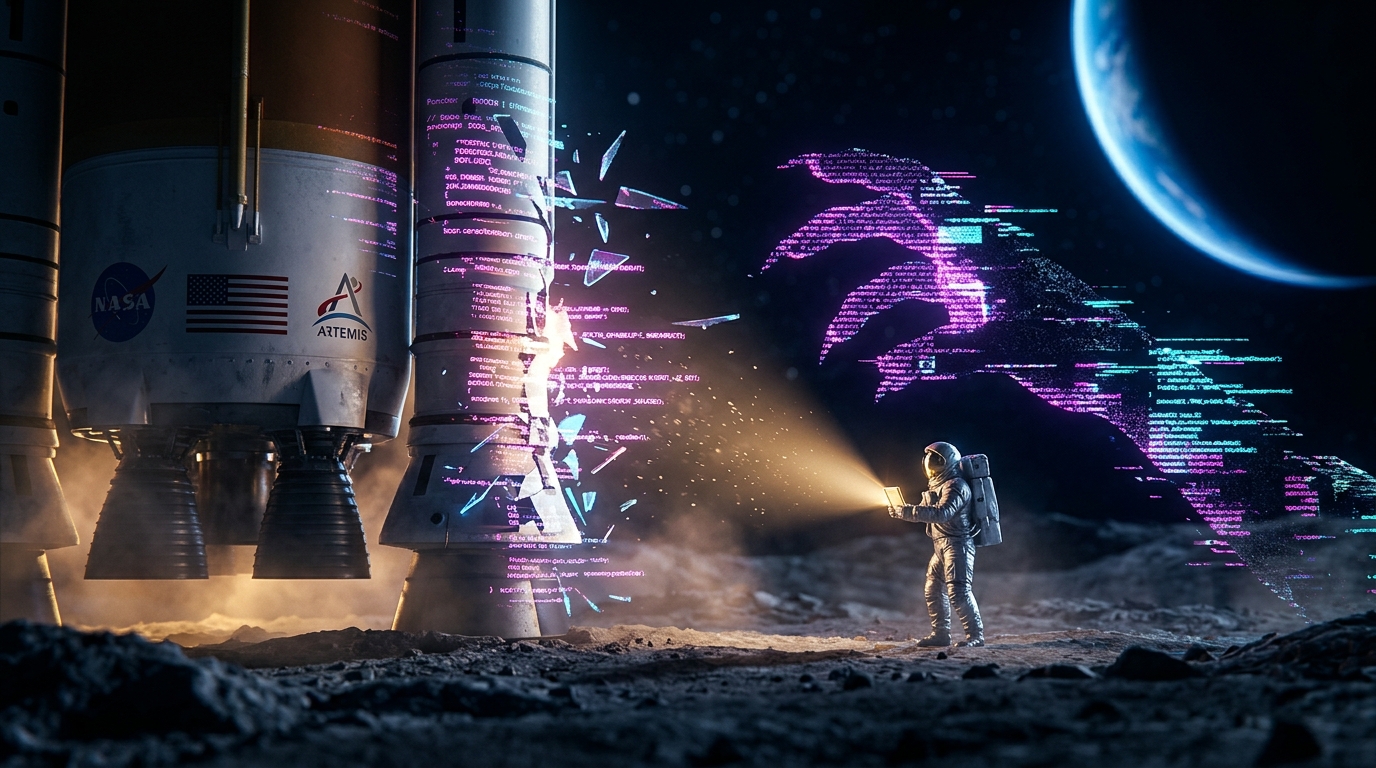
NASA scientists have been forced to divert critical resources over the past 48 hours to counter a surge of synthetic imagery claiming the Artemis II mission is merely an elaborate production. As the agency manages the most complex crewed lunar flyby since Apollo, mission controllers found themselves issuing categorical denials of viral videos suggesting the Orion spacecraft’s trajectory maneuvers were rendered using artificial intelligence. While these sophisticated deepfakes have accumulated millions of views across social platforms, the actual mission continues approximately 380,000 kilometers from Earth.
The situation represents more than a simple annoyance—it signals a growing threat to scientific integrity and public understanding of space exploration. As generative AI technology becomes more widely accessible, the distinction between verifiable scientific observation and convincing fiction continues to blur, creating ideal conditions for conspiracy theories that exploit public curiosity about space missions.
For the Artemis program, which carries an estimated price tag exceeding $23 billion, this erosion of public trust could have significant policy implications, potentially affecting future funding and international partnerships essential to the program’s long-term goals.
The deceptive content gaining traction online leverages sophisticated diffusion models capable of creating fluid, plausible movement in fabricated space environments. These AI generators replicate the distinctive lighting and atmospheric effects of space but typically contain technical inaccuracies that professional astronomers quickly identify as impossible.
Independent aerospace engineers have highlighted several flaws in the viral footage, including trajectory patterns that violate orbital mechanics, incorrect shadow patterns from lunar craters, telemetry data that doesn’t match official broadcasts to the global Deep Space Network, and structural details of the Service Module that don’t correspond to the actual Artemis II vehicle design.
NASA officials emphasize their commitment to transparency, pointing to their continuous high-definition broadcasts from the mission. The conspiracy theories also overlook corroborating evidence from independent ground-based telescopes and amateur radio operators worldwide who have successfully tracked Orion’s position.
“What we’re witnessing is an unprecedented challenge to scientific authority,” said Dr. Elena Marquez, an expert in science communication at Stanford University. “The space program has always faced skepticism, from the moon landing onward, but the sophistication of today’s synthetic media creates entirely new dimensions of doubt.”
This wave of misinformation highlights a growing divide in how society processes and validates information. Digital ethics experts from MIT note that space exploration conspiracy theories are particularly appealing because they offer followers the illusion of uncovering hidden truths. By portraying Artemis II as fabricated, content creators aren’t simply generating engagement—they’re exploiting a fundamental distrust of large-scale government scientific initiatives.
The consequences extend beyond NASA’s public relations concerns. The situation particularly impacts younger generations, including students globally who view space exploration as inspiration for careers in science, technology, engineering, and mathematics. When legitimate scientific achievements face the same skepticism as internet fiction, the aspirational value of science diminishes significantly.
Educators now face the additional challenge of teaching media literacy alongside traditional STEM subjects to ensure future scientists can distinguish between AI-generated content and verified scientific reality.
The implications extend globally. As space agencies in developing regions, including the Kenya Space Agency, expand their orbital capabilities and international collaborations, communicating verifiable data to the public becomes increasingly critical. The Artemis program represents the foundation for future lunar base camps and eventual Mars missions—endeavors requiring sustained global investment and public support.
Meanwhile, the Artemis II crew—Reid Wiseman, Victor Glover, Christina Koch, and Jeremy Hansen—continue their historic mission, representing years of preparation by the global scientific community. Their work demonstrates engineering excellence and human endurance in ways that cannot be replicated by artificial intelligence, regardless of how convincing the synthetic alternatives might appear.
As the mission progresses toward completion, NASA’s focus shifts from debunking falsehoods to comprehensive documentation. The agency’s ability to weather this wave of misinformation will depend largely on continued public engagement, ensuring that factual mission data remains more accessible and compelling than the fiction created to undermine it.
The ultimate legacy of Artemis II may extend beyond its scientific achievements to include how it navigated the challenging intersection of groundbreaking space exploration and the emerging era of synthetic media—a challenge that future missions will undoubtedly face with increasing frequency.
Fact Checker
Verify the accuracy of this article using The Disinformation Commission analysis and real-time sources.

13 Comments
The rise of AI-driven disinformation is a concerning trend that can have serious implications for important scientific initiatives like the Artemis mission. I applaud NASA’s proactive approach to addressing this threat and maintaining public trust in their work.
This is a disturbing development, but not entirely unexpected given the rapid advancements in AI technology. NASA’s efforts to combat AI-generated misinformation are commendable, as the Artemis program represents a significant milestone in space exploration.
The Artemis program is a major undertaking, and it’s a shame to see it being undermined by AI-generated propaganda. NASA’s diligence in countering these deepfakes is admirable, but it’s concerning that this has become a necessary part of their work.
It’s frustrating to see critical resources being diverted to counter AI-generated propaganda instead of advancing the Artemis mission. NASA is right to take this threat seriously and protect the integrity of their work.
While AI-powered disinformation is a growing challenge, I’m glad to see NASA taking it seriously and working to protect the integrity of the Artemis mission. Maintaining public trust in space exploration is crucial, especially for ambitious programs like this.
Cutting-edge space exploration missions like Artemis II shouldn’t have to divert resources to fight AI-generated propaganda. It’s a shame that malicious actors are trying to sow confusion and erode scientific integrity.
Agreed. The public deserves access to accurate, fact-based information about these historic space missions. Spreading misinformation only serves to undermine important scientific progress.
While advanced AI can create very convincing synthetic media, I’m glad to see NASA taking a strong stance against these deepfake attempts. Maintaining public trust in their work is crucial, especially for ambitious programs like Artemis.
Absolutely. NASA needs to keep the focus on the actual progress and achievements of the Artemis mission, not get sidetracked by disinformation campaigns. Fact-based transparency is key.
Harnessing the power of AI to spread disinformation about space exploration is a concerning trend. I hope NASA can stay ahead of these efforts and ensure the public has access to reliable information about the Artemis program.
This situation highlights the growing challenge of managing AI-driven misinformation, even for high-profile government agencies like NASA. Maintaining public trust in science and exploration will only become more difficult.
You’re right. As generative AI capabilities continue to advance, the potential for abuse will only increase. NASA’s efforts to stay ahead of this are important, but it’s a battle they’ll likely have to fight more frequently.
This is worrying. AI-generated disinformation can really undermine public trust in important scientific missions like Artemis. I hope NASA is able to get ahead of this and effectively counter the fake videos.