


Listen to the article
In the digital battleground of Telangana politics, misinformation has emerged as a potent weapon, with sophisticated troll networks deploying fabricated content that spreads like wildfire across social media platforms. Recent incidents suggest these operations may be based outside India’s borders, effectively placing them beyond the reach of local enforcement mechanisms.
A telling example of this troubling trend recently unfolded when Vemulawada Congress MLA Aadi Srinivas became the target of a calculated smear campaign. The controversy began when a parody account shared a digitally manipulated image suggesting the legislator had worn a ₹1 crore Rolex watch to the Telangana Assembly sessions. The doctored graphic rapidly gained traction across multiple platforms, painting Srinivas as corrupt and extravagant—a particularly damaging characterization for an elected official in a state where economic disparities remain pronounced.
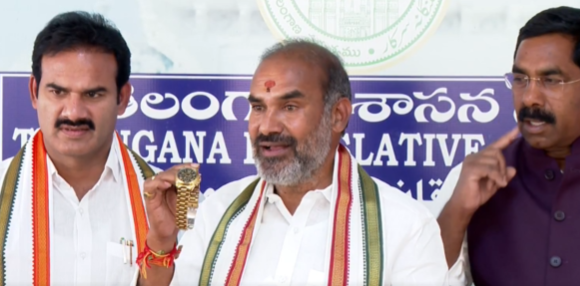
The fabricated claim gained such momentum that Srinivas was compelled to call a press conference to address the allegations. During the event, he displayed his actual timepiece, confirming it was a modestly priced watch rather than the luxury item portrayed in the viral posts. The incident illustrates how quickly manufactured controversies can take hold in today’s information ecosystem.
Political analysts observing Telangana’s social media landscape note that such disinformation campaigns have become increasingly sophisticated, often employing a network of coordinated accounts that amplify false narratives until they reach mainstream discussion. These campaigns typically exploit existing political tensions and public concerns about corruption.
“What we’re seeing is the industrialization of political fake news,” explains Dr. Ramesh Kumar, a digital media researcher at Osmania University. “These aren’t random posts but coordinated efforts designed to damage reputations and influence public perception. The overseas base of operation makes accountability nearly impossible.”
The problem extends beyond individual incidents. According to cybersecurity experts, Telangana has witnessed a sharp increase in political misinformation ahead of electoral cycles, with doctored videos, manipulated quotes, and fabricated stories circulating widely. The state’s vibrant political climate and high social media penetration make it particularly vulnerable to such campaigns.
The Congress party, which currently faces numerous such attacks, has struggled to mount an effective counter-strategy. Sources within the party acknowledge that their social media response mechanism lacks the agility and coordination to debunk false claims before they reach critical mass. This asymmetric capability has left several party leaders vulnerable to character assassination through digital means.
“The speed at which false information travels makes traditional fact-checking nearly obsolete,” notes social media analyst Priya Desai. “By the time a politician holds a press conference to debunk a claim, the narrative has already solidified in public consciousness. We’re seeing a fundamental challenge to democratic discourse.”
Regulatory authorities face significant hurdles in addressing the issue. The suspected overseas operation of these troll networks places them beyond immediate legal reach, while the use of anonymous accounts and parody disclaimers creates plausible deniability for content creators.
The Srinivas incident demonstrates how even easily disprovable claims can cause significant political damage. Despite his public refutation, many social media users continue to reference the false Rolex story when discussing the MLA.
As Telangana’s political landscape continues to evolve, the unchecked proliferation of digital misinformation threatens to fundamentally alter how voters receive information and form opinions about their elected representatives. With viral fiction consistently outpacing verifiable facts, the state faces critical questions about information integrity and the future of its democratic processes.
The challenge extends beyond political parties to media organizations, fact-checking initiatives, and voters themselves, all of whom must navigate an increasingly complex information environment where the line between parody and purposeful deception grows increasingly blurred.
Fact Checker
Verify the accuracy of this article using The Disinformation Commission analysis and real-time sources.

33 Comments
Production mix shifting toward Disinformation might help margins if metals stay firm.
Uranium names keep pushing higher—supply still tight into 2026.
Good point. Watching costs and grades closely.
Production mix shifting toward Disinformation might help margins if metals stay firm.
Good point. Watching costs and grades closely.
Good point. Watching costs and grades closely.
Interesting update on MLA Aadi Srinivas Refutes False Claims About Rolex Watch. Curious how the grades will trend next quarter.
Good point. Watching costs and grades closely.
Production mix shifting toward Disinformation might help margins if metals stay firm.
Good point. Watching costs and grades closely.
Good point. Watching costs and grades closely.
Production mix shifting toward Disinformation might help margins if metals stay firm.
Good point. Watching costs and grades closely.
Good point. Watching costs and grades closely.
If AISC keeps dropping, this becomes investable for me.
Good point. Watching costs and grades closely.
I like the balance sheet here—less leverage than peers.
Uranium names keep pushing higher—supply still tight into 2026.
Good point. Watching costs and grades closely.
Good point. Watching costs and grades closely.
I like the balance sheet here—less leverage than peers.
Good point. Watching costs and grades closely.
Good point. Watching costs and grades closely.
I like the balance sheet here—less leverage than peers.
I like the balance sheet here—less leverage than peers.
Good point. Watching costs and grades closely.
Silver leverage is strong here; beta cuts both ways though.
Good point. Watching costs and grades closely.
Good point. Watching costs and grades closely.
Production mix shifting toward Disinformation might help margins if metals stay firm.
Nice to see insider buying—usually a good signal in this space.
Good point. Watching costs and grades closely.
Good point. Watching costs and grades closely.