


Listen to the article
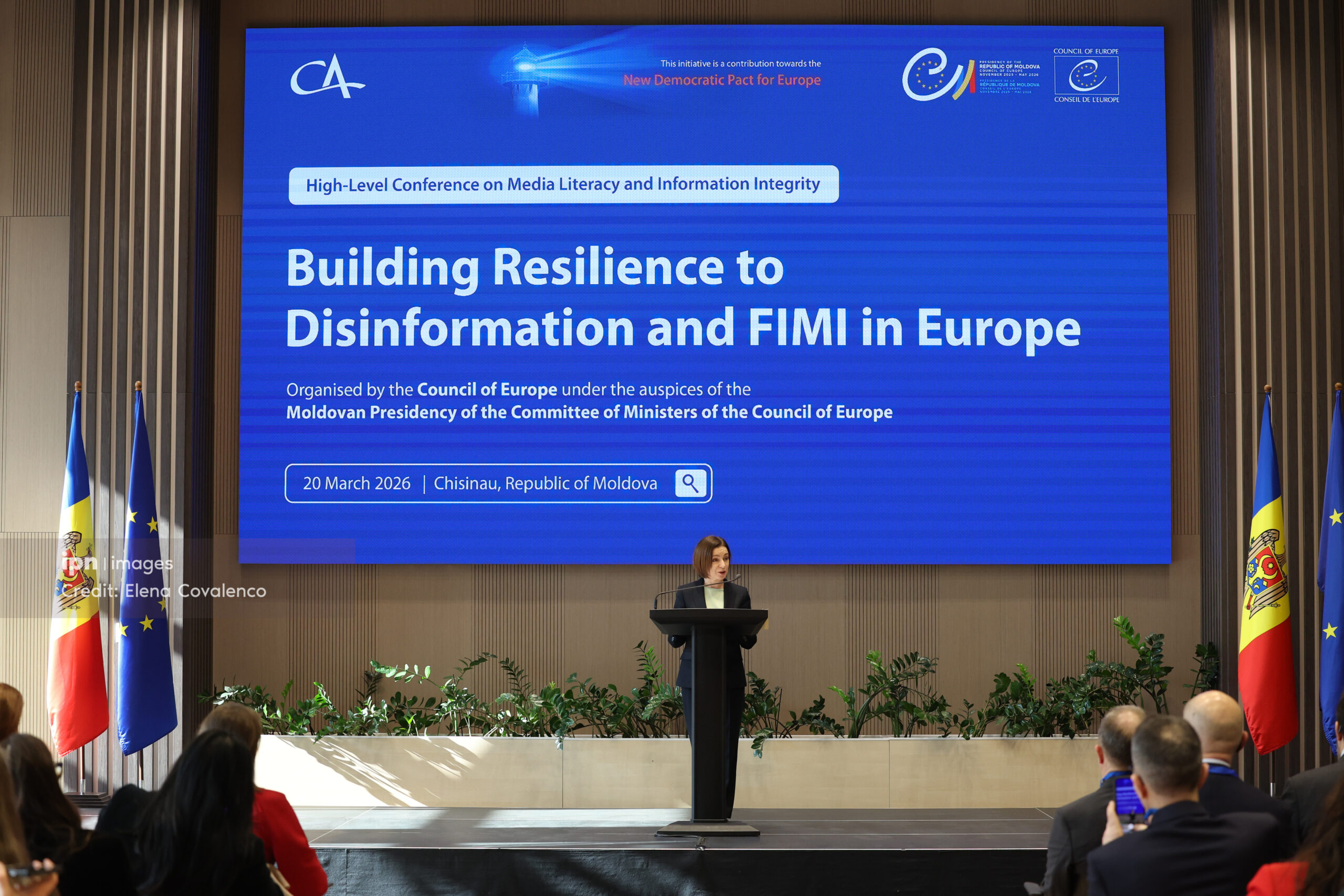
In a direct appeal to enhance democratic resilience, President Maia Sandu warned that democracies must now focus on citizens’ ability to resist manipulation rather than relying solely on institutional frameworks. Her remarks came during an international conference in Chisinau organized by the Council of Europe addressing information integrity and media literacy.
“Information manipulation isn’t a temporary crisis—it’s our new constant reality,” Sandu told attendees, describing cognitive warfare as “a state, not an episode” that fundamentally impacts public trust and decision-making processes. She highlighted Moldova’s firsthand experience with sophisticated disinformation campaigns, particularly during election cycles.
The Moldovan president emphasized that these information pressures continue to evolve in increasingly sophisticated forms that prove more difficult to detect. According to Sandu, such manipulation tactics transcend borders, affecting countries throughout Europe, with Ukraine serving as a prime example where information warfare runs parallel to physical conflict.
Council of Europe Secretary General Alain Berset echoed these concerns while commending Moldova for its demonstrated ability to withstand significant information pressures. “No country remains immune to these threats,” Berset stated, noting that the contemporary challenge isn’t about information access but rather developing citizens’ ability to evaluate information critically.
Berset emphasized that responses to misinformation must be anchored in democratic values. “Protecting journalism, media plurality, public integrity and trust remains fundamental to strengthening democratic resilience,” he said. The Secretary General revealed that the Council is developing new mechanisms to address information manipulation and foreign interference as part of a coordinated European response.
Moldova’s vulnerability to information manipulation has increased since 2022 when the country applied for European Union membership. The nation of 2.6 million, situated between Romania and Ukraine, has experienced heightened Russian influence operations attempting to derail its Western integration path. These campaigns have exploited economic anxieties, energy dependence, and Moldova’s complex relationship with its breakaway Transnistria region.
The conference, titled “Media Literacy and Information Integrity: Strengthening Resilience against Disinformation and IFM in Europe,” convened representatives from government, international organizations, academia, and civil society. Discussions centered on developing practical solutions to combat disinformation, external interference, and hate speech that undermine public confidence and democratic institutions.
Media experts at the event highlighted the particularly challenging nature of the threat facing smaller countries like Moldova, which have limited resources to counter sophisticated state-backed information operations. Several speakers noted that disinformation campaigns targeting Moldova have become testing grounds for tactics later deployed across Europe.
“What we’re witnessing isn’t simply false information—it’s strategic, coordinated efforts to reshape how citizens perceive reality,” noted one media researcher participating in the conference.
The gathering underscored a growing recognition among European institutions that information manipulation represents a fundamental security challenge requiring coordinated responses across nations. Participants stressed that building societal resilience demands investment in quality journalism, media literacy education, and transparent governance.
Moldova’s experience offers valuable insights for other European democracies facing similar challenges. The country’s proactive approach to media literacy and institutional transparency has garnered international recognition, with several European partners offering technical assistance to strengthen its information ecosystem.
As information warfare techniques continue evolving, experts agree that protecting democratic processes requires constant vigilance and adaptation from both governments and citizens alike.
Fact Checker
Verify the accuracy of this article using The Disinformation Commission analysis and real-time sources.

10 Comments
The Council of Europe’s efforts to address information integrity and media literacy are commendable. Multilateral cooperation will be key to developing effective countermeasures against evolving disinformation tactics.
Absolutely, this is a global challenge that demands a coordinated international response.
Protecting citizens from manipulation and ensuring access to factual information should be top priorities. Sandu’s call for enhancing social resilience is well-founded given the persistent nature of these threats.
Absolutely, democracies must adapt to this new landscape and empower the public to navigate it skillfully.
Sandu’s emphasis on cognitive warfare as an ongoing state, not just a temporary crisis, is a sobering assessment. Strengthening societal resilience is essential to maintaining trust in democratic institutions.
Agreed, this requires a comprehensive, long-term strategy to empower citizens and protect core democratic values.
Cybersecurity and media literacy are critical to safeguarding democratic institutions. Sandu’s warnings about the evolving nature of disinformation campaigns are concerning but important to confront head-on.
I agree, the threat of information warfare undermining public trust is a serious challenge facing democracies worldwide.
The parallels between Ukraine’s experience with information warfare and Moldova’s own challenges are concerning. Sandu’s insights highlight the transnational nature of these disinformation campaigns.
It’s crucial that democratic nations coordinate efforts to counter these threats and promote media literacy across borders.