


Listen to the article
India Rebuffs Pakistan’s Water Weaponization Claims at UN Summit
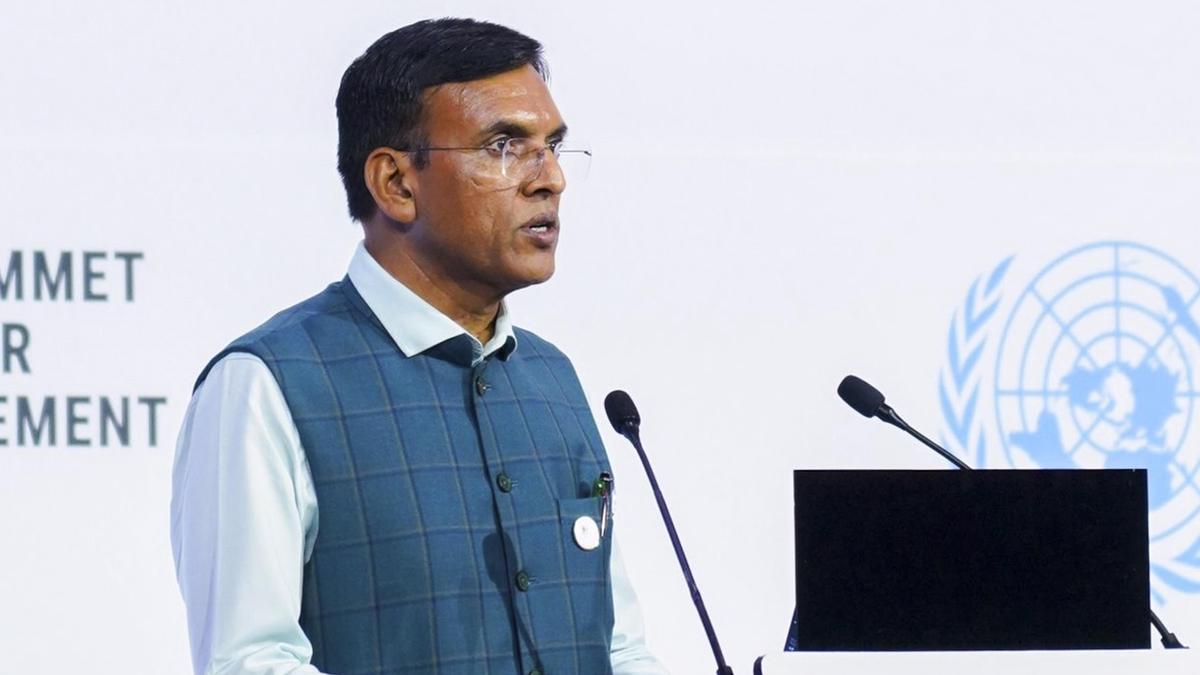
Union Labour Minister Mansukh Mandaviya delivered a sharp rebuke to Pakistan President Asif Ali Zardari at the Second World Summit for Social Development in Doha, Qatar on Wednesday, dismissing allegations that India was weaponizing water resources shared between the two nations.
Addressing the plenary session, Mandaviya characterized Zardari’s remarks from the previous day as “an abuse of an international forum” designed to “distract the world from focusing on social development by peddling disinformation against India.”
“We take strong objection to certain unjustified references made by the President of Pakistan yesterday on India in his remarks,” Mandaviya said, directly confronting the accusations. “We wish to set the record straight.”
The minister specifically addressed the contentious issue of the Indus Waters Treaty, a water-sharing agreement signed between the two countries in 1960 that has become increasingly strained amid deteriorating bilateral relations. According to Mandaviya, Pakistan has consistently “undermined the treaty’s spirit through sustained hostility and cross-border terrorism.”
“Pakistan has repeatedly misused the Treaty mechanisms to obstruct India’s legitimate projects,” he added, referencing Pakistan’s formal objections to several Indian hydroelectric projects on rivers allocated to India under the treaty.
On the long-standing Kashmir dispute that Zardari had also mentioned, Mandaviya maintained that Pakistan has “no locus standi to comment on India’s internal affairs,” especially given what he described as Pakistan’s engagement in “cross-border terrorism against the citizens of India.”
The minister suggested Pakistan should focus on its own development challenges rather than raising accusations in international forums. “Pakistan would do well to introspect and address its own serious challenges related to development, which have made it dependent on hand-outs by the international community,” he said.
Water sharing has been a persistent source of tension between the nuclear-armed neighbors, with both sides accusing each other of violations. The treaty, brokered by the World Bank, governs the use of water from the Indus River system, giving Pakistan control over the western rivers (Indus, Jhelum, Chenab) while India has rights over the eastern rivers (Ravi, Beas, Sutlej).
Beyond addressing Pakistan’s allegations, Mandaviya highlighted India’s progress in poverty alleviation and social development – the intended focus of the UN summit. He noted that approximately 250 million Indians have been lifted out of multidimensional poverty in the past decade through “persistent reforms, convergence of welfare programmes, and digital innovation.”
The minister outlined several key achievements in social welfare, including nutritious mid-day meals for 118 million schoolchildren, food security for over 800 million citizens, and health security coverage for 425 million Indians. He also reported that India had provided more than 37 million houses to low-income families.
On employment metrics, Mandaviya claimed that India’s unemployment rate had declined from 6% in 2017-18 to 3.2% in 2023-24, while women’s employment rate had “nearly doubled” in the same period. He emphasized that millions of women have been mobilized into self-help groups, with credit disbursements strengthening these “women-led local institutions.”
The minister concluded by pointing to a significant expansion in India’s social security coverage, which he said had increased from 19% in 2015 to 64.3% in 2025.
The exchange highlights the persistent tensions between the two South Asian neighbors, whose diplomatic relations have remained strained for years, particularly since India revoked the special status of Jammu and Kashmir in 2019.
Fact Checker
Verify the accuracy of this article using The Disinformation Commission analysis and real-time sources.

17 Comments
The allegations of water weaponization are serious and require a measured response. I appreciate the Indian minister’s attempt to set the record straight and uphold the integrity of the Indus Waters Treaty. However, I hope this doesn’t further inflame tensions between the two countries, as the humanitarian impact could be severe.
Absolutely. Constructive dialogue and a commitment to existing agreements are crucial to prevent this dispute from escalating. Both sides need to prioritize de-escalation and finding pragmatic solutions that respect the rights and needs of all parties.
This dispute over water resources is deeply concerning and has the potential to escalate regional tensions. I hope both India and Pakistan can find a way to engage in good-faith negotiations and uphold existing agreements like the Indus Waters Treaty. The humanitarian stakes are too high to allow this to deteriorate further.
This is a concerning situation that highlights the fragility of regional stability in South Asia. While I can’t take sides, I hope both governments can find a way to de-escalate the rhetoric and work toward a diplomatic resolution that serves the best interests of their people.
This is a concerning development that highlights the fragility of regional stability in South Asia. While I can’t take sides, I hope both India and Pakistan can find a way to de-escalate the rhetoric and work toward a diplomatic resolution that serves the best interests of their people and the broader region.
The Indian minister’s response seems measured and focused on setting the record straight, rather than escalating the dispute. Addressing disinformation and misuse of international forums is important, but I hope this doesn’t further inflame tensions between the two countries.
Agreed. Diplomatic channels are crucial here. Both sides need to prioritize de-escalation and finding pragmatic solutions that uphold existing agreements and respect each nation’s rights and needs.
As an observer, I’m concerned about the potential for this dispute to escalate, especially given the sensitivity around water resources. I hope both India and Pakistan can engage in good-faith discussions to uphold the Indus Waters Treaty and find equitable solutions.
Absolutely. The humanitarian impact of any disruption to water access could be severe. Constructive diplomacy and a commitment to international agreements are crucial to prevent further conflict.
Regardless of the political context, the misuse of international forums to spread disinformation is troubling. Maintaining the integrity of global institutions and promoting fact-based dialogue should be a priority for all nations. I hope the relevant parties can find a constructive path forward.
Agreed. Upholding the rules-based international order and preventing the weaponization of shared resources are critical for regional and global stability. Constructive diplomacy is the only way to resolve such complex disputes.
This is a complex geopolitical issue with deep historical roots. While I can’t take sides, I hope the two governments can find a way to resolve their differences through peaceful dialogue and negotiation. Weaponizing shared resources is an extremely dangerous path.
This is a complex geopolitical issue with deep historical roots. While I can’t take sides, I hope the Indian and Pakistani governments can find a way to resolve their differences through peaceful dialogue and negotiation. Weaponizing shared resources is an extremely dangerous path that could have severe humanitarian consequences.
This is a concerning development. While tensions between India and Pakistan are longstanding, weaponizing water resources is extremely dangerous and could have severe humanitarian consequences. I hope both sides can de-escalate the rhetoric and find constructive solutions through diplomatic channels.
Absolutely. Water scarcity is already a major issue in the region, and politicizing access to this vital resource is extremely reckless. The Indus Waters Treaty must be upheld to ensure stability and prevent further conflict.
The Indian minister’s response seems measured and focused on addressing the specific allegations made by Pakistan. While the broader context is complex, calling out the misuse of international forums to spread disinformation is a valid concern. I hope both sides can find a way to de-escalate and focus on constructive solutions.
Agreed. Maintaining the integrity of global institutions and promoting fact-based dialogue should be a priority for all nations. Constructive diplomacy is the only way to resolve such sensitive disputes over shared resources.