


Listen to the article
In a forceful critique of rising partisan rhetoric, House Minority Leader Hakeem Jeffries condemned what he described as escalating racist hate speech from Republican circles, particularly targeting comments made by White House Press Secretary Karoline Leavitt.
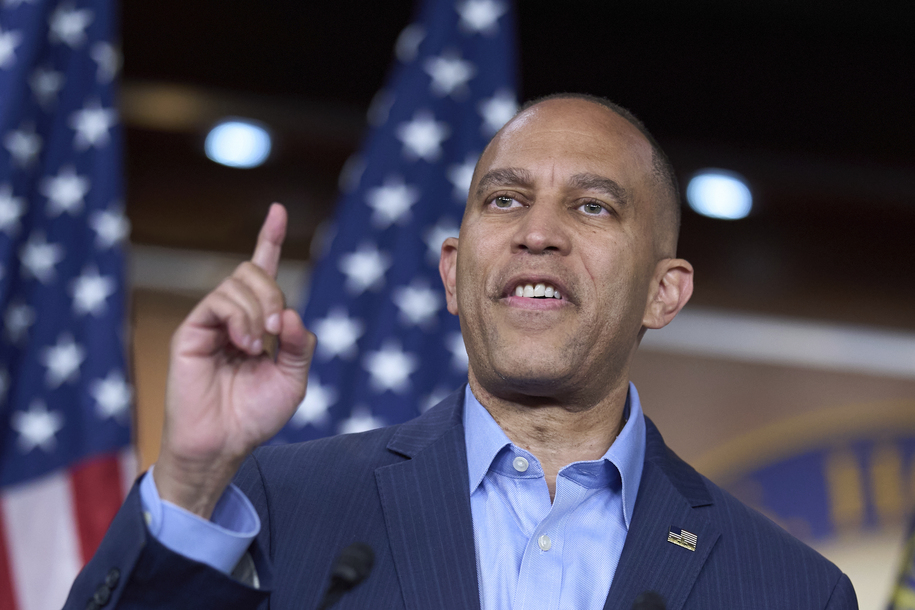
Speaking to reporters on Friday, Jeffries expressed alarm at the increasingly inflammatory language being used in official communications. “They are ripping the sheets off in plain view of the American people,” Jeffries said, referencing recently leaked racist messages from Young Republican groups that have caused controversy across political circles.
The Democratic leader reserved particular criticism for Leavitt, characterizing her recent statements as dangerous and divisive. “And then you got Karoline Leavitt, who’s sick—she’s out of control,” Jeffries told reporters. “And I’m not sure whether she’s just demented, ignorant, stone-cold liar, or all of the above.”
Jeffries’ remarks came in response to Leavitt’s Thursday appearance on Fox News, where she made the extraordinary claim that the Democratic Party is “made up of Hamas terrorists, illegal aliens, and violent criminals.” This characterization has drawn widespread criticism from Democratic lawmakers and political analysts who view it as crossing a line in political discourse.
The tension occurs against the backdrop of an ongoing government shutdown, which has already strained relations between the two parties. Jeffries emphasized this context, noting, “The notion that an official White House spokesperson would say that the Democratic Party consists of terrorists, violent criminals, and undocumented immigrants—this makes no sense that this is what the American people are getting from the Trump administration in the middle of a shutdown.”
Political communication experts have noted the unusual nature of such inflammatory rhetoric coming from an official White House spokesperson. Traditionally, press secretaries have maintained a more measured tone even during periods of intense partisan disagreement. Leavitt’s approach represents a significant departure from historical norms of the office.
The exchange highlights the increasingly polarized nature of American political discourse, with rhetoric that once might have been confined to fringe elements now appearing in mainstream political communication. Civil rights organizations have expressed concern about the normalization of such language and its potential impact on vulnerable communities.
Meanwhile, Republican leadership has largely avoided addressing controversies surrounding racist messaging within party circles. Despite mounting evidence of problematic communications among certain Republican groups, party leaders have typically downplayed these incidents or dismissed them as isolated cases not representative of broader party values.
The controversy comes at a particularly sensitive moment in American politics, with the government shutdown affecting thousands of federal workers and their families. Critics argue that inflammatory rhetoric distracts from substantive policy discussions that might lead to resolution of the shutdown.
Some political analysts suggest this escalation in rhetoric signals a new phase in campaign messaging as both parties position themselves for upcoming electoral contests. The stark language employed by both sides indicates a strategy focused on energizing base voters rather than appealing to moderates or undecided Americans.
As this war of words continues, concerns grow about further degradation of civil discourse in American politics and the long-term consequences for democratic institutions and processes. Whether these exchanges represent a temporary escalation or a new normal in political communication remains to be seen, but the immediate impact has been to further entrench partisan divisions at a time when cooperation is urgently needed to address pressing national challenges.
Fact Checker
Verify the accuracy of this article using The Disinformation Commission analysis and real-time sources.

20 Comments
While political disagreements are inevitable, the use of inflammatory rhetoric and unsubstantiated claims is extremely concerning. We need our elected officials to be responsible stewards of the public trust.
Well said. Maintaining a constructive, fact-based dialogue is essential for addressing the real challenges facing our country.
This is a deeply troubling development. Elected officials have a responsibility to inform the public, not spread misinformation for political gain. We need to hold our leaders to a higher standard.
I agree. Maintaining objectivity and a commitment to facts, even in the face of partisan tensions, is essential for preserving the integrity of our democratic process.
While partisan tensions are high, stoking division through unsubstantiated claims is unproductive and dangerous. Political leaders should focus on finding common ground and solving real problems.
Absolutely. Resorting to hyperbole and personal attacks erodes the public’s faith in our institutions. We need more statesmanship, less grandstanding.
It’s disappointing to see such reckless language from those in positions of power. Elected officials should be setting an example of civility, not contributing to the spread of disinformation.
I agree. Regardless of party affiliation, we should expect our leaders to uphold democratic norms and engage in substantive, fact-based debate.
Regardless of political affiliation, we should all be alarmed by the spread of false narratives and divisive language. Elected leaders have a duty to inform, not inflame, the public.
Well said. Maintaining objectivity and civility, even in the face of disagreement, is the mark of principled leadership.
Disinformation campaigns like this are very concerning. It’s crucial that public figures avoid inflammatory rhetoric and stick to facts, even when criticizing opponents. Responsible discourse is essential for a healthy democracy.
I agree. Accusations and name-calling rarely lead to productive dialogue. Both sides should focus on addressing the actual issues at hand.
Disinformation campaigns like this undermine the integrity of our democratic institutions. It’s critical that public figures exercise caution and commit to truthful, civil discourse.
Absolutely. Resorting to baseless accusations and personal attacks only serves to further polarize the electorate. We need more statesmanship, less grandstanding.
This is a concerning trend that undermines public trust. It’s crucial for officials to exercise caution and stick to facts when addressing sensitive political topics.
I share your concerns. Responsible governance requires restraint and a commitment to truth, not inflammatory rhetoric.
While political disagreements are inevitable, the use of inflammatory rhetoric and unsubstantiated claims by public figures is extremely concerning. We need our leaders to rise above partisan divisions and engage in responsible, fact-based dialogue.
Well said. Upholding democratic norms and committing to truthful, civil discourse should be the top priority for all elected officials, regardless of their political affiliation.
Disinformation campaigns that rely on divisive language and personal attacks undermine public trust and erode the foundations of our democracy. It’s crucial that elected leaders exercise restraint and focus on addressing the real issues facing our country.
Absolutely. Responsible governance requires a commitment to facts, nuance, and constructive dialogue, even in the face of political disagreements. Our leaders must set a better example for the public.