


Listen to the article
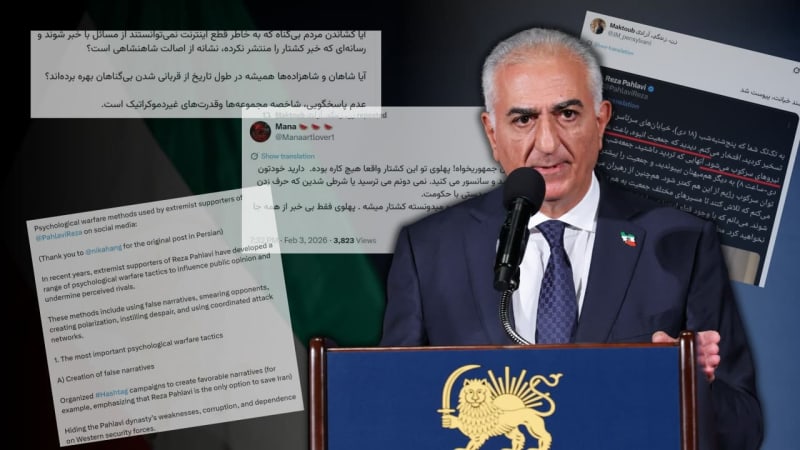
Iran’s Supreme Leader Orders Cyber Campaign Against Crown Prince Pahlavi Amid Growing Protests
Supreme Leader Ali Khamenei has reportedly issued a directive to mobilize Iran’s cyber apparatus against Crown Prince Reza Pahlavi, as the regime faces its most significant challenge in years. The son of the late, deposed Shah has emerged as the unifying figure that previous protest movements lacked, coordinating nationwide demonstrations that have drawn millions to the streets.
The regime’s fear has intensified following Pahlavi’s call for coordinated action on January 8-9, which resulted in massive demonstrations where protesters chanted “Pahlavi barmigardeh” (Pahlavi will return) and “Javid Shah” (long live the Shah).
“In late December and early January, the Iranian people had already bravely taken to the streets as they have so many times before,” Pahlavi told The Jerusalem Post. “They called on me for leadership and for direction. The regime was weaker than ever, the people more united than ever.”
The Islamic Republic has responded with brutal force. An internet shutdown has now entered its third week, cutting off Iranians from communicating with the outside world. While the official death toll stands at just under 7,000, some estimates suggest that more than 40,000 protesters were killed on January 8-9 alone when security forces opened fire indiscriminately.
Pahlavi has signaled he is preparing to return to Iran, telling The Jerusalem Post, “My team and I are actively making the necessary preparations for my return. I am prepared to do this even before this regime falls to be alongside my compatriots for the final battle.”
This declaration has apparently triggered alarm within the regime. According to Saeed Ghasseminejad, an Iranian economist and senior adviser at the Foundation for Defense of Democracies, Khamenei has directed a specific narrative against Pahlavi: to blame him for the deaths of protesters.
A leaked internal memo from Tasnim News Agency’s Strategic Center, an IRGC-linked media network, reveals the regime’s three-pronged strategy to neutralize Pahlavi as a political alternative. First, they deny he has meaningful support inside Iran, claiming protests were orchestrated by foreign powers. Second, they attempt to separate general social anger from support for Pahlavi specifically. Third, they seek to undermine his credibility, portraying him as inconsistent, cowardly, and ultimately a “puppet” of Western interests.
The regime’s ability to push these narratives depends on controlling who can communicate during crises. Khosro Isfahani, a senior analyst with the National Union for Democracy in Iran, explained that the government uses “white SIM cards” to grant unfiltered internet access to selected groups including businesses, academic centers, and pro-regime influencers.
“If you’re part of one of these incubators or circles, you can have more freedom — as long as, at critical moments, you echo the exact message coming from the regime,” Isfahani told The Jerusalem Post.
The breaking point for Tehran came when Pahlavi took on the role of coordinating protests. “Immediately after the Crown Prince issued his call, and we saw that massive outpouring of the population who have determined that the Islamic Republic, in its entirety, has to go — the language these influence networks used changed immediately,” Isfahani noted.
The regime also employs sophisticated bot networks to amplify its messaging. Research by Golden Owl identified a hierarchical influence system on social media platform X (formerly Twitter) built around “originators” producing narratives and “amplifiers” pushing them to the public. Their analysis of over 7,500 accounts found that “Anti-Pahlavi Campaigns” were a recurring category, with sustained efforts to delegitimize the Pahlavi name and constitutional monarchy advocates.
More than 40% of these accounts exhibited bot-like behavior, including empty biographies, default profiles, numeric username patterns, extreme posting rates, and mass-following behavior. While some of this activity comes from commercial operators, the most effective operations appear tied to state actors, particularly Iran’s Intelligence Ministry, which specializes in “narrative-building — fake news, distortion of facts and social engineering.”
For the Islamic Republic, the threat Pahlavi represents isn’t just about the man himself, but what he symbolizes: a credible alternative to the current regime and a unifying figure who can coordinate street protests that have previously remained fragmented. As protests continue despite the brutal crackdown, the regime’s digital warfare against Pahlavi signals its recognition that the crown prince may represent its most serious challenge in decades.
Fact Checker
Verify the accuracy of this article using The Disinformation Commission analysis and real-time sources.

14 Comments
The Crown Prince’s emergence as a unifying figure for the protest movement is an interesting development. It’s understandable why the Iranian regime would view him as a threat and try to undermine him through disinformation. But their heavy-handed tactics may ultimately fail to stop the momentum of the protests.
You make a good point. The regime’s use of disinformation and internet shutdowns suggests they are feeling increasingly desperate to maintain control. But these measures are unlikely to be effective in the long run against a determined and united protest movement.
Interesting to see Iran resorting to disinformation tactics against the Crown Prince. It suggests the regime is feeling threatened by his growing influence and ability to rally the people. I wonder if this crackdown on communication will backfire and further galvanize the protesters.
You’re right, the regime’s heavy-handed response is likely to backfire. Cutting off internet access will only make the people more determined to get their voices heard.
The Crown Prince seems to be emerging as a unifying figure for the protest movement, which must be concerning for the Iranian regime. Their cyber campaign against him suggests they view him as a real threat to their hold on power.
I agree, the regime’s actions show they are worried about the Crown Prince’s ability to coordinate and inspire the protests. Resorting to disinformation tactics is a sign of their desperation.
It’s concerning to see the Iranian regime resorting to such aggressive tactics to try and undermine the Crown Prince and the protest movement. Shutting down the internet and launching a disinformation campaign suggests they are feeling increasingly threatened by the growing unity and momentum of the protests.
You’re right, the regime’s actions indicate they are growing more desperate to maintain their grip on power. But these types of repressive measures often end up backfiring and fueling even greater public resentment against the authorities.
The regime’s fear of the Crown Prince’s growing influence is palpable in their response. Launching a disinformation campaign and cutting off communication channels is a clear attempt to isolate him and the protesters. But this kind of crackdown often backfires and further galvanizes public sentiment against the regime.
Exactly. The regime’s heavy-handed tactics are likely to do more harm than good in the long run. Trying to suppress information and communication will only make the protesters more determined to get their message out.
It’s concerning to see the Iranian regime ramping up its crackdown on communication and free expression. Shutting down the internet is a heavy-handed tactic that is unlikely to stop the protesters and may even backfire by further fueling their determination.
Absolutely, the internet shutdown is a clear attempt to isolate the Iranian people and cut off their access to information and coordination. But this will probably only make them more defiant in the face of the regime’s repression.
The Crown Prince’s emergence as a unifying figure for the protesters is certainly concerning for the Iranian regime. Their response of launching a disinformation campaign and cutting off communication channels shows they view him as a major threat to their hold on power. But these heavy-handed tactics are unlikely to be effective in the long run.
Absolutely, the regime’s actions reveal just how threatened they feel by the Crown Prince’s growing influence. Resorting to censorship and propaganda is a sign of their desperation, and is more likely to backfire than succeed in stopping the momentum of the protests.