


Listen to the article
In Iran’s struggle for political change, Crown Prince Reza Pahlavi has emerged as the opposition’s unifying figure, posing a significant challenge to the Islamic Republic’s grip on power.
Throughout Iran’s history of mass protests—from 2009 to 2019 and 2022—opposition movements consistently lacked a central figure who could coordinate action and present a viable alternative to the current regime. That appears to be changing, as Pahlavi, son of the late deposed Shah, has stepped into this crucial leadership void.
“In late December and early January, the Iranian people had already bravely taken to the streets as they have so many times before,” Pahlavi told The Jerusalem Post last week. “They called on me for leadership and for direction. The regime was weaker than ever, the people more united than ever, and so I called for coordinated action on January 8 and 9, and millions took to the streets.”
His emergence as a focal point for opposition forces comes at a critical moment. Crowds across Iran have been heard chanting “Pahlavi barmigardeh” (Pahlavi will return) and “Javid Shah” (long live the Shah), indicating growing popular support for the exiled crown prince.
“My position has been consistent for over four decades: Iran’s future will be decided by the Iranian people themselves,” Pahlavi stated. “They are the boots on the ground needed to end this regime.”
The Islamic Republic has responded with alarming brutality. The regime is now three weeks into an internet shutdown aimed at preventing communications both within Iran and with the outside world. While the official death toll stands at just under 7,000, reports suggest the actual numbers are far higher, with estimates claiming more than 40,000 protesters were killed on January 8-9 alone when security forces opened fire indiscriminately.
Pahlavi has already signaled his intention to return to Iran, telling The Post, “My team and I are actively making the necessary preparations for my return. I am prepared to do this even before this regime falls to be alongside my compatriots for the final battle.”
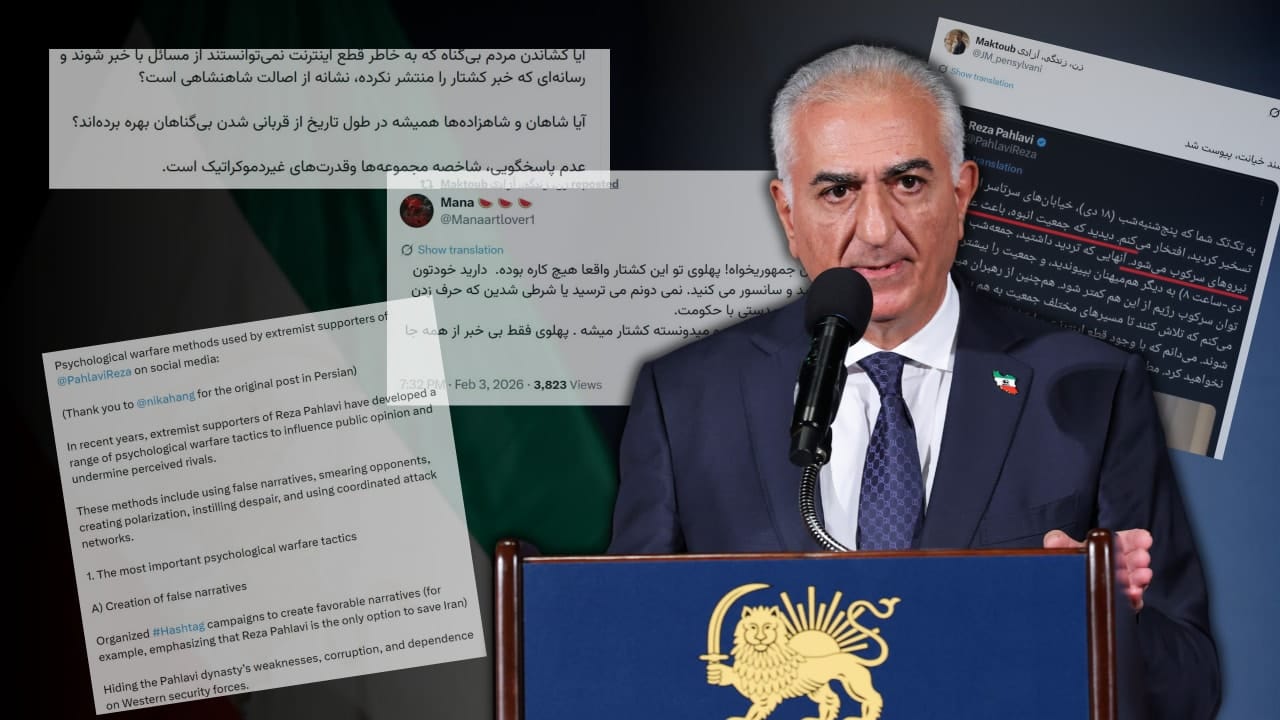
This level of opposition coordination has clearly rattled the regime. According to Saeed Ghasseminejad, an Iranian economist and senior adviser at the Foundation for Defense of Democracies who is part of the prince’s inner circle, Supreme Leader Ali Khamenei has “issued a directive” to mobilize the regime’s cyber apparatus against Pahlavi with a specific narrative: “that Prince Reza Pahlavi is responsible for the deaths of the protesters.”
An internal memo from Tasnim News Agency’s Strategic Center, which is linked to the Islamic Revolutionary Guard Corps, reveals the regime’s playbook for discrediting Pahlavi. According to the document, which was reported by Iran International, the regime’s strategy involves three main approaches: denying that Pahlavi has meaningful support inside Iran, distinguishing general anger at the regime from specific support for Pahlavi, and systematically undermining his credibility.
The memo advises portraying him not as a credible domestic leader but as a Western-backed figure, while framing the uprising as foreign-driven by the CIA and Mossad rather than stemming from genuine public dissatisfaction.
Khosro Isfahani, a senior analyst with the National Union for Democracy in Iran, explained to The Post how the regime manages its messaging during crises. Since 2009, Iran has developed a sophisticated system of information control, restricting broader public access to the internet while providing selected regime-aligned groups and individuals with unrestricted connectivity through “white SIM cards.”
“If you’re part of one of these incubators or circles, you can have more freedom — as long as, at critical moments, you echo the exact message coming from the regime,” Isfahani explained.
This coordinated messaging has been evident in past crises. When Iran shot down Ukraine International Airlines Flight 752 in January 2020, “regime insiders all pushed the same line: ‘This is probably an accident. Airbus planes are bad etc,'” according to Isfahani, “denying the evidence until the IRGC itself came out and accepted responsibility.”
The regime’s messaging approach has evolved with the current protests. “In the first week, the regime tried to frame this as legitimate protests over economic issues,” Isfahani noted. But when Pahlavi issued his call for coordinated protests, “the language these influence networks used changed immediately.”
Beyond human-coordinated messaging, research by Golden Owl identified a hierarchical influence system on X (formerly Twitter) with “originators” creating narratives and “amplifiers” distributing them. Their analysis of over 7,500 accounts found sustained “Anti-Pahlavi Campaigns” attempting to delegitimize the crown prince and constitutional monarchy advocates.
For Tehran, targeting Pahlavi isn’t simply about the man himself but about the existential threat he represents. After decades of leaderless protests that ultimately fizzled out, Iranians now have a figure who can coordinate street action, represent Iran internationally, and offer an alternative vision to the Islamic Republic—precisely the scenario the regime has long feared most.
Fact Checker
Verify the accuracy of this article using The Disinformation Commission analysis and real-time sources.

15 Comments
Production mix shifting toward Disinformation might help margins if metals stay firm.
Good point. Watching costs and grades closely.
Production mix shifting toward Disinformation might help margins if metals stay firm.
Good point. Watching costs and grades closely.
The cost guidance is better than expected. If they deliver, the stock could rerate.
Silver leverage is strong here; beta cuts both ways though.
Good point. Watching costs and grades closely.
Good point. Watching costs and grades closely.
Interesting update on Iran Initiates Digital Campaign to Undermine Reza Pahlavi’s Credibility. Curious how the grades will trend next quarter.
I like the balance sheet here—less leverage than peers.
Good point. Watching costs and grades closely.
Good point. Watching costs and grades closely.
Interesting update on Iran Initiates Digital Campaign to Undermine Reza Pahlavi’s Credibility. Curious how the grades will trend next quarter.
Good point. Watching costs and grades closely.
Good point. Watching costs and grades closely.