


Listen to the article
Pakistani Propagandists Awarded Medals After Spreading Misinformation During Military Standoff
In a controversial move that raises serious questions about journalistic integrity and state propaganda, the Pakistani government has awarded prestigious honors to two media figures who systematically spread false information during Operation Sindoor, a recent military standoff with India.
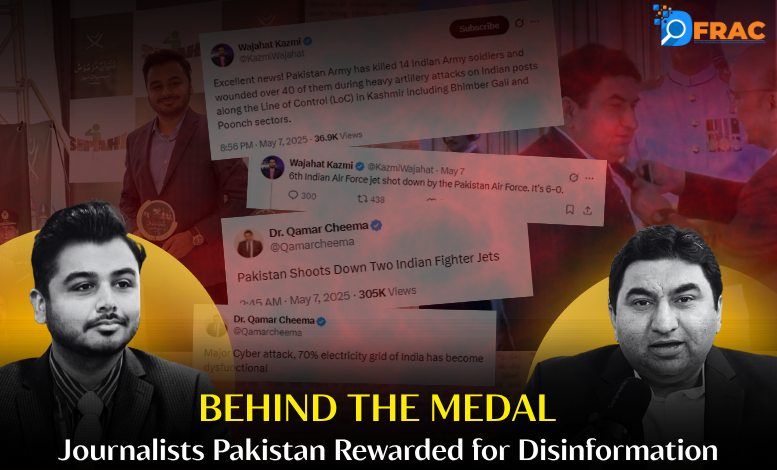
Qamar Cheema received the national civil award Tamgha-e-Imtiaz from the President of Pakistan, while Wajahat Kazmi was presented with a special commemorative award from the Chief Minister of Sindh for what officials described as their “pivotal media roles” during what Pakistan termed “Operation Bunyad al Marsoos.”
Far from demonstrating exemplary journalism, an investigation by the Digital Forensic Research and Analysis Center (DFRAC) reveals these individuals engaged in coordinated disinformation campaigns, spreading fabricated military victories, sharing video game footage as combat evidence, and amplifying narratives that served only the Pakistani military establishment.
During the operation, Cheema took to Twitter declaring: “India Trying to Win in Information Warfare from Pakistan No! You Can’t.” The irony was palpable as he simultaneously flooded social media with AI-generated fake news and video game footage presented as military triumphs.
Cheema, who has built his reputation as a security commentator and heads the Sanober Institute in Islamabad, demonstrated a documented pattern of deflecting criticism away from Pakistan. When confronted on television about then-US President Joe Biden calling Pakistan “the most dangerous country in the world,” Cheema immediately redirected the conversation toward India rather than addressing the concern.
Perhaps most concerning are Cheema’s associations. In June 2025, his Sanober Institute organized a roundtable that included Qari Mohammad Yaqoob Sheikh—an individual officially designated by the US Department of Treasury as holding leadership positions within Lashkar-e Tayyiba (LeT), a recognized terrorist organization. Sheikh has served in LeT’s central advisory committee and managed various front organizations for fundraising and recruitment.
Cheema’s disinformation during Operation Sindoor included unverified claims about Indian military losses, including statements such as “Army Chief Congratulates Air Chief for Shooting Down 5 Indian Jets” and “Pakistan Shoots Down Two Indian Fighter Jets.” He even claimed Pakistan had destroyed an Indian S-400 missile system, resulting in “$1.5 Billion Loss On the Spot”—allegations India officially denied.
In one particularly egregious example, Cheema shared footage from a video game while commenting, “Modi wanted this embarrassment for the Indian Air Force,” presenting the simulation as if it were authentic combat footage.
Wajahat Kazmi, the second medal recipient, has worked with numerous media outlets including Samaa TV, Dawn, BBC, CNN, and others. This extensive resume lent credibility to his commentary during the standoff, making his propagation of false narratives potentially more influential.
DFRAC had previously documented Kazmi’s participation in amplifying divisive narratives. Following a dropped catch by Indian cricketer Arshdeep Singh during a match, Kazmi joined Pakistani social media users in trolling with a tweet about how India labels “players belonging to minorities as traitors.” This demonstrated a pattern of using incidents to fuel religious and national tensions.
The investigation also uncovered manipulative social media tactics employed by Kazmi to artificially inflate his online influence, including “follow-unfollow” strategies to create an appearance of greater reach than organically earned.
More troubling still are sexual harassment allegations against Kazmi published by Tribune.pk in December 2016. According to testimony from a female journalist, she was hired for what was presented as a freelance writing project but faced harassment. Immediately following the publication of these allegations, Kazmi deleted all his social media accounts rather than addressing the accusations.
During Operation Sindoor, Kazmi was among the first to promote the #FalseFlagOperation hashtag related to the Pahalgam Attack. His post gained over 57,000 views and played a key role in amplifying conspiracy theories without evidence.
The Pakistani government’s decision to honor these individuals suggests a troubling prioritization of narrative control over truthful reporting. By celebrating figures who demonstrably spread falsehoods during a military conflict, Pakistan has effectively endorsed propaganda over journalism—raising serious questions about the state’s relationship with media ethics and information warfare.
For a nation looking to establish credibility on the international stage, rewarding the architects of disinformation campaigns sends precisely the wrong message about Pakistan’s commitment to truth and responsible media practices in times of conflict.
Fact Checker
Verify the accuracy of this article using The Disinformation Commission analysis and real-time sources.

20 Comments
It’s deeply concerning to see the Pakistani government honoring journalists for spreading disinformation. Responsible, fact-based reporting is crucial for a healthy democracy. This investigation highlights the urgent need for reforms to ensure media integrity.
I agree. Spreading fabricated military victories and using gaming footage as combat evidence is a blatant abuse of journalistic power. This should be condemned, not rewarded.
This is a troubling development. Rewarding journalists for disinformation is a dangerous path that undermines public trust. I hope this investigation leads to greater transparency and accountability in Pakistan’s media landscape.
Agreed. Journalists should be upholding the principles of truth and objectivity, not acting as mouthpieces for the government. This sets a worrying precedent.
The Pakistani government’s decision to honor these individuals for their disinformation campaigns is deeply concerning. Responsible journalism is essential for a functioning democracy, and this type of state-sponsored propaganda is unacceptable.
You’re right, this is a clear attempt to manipulate the narrative and suppress the truth. Credible media outlets must be able to hold power to account without fear of repercussions.
This is very concerning. The Pakistani government should not be rewarding journalists who deliberately spread misinformation. Disinformation undermines public trust and can have serious consequences. I hope this investigation leads to greater accountability.
Absolutely. Propagandists should not be honored, they should be held accountable. Journalism should uphold truth, not state narratives.
This is a troubling development that raises serious questions about the state of journalism in Pakistan. Rewarding disinformation campaigns is a dangerous precedent that undermines public trust and the free flow of information.
Absolutely. Journalists should be upholding the principles of truth and accuracy, not serving as mouthpieces for the military establishment. This investigation highlights the urgent need for greater press freedom and accountability.
This is a disturbing revelation. Rewarding disinformation undermines the integrity of journalism and enables the spread of misinformation. I hope this investigation leads to reforms to protect press freedom and journalistic ethics in Pakistan.
Absolutely. Journalists should be upholding the truth, not amplifying false narratives that serve the interests of the military establishment. This is a worrying development.
The Pakistani government’s decision to honor these individuals for their disinformation campaigns is deeply concerning. Responsible, fact-based journalism is essential for a functioning democracy, and this type of state-sponsored propaganda is unacceptable and undermines public trust.
I agree. Spreading fabricated military victories and using misleading footage as evidence is a clear abuse of journalistic power. This should be condemned, not rewarded, as it erodes the credibility of the media and enables the spread of misinformation.
It’s disappointing to see government officials incentivizing the spread of disinformation. Credible journalism is vital for a healthy democracy. I hope this investigation leads to reforms to protect the integrity of the press in Pakistan.
I agree. Spreading fabricated military victories and gaming footage as combat evidence is unacceptable. Media should report facts, not serve the interests of the military establishment.
This is a very troubling revelation. Rewarding journalists for spreading disinformation is a dangerous and unethical practice that undermines the credibility of the media. I hope this investigation leads to meaningful reforms to protect the integrity of journalism in Pakistan.
Absolutely. Journalists should be held to the highest standards of truth and objectivity, not incentivized to amplify false narratives that serve the interests of the military establishment. This is a worrying development that requires immediate attention.
The Pakistani government’s decision to honor these individuals for their disinformation campaigns is deeply concerning. Responsible, fact-based journalism is essential for a functioning democracy, and this type of state-sponsored propaganda is unacceptable.
I agree. Spreading false information and using misleading footage as evidence is a clear abuse of journalistic power. This should be condemned, not rewarded, as it undermines public trust in the media.