


Listen to the article
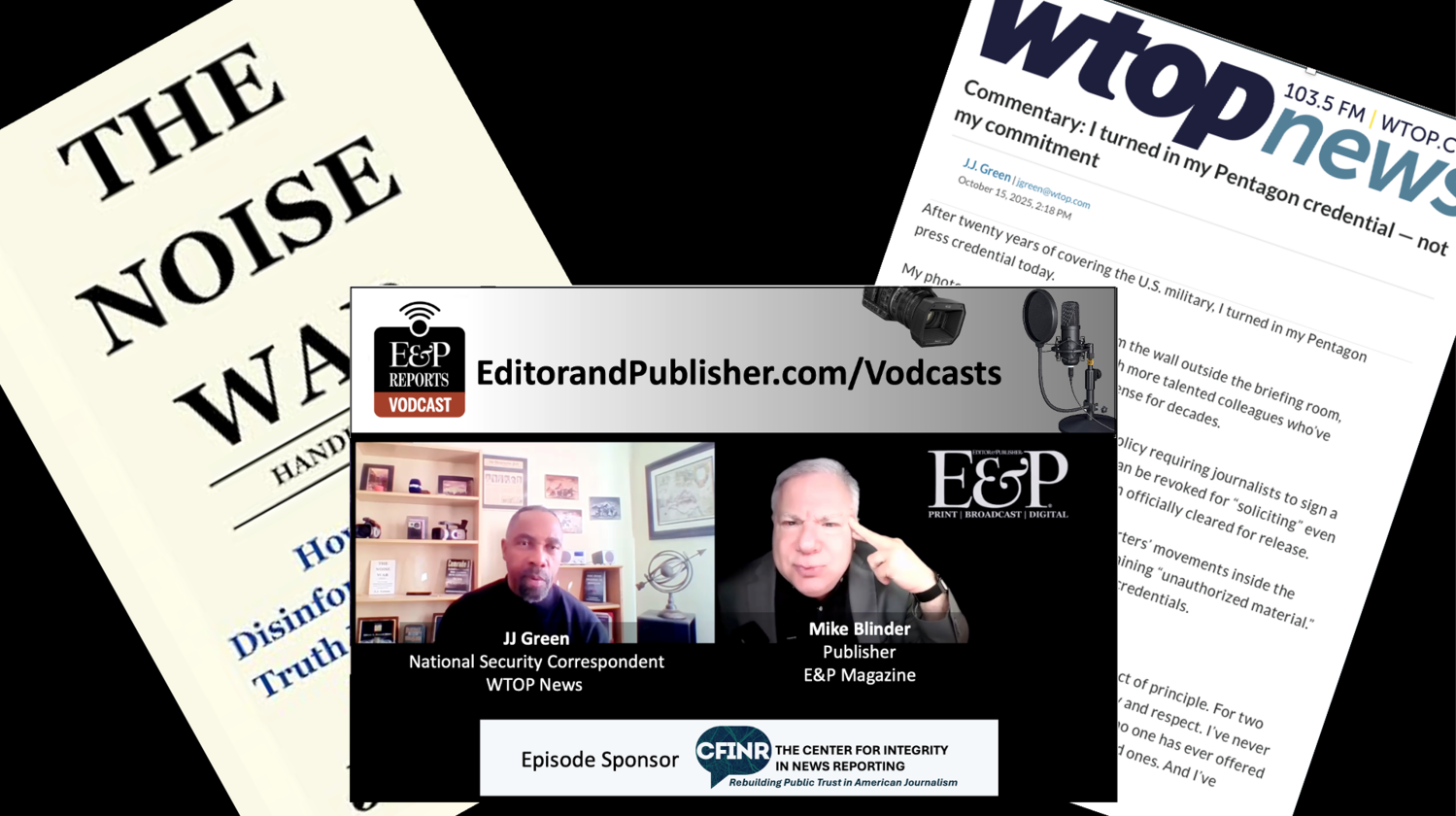
In his alarming new book, veteran war correspondent J.J. Green issues a stark warning: disinformation has become the most dangerous weapon of our time, waged against us daily in what he calls “the noise war.”
“Disinformation is the new WMD. It’s invisible, it’s instantaneous and it’s everywhere all at once,” says Green, whose three decades of reporting from conflict zones inform his latest work, “The Noise War: How to Fight Disinformation and Find the Truth When Everything Is Lying to You.”
Green’s message is urgent and unambiguous. The deliberate spread of false information isn’t just about twisting facts—it represents a comprehensive strategy deployed by hostile actors to exhaust and immobilize citizens and institutions. “Disinformation is not just somebody twisting words. It’s a whole lifestyle,” Green explains. “The foundation of disinformation are organizations and people who specialize in lies.”
This systematic approach to misinformation has already been embraced by authoritarian regimes in Russia, China, and North Korea, but Green emphasizes that the threat has now landed firmly on American shores. “Entire countries are beginning to embrace disinformation as a lifestyle and as a pattern to achieve their objectives,” he says. “This disinformation kills people. I mean, it literally can kill people.”
What makes modern disinformation particularly insidious, according to Green, is its psychological impact. The strategy isn’t necessarily to convince people of specific falsehoods, but rather to overwhelm them into apathy. “It’s designed to make you give up, trying to figure out what’s going on, exhausted with all of the chaos,” he notes.
The concept of a “noise war” describes how truth becomes impossible to discern amid the cacophony of conflicting narratives. This approach has historical precedents—Green cites propaganda techniques used by Hitler and Stalin—but today’s digital landscape has amplified its reach and impact exponentially.
“Flooding the zone is absolutely that—a fire hose, a stream,” Green says. “They’ll take both sides and give you things from both sides and get you thinking, arguing, bickering. And then at some point some just say, ‘You know what, forget it.’ They throw their hands up and just walk away.”
For Green, the threat became personal in October 2023, when he faced a critical professional dilemma at the Pentagon. “It was October 15th of last year when I had to walk outta the Pentagon and leave my press credentials behind,” he recounts, “or either that or sign a memo saying I’ll only report whatever the Pentagon clears and says I can.”
This moment crystallized his understanding that the disinformation crisis wasn’t abstract or distant—it had reached the heart of American journalism. “It was at that point that I realized disinformation was no longer what I knew it to be at arm’s length,” Green says. “This is an existential situation for journalism, not just around the world, but also here in the U.S.”
Green is careful to note that the problem transcends partisan politics. “It wasn’t because of the Trump administration,” he clarifies. “It was because of this pattern—this road that all the administrations in the U.S. had walked down for many years,” systematically controlling access and manipulating information flows.
Rather than merely diagnosing the problem, Green’s book offers practical strategies for journalists and citizens alike. He advocates for education about disinformation’s mechanics and impacts, and emphasizes the importance of “pre-bunking” rather than debunking false information.
“We have these debunking efforts where we go out and we try to knock down rumors and disinformation,” he explains. “And what we actually end up doing is we pump oxygen into it.” Instead, Green suggests preemptively preparing audiences: “If we understand or think that a disinformation wave may be coming, prep the audience for it. Tell them this may be coming.”
Perhaps his most innovative proposal draws inspiration from NATO’s collective defense doctrine. “One of the most important parts about this whole process of fighting disinformation is the Article Five approach,” Green says. “If one journalistic organization or journalist is attacked, all journalists should come to their aid, wherever they are in the world.”
Despite the gravity of his warnings, Green maintains a cautious optimism. “I am in that Pollyanna group,” he admits, “but I’m doing that with a very focused and a very real objective.” He acknowledges that emerging technologies like deepfakes will make the challenge more difficult, and that more political actors are embracing information warfare tactics.
The book itself is intended as a practical tool, not an academic exercise. “It’s not a book for the shelf,” Green insists. “It’s a book that you take and you lace up your boots with that book… It’s a book you stick in your backpack and you hit the streets and you start working using that.”
For Green, the future of journalism—and truth itself—depends on collective action in the face of these evolving threats. “All of us are going to have to fight for tomorrow’s future for journalism,” he concludes, “because what we’ve been looking at happening in foreign countries for years is home right here.”
Fact Checker
Verify the accuracy of this article using The Disinformation Commission analysis and real-time sources.

6 Comments
Important for journalists to have a playbook for identifying and countering disinformation. Fact-based reporting has never been more vital in an age of information overload and manipulation.
Fascinating insights into the dangerous rise of disinformation. Journalists play a vital role in combating this threat to truth and democracy. Fact-checking and transparency will be critical in the ‘noise war’.
Disinformation as a ‘lifestyle’ – that’s a chilling concept. Journalists will need innovative strategies to stay ahead of bad actors weaponizing lies. Rigorous standards and public trust will be their strongest defenses.
Disinformation seems to have become a go-to tactic for authoritarian regimes. Concerning to see it taking root in the US as well. Robust journalistic standards and public awareness will be key to pushing back.
Agreed, this ‘noise war’ requires vigilance from both the media and citizens. Verifying sources and resisting the temptation to spread unconfirmed claims will be essential.
Troubling to see disinformation becoming a go-to tactic globally. Journalists have a responsibility to be beacons of truth, cutting through the ‘noise’ with verifiable facts. Their role in safeguarding democracy is critical.