


Listen to the article
Bangladesh’s government has accused Indian media and the former ruling party of orchestrating a disinformation campaign against the interim administration, raising concerns about cross-border tensions and media ethics.
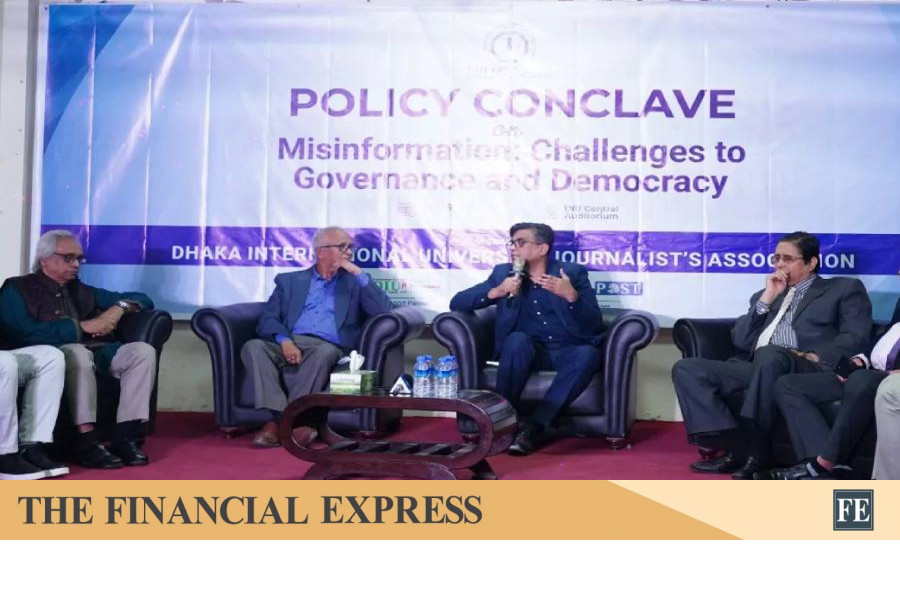
Speaking at a policy conclave on Monday, Chief Adviser’s Press Secretary Shafiqul Alam claimed that “India is deliberately spreading misinformation and disinformation” about Bangladesh, citing publications from prominent Indian news outlets, including one of India’s most widely read Bengali-language dailies.
“For the first time in 18 months, we have observed Indian media circulating alarming false narratives about Bangladesh,” Alam said at the event hosted by Dhaka International University Journalists’ Association. “No government in our 54-year history has faced such a situation. They spread lies every day, fuel hatred, and even major Indian dailies and television channels are involved.”
The accusations come amid Bangladesh’s political transition following the ousting of Prime Minister Sheikh Hasina’s Awami League government in August after mass protests. The interim government, led by Nobel laureate Muhammad Yunus, has been working to establish stability while promising democratic reforms and new elections.
According to Alam, the disinformation campaign presents a “serious threat to our government and democracy” at a critical juncture for Bangladesh. He expressed particular concern about foreign narratives suggesting that religious minorities would face threats even after democracy is restored in the country.
Bangladesh and India have historically maintained close ties, with the Awami League government fostering strong relations with New Delhi during its 15-year rule. The current allegations could signal growing diplomatic tensions between the neighboring countries as Bangladesh charts a new political course.
Media experts at the event highlighted broader challenges facing journalism in the digital era. Dhaka International University Vice-Chancellor Professor Dr. Zahidul Islam pointed to artificial intelligence as a factor that has “significantly amplified disinformation, leaving the state confused and vulnerable.”
Dr. Sheikh Mohammad Shafiul Islam, who chairs DIU’s Media Studies Department, described misinformation as a “structural crisis reinforced by social media algorithms, political polarization and weak media literacy.” He advocated for comprehensive solutions involving media policy reforms, education initiatives, and critical thinking development.
Daily Protidin Editor Maruf Kamal Khan offered self-reflection on the media’s role, suggesting that Bangladesh’s press had previously failed its responsibility to represent ordinary citizens. “We often talk about the ‘media,’ but for a long time we failed to speak for the common people. Instead, we promoted one side and tried to eliminate the other, which itself contributed to misinformation,” he said.
Khan added that despite the end of what he termed a “fascist system,” the media has not fully transformed its approach, calling for journalism that truly represents public interests.
The allegations come at a time when Bangladesh is navigating complex political terrain. Since the formation of the interim government, the country has been working to address economic challenges, restore public trust in institutions, and prepare for elections that would return the nation to democratic governance.
The event concluded with the presentation of the M I Patwari Best Reporting Awards to four journalists for excellence in reporting for 2025.
Media analysts note that accusations of cross-border disinformation campaigns reflect growing concerns about information warfare in South Asia, where historical rivalries and current geopolitical interests often shape media narratives across national boundaries.
Fact Checker
Verify the accuracy of this article using The Disinformation Commission analysis and real-time sources.

8 Comments
This is a delicate situation that could have implications for the mining, energy, and commodities sectors in Bangladesh and the broader region. I hope the interim government and media outlets can find a constructive path forward.
As a commodity-focused observer, I’m curious to see how this political situation in Bangladesh may impact the mining, energy, and natural resource sectors there. Transparency and reliable information will be key.
While I don’t have a strong opinion on the specifics of this situation, I think it’s important for all media outlets to strive for accuracy and objectivity, especially when reporting on complex geopolitical matters.
Interesting to see the allegations of disinformation coming from the Bangladesh government. Cross-border media disputes can be tricky, but maintaining transparency and facts is crucial for stability.
The allegations of Indian media and the Awami League spreading disinformation about Bangladesh raise important questions about regional geopolitics and journalistic integrity. I hope all sides can focus on facts and de-escalation.
Absolutely. Maintaining open and honest dialogue between neighboring countries is crucial, especially when it comes to sensitive political and economic issues.
The political transition in Bangladesh seems complex, with concerns around media ethics and cross-border tensions. I hope the interim government can establish stability while upholding democratic principles.
Agreed. Establishing the truth and avoiding the spread of harmful disinformation will be critical during this sensitive period for Bangladesh.