


Listen to the article
Hungary’s Pivotal Election Reveals Deeper Political Transformation
As Hungary approaches its April 2026 parliamentary election, the country finds itself at the epicenter of overlapping crises that extend far beyond its borders. Widely considered the most consequential vote since Hungary’s democratic transition, the election carries significant implications not only for domestic governance but also for European Union cohesion and Russia’s influence across the continent.
The contest is shaping up as more than a typical electoral battle between government and opposition. Hungary has evolved into a revealing case study of how political power, foreign policy maneuvering, and disinformation can merge into a cohesive governance system with far-reaching consequences.
Viktor Orbán’s political evolution provides crucial context for understanding Hungary’s transformation. Emerging in 1989 as a liberal reformer who demanded Soviet troop withdrawal and free elections, there was little indication he would later become one of Europe’s most prominent critics of liberal democracy. Former allies describe Orbán as driven less by fixed ideology than by political pragmatism and power consolidation. His repositioning of Fidesz from a liberal youth movement to a national-conservative party in the 1990s was strategically calculated, allowing him to occupy less crowded political space and build a more loyal base.
Since returning to power in 2010, Orbán has overseen comprehensive restructuring of state institutions. Constitutional revisions, judicial reforms, and reconfiguration of media and electoral systems have collectively weakened checks and balances. While elections remain formally competitive, the institutional environment has lost neutrality. Democracy hasn’t been abolished but transformed into a system where political competition operates within increasingly narrow parameters.
The system is specifically designed to outlast electoral cycles, creating hurdles for potential opposition victories. Even Péter Magyar’s rising Tisza party acknowledges that ballot box success wouldn’t necessarily translate to effective governance. Key institutions – from the constitutional court to regulatory bodies and public media – are widely regarded as staffed with ruling party loyalists.
Influence networks extend beyond formal government structures into foundations and state-linked enterprises like the Mathias Corvinus Collegium and energy company MOL, where political and economic power intersect. This creates a form of entrenchment that is both institutional and systemic, making meaningful change difficult even if electoral power shifts.
Hungary’s foreign policy has undergone a parallel transformation. While maintaining formal NATO and EU commitments, the government has cultivated increasingly close ties with Russia. This shift began with pragmatic economic cooperation, notably the 2014 agreement with Moscow to expand the Paks nuclear power plant, but has since developed a more political dimension.
Hungary consistently positions itself as an EU outlier on Russia and Ukraine policies, delaying or blocking collective decisions including financial support packages for Kyiv. Recent reports that Foreign Minister Péter Szijjártó maintained communication with Russian counterpart Sergey Lavrov during EU meetings have further eroded trust, with European diplomats now reportedly limiting information shared with Hungary.
This external positioning extends beyond Russia relations. U.S. Vice President JD Vance’s recent Budapest visit during the campaign season has been widely interpreted as support for Orbán’s government, reinforcing connections with like-minded conservative political actors across the Atlantic. Such alignments provide Orbán with symbolic validation and additional external reference points that complement his sovereignty-focused narrative.
In the current campaign, foreign policy narratives play a central role. The government frames Hungary as a country under threat, leveraging historical memories of external domination. Ukraine is portrayed as destabilizing, the EU as overreaching, and the opposition as aligned with foreign interests. Campaign messaging explicitly portrays Magyar as a Brussels and Kyiv proxy, resonating particularly with older and rural voters while creating generational divides within Hungarian society.
Disinformation amplifies this framework through a media landscape dominated by pro-government voices. Simultaneously, Hungary has become a target for external disinformation campaigns linked to pro-Kremlin networks, including fabricated videos and false claims about assassination plots or violent uprisings. Unlike earlier reactive disinformation efforts, current operations appear proactively designed to shape the narrative environment.
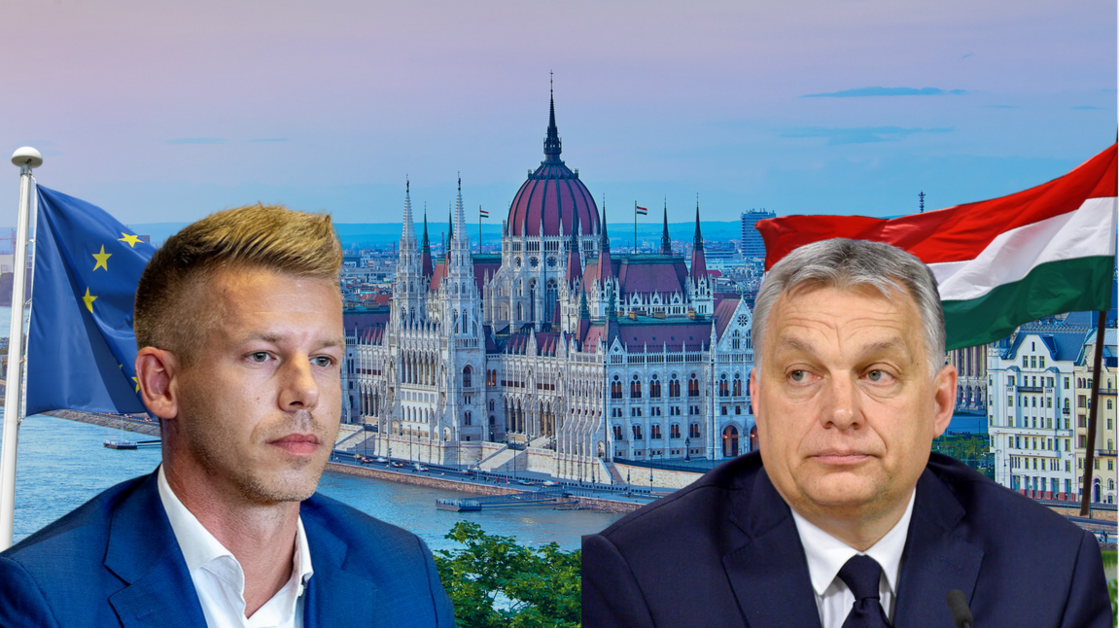
The highly polarized contest between Orbán and Magyar centers on competing visions of sovereignty versus systemic change. While Magyar promises “true regime change” focused on corruption, governance reform, and European reorientation, the contest occurs under asymmetrical conditions where Orbán’s institutional control and media influence provide structural advantages.
Independent journalism faces increasing pressure, with investigative reporters subjected to surveillance, legal accusations, and smear campaigns. In one high-profile case, journalist Szabolcs Panyi, known for reporting on Russian influence, was accused of espionage by the government and claims Hungarian intelligence services monitored his communications to construct a campaign discrediting his work.
For the European Union, Hungary presents a complex challenge beyond policy disagreements, affecting the integrity of the bloc’s internal processes and inter-member trust. When sensitive information is withheld, common decisions obstructed, and external actors exploit divisions, the EU’s collective action capacity weakens – already visible in Ukraine support, sanctions policy, and internal trust dynamics.
As the election approaches, polls suggest a competitive race with the opposition gaining ground among younger voters. Yet regardless of the outcome, the underlying power structures remain the defining factor in Hungary’s political future. The fundamental question extends beyond electoral winners to whether the system itself can be meaningfully transformed. Hungary stands as a case study in 21st century political power consolidation, maintenance, and legitimization – with lessons that may prove relevant elsewhere in Europe.
Fact Checker
Verify the accuracy of this article using The Disinformation Commission analysis and real-time sources.

11 Comments
This election in Hungary will be fascinating to watch. Orbán has certainly taken the country in a more authoritarian direction, but it will be interesting to see if he can maintain his grip on power amidst the various crises facing the country.
Agreed, Hungary’s trajectory under Orbán has been concerning from a democratic standpoint. It will be telling to see if the opposition can mount a serious challenge this time around.
This election will have significant implications not just for Hungary, but for the EU and Russia’s influence in the region. The article highlights the complex interplay of domestic politics, foreign policy, and disinformation that is shaping the country’s trajectory.
Absolutely. Hungary’s position as a member of the EU but also with close ties to Russia makes it a strategic battleground. The outcome of this election could have far-reaching consequences.
The article raises important questions about the nature of Orbán’s political ideology and motivations. It seems his drive for power and consolidation of authority has superseded any fixed ideological beliefs. This is a concerning trend.
Yes, the pragmatic approach to power described in the article is troubling. It suggests Orbán is more interested in maintaining his grip on power than upholding democratic principles and institutions.
This election will be a crucial test for Hungary’s democracy. The country’s evolution under Orbán’s leadership has been a worrying departure from the liberal democratic path it initially embarked upon after the fall of the Soviet Union.
The article highlights how Hungary has become a revealing case study of the blending of political power, foreign policy, and disinformation. This is a concerning trend that bears close monitoring, not just in Hungary but across Europe.
Absolutely. The potential for disinformation to shape political outcomes is a serious threat to democracy that we need to grapple with. Maintaining the integrity of the electoral process is crucial.
I’m curious to see how Orbán’s political evolution and consolidation of power will play out in this election. His shift from liberal reformer to critic of liberal democracy is a fascinating and troubling transformation.
Yes, Orbán’s trajectory is a cautionary tale about the fragility of democratic institutions and the ease with which they can be eroded. I hope the Hungarian people are able to make their voices heard.