


Listen to the article
Former Vice President Harris Discusses New Book, Democracy Concerns at Cleveland Event
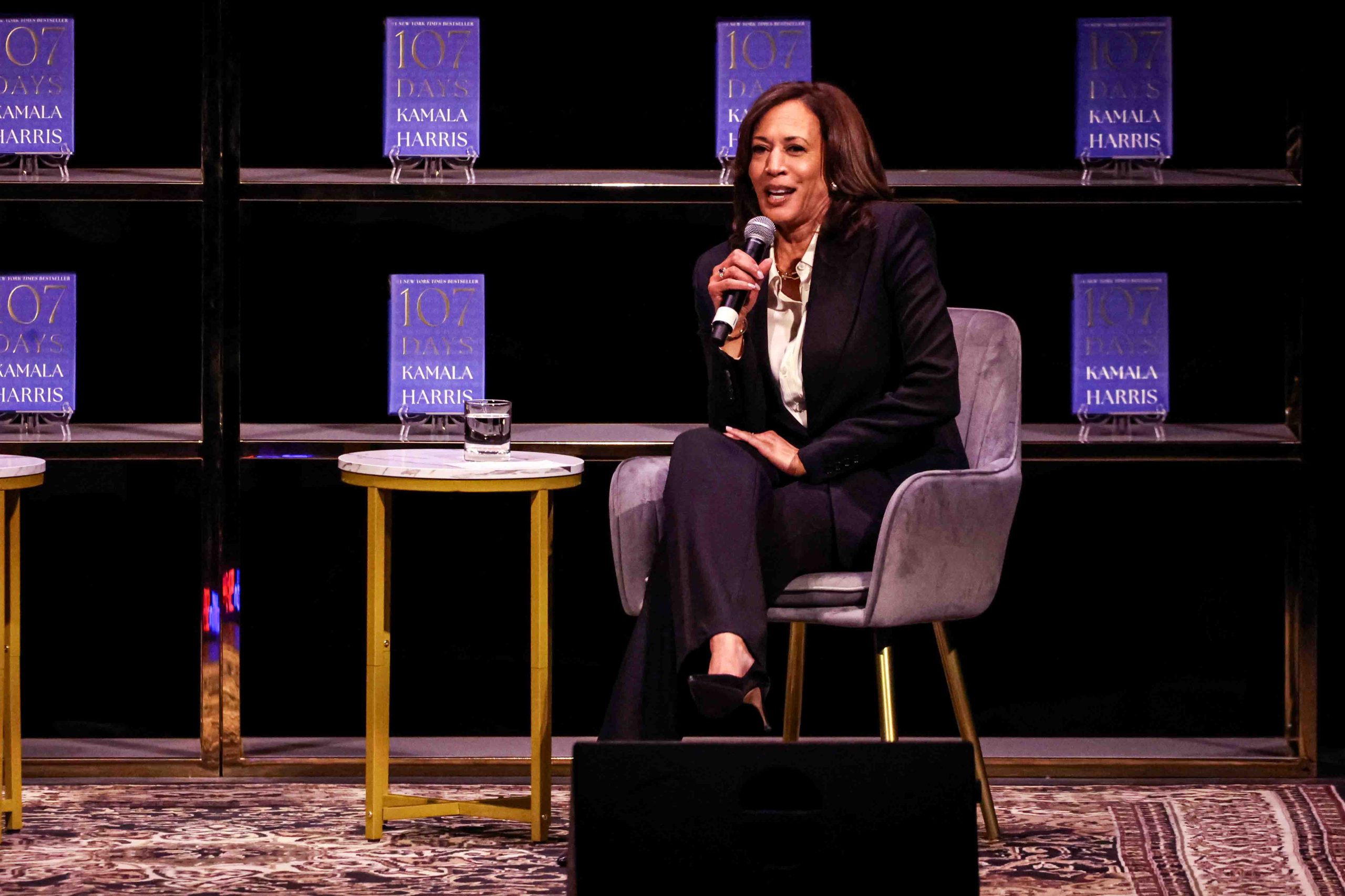
Former Vice President and 2024 Democratic presidential nominee Kamala Harris addressed a sold-out crowd at Cleveland’s Playhouse Square during her nationwide book tour promoting “107 Days,” which chronicles her presidential campaign—the shortest in American history.
Cleveland native and comedian Phoebe Robinson moderated the evening’s conversation, which frequently returned to Harris’s central theme of community and its importance in addressing national challenges.
Harris began by critiquing President Donald Trump’s recent State of the Union address, arguing that his administration has failed to address problems facing everyday Americans. She specifically highlighted what she described as a trillion-dollar cut to programs like Medicaid to fund tax cuts for wealthy Americans.
“With every abuse of power that we’re seeing, the founders knew that one day there would be a situation like this,” Harris said. She expressed concern that Congress has “abdicated its responsibility to the American people” by failing to provide effective checks and balances against presidential power.
The former Vice President emphasized that Congress has two essential constitutional duties—control of government spending and the authority to declare war—which she believes have been “neglected” under the current administration.
Looking ahead to the November midterm elections, Harris expressed hope that voters might “bring back a semblance of balance” to government. Her comments drew enthusiastic cheers from the audience.
Harris also addressed concerns about voting rights and election integrity, specifically referencing controversial redistricting efforts in Republican-led states. She suggested these gerrymandering attempts might backfire as “more and more people are seeing up close how their rights are being taken away from them.”
The conversation turned to recent election law changes, with Harris claiming the SAVE Act would disproportionately affect people of color and women whose birth certificates may not match their married names. “Forty percent of Americans would not have the proper documents to qualify to vote under the new legislation,” Harris stated.
Throughout the evening, Harris repeatedly emphasized community involvement as an antidote to political challenges. “When the people show up and vote, we will demand change. We will demand that the government serve the people and not the special interests,” she said.
One of the most resonant portions of the evening focused on post-pandemic isolation. Harris noted that since her election loss, people across the country have expressed feeling alone. “Nothing is more disenfranchising than feeling alone,” she observed, suggesting that community connections through local leaders like mayors, pastors, and community organizers represent a path forward.
Harris expressed concern about growing distrust among Americans that extends beyond physical safety to existential fears. “There’s an extraordinary amount of distrust among the American people. It’s not just ‘Can I leave my door unlocked?’ But are you an existential threat to my existence?”
When asked about the increasingly divisive nature of political discourse, Harris referenced her Senate experience investigating Russian interference in the 2016 election. She discussed how social media has democratized information access but also lowered barriers to spreading misinformation.
Harris concluded with a call for establishing common factual ground in conversations. “We need to approach any conversation that at first is a query: What information are you working with?” she said. “We need to agree that two plus two equals four, for instance… we have to agree on the same information in order to engage each other in a meaningful way.”
The event highlighted Harris’s continued engagement in national political conversations despite her electoral defeat, with her emphasis on community, voting rights, and information integrity resonating strongly with the Cleveland audience.
Fact Checker
Verify the accuracy of this article using The Disinformation Commission analysis and real-time sources.

11 Comments
The discussion on disinformation and its impact on the democratic process is a critical one. I’m glad to see Harris addressing these concerns directly. However, I would encourage a more nuanced approach that acknowledges the complexities of the issues and the need for bipartisan solutions.
Agreed. Disinformation is a complex challenge that requires a thoughtful, evidence-based approach that transcends partisan divides. I hope Harris can offer a constructive path forward that brings diverse stakeholders together.
While I appreciate Harris’s efforts to engage with the community, I can’t help but feel that the event has a strong partisan undertone. It’s important to address these issues in a balanced and inclusive manner that brings people together, rather than further divides them.
As someone with a background in the mining and energy sectors, I’m interested to hear Harris’s perspective on how these industries intersect with the broader issues of disinformation and community impact. It’s a delicate balance, and I hope she can provide a nuanced and inclusive approach.
This is a timely discussion on the challenges facing democracy and the need for stronger checks and balances. Harris raises some valid concerns about the current state of affairs. I’m curious to learn more about her proposed solutions to address the issues of disinformation and abuse of power.
Agreed, the issues of disinformation and accountability are critical for the health of our democratic institutions. Harris’s book seems to offer a firsthand perspective on these pressing matters.
While I appreciate Harris’s efforts to engage the community and address important issues, I remain somewhat skeptical of the partisan framing. It’s important to look at these problems objectively and consider solutions that can bring people together, not further divide them.
That’s a fair point. Maintaining non-partisanship and finding common ground will be key to making real progress on these complex challenges.
Harris’s remarks on the need to reinforce checks and balances resonate with me. Protecting democratic norms and institutions should be a top priority for all elected officials, regardless of party affiliation. I’m curious to hear more about the specific policy proposals she has in mind.
As someone interested in mining and energy issues, I’m curious to see how Harris addresses the intersection of these sectors with the broader challenges of disinformation and community impact. It will be interesting to hear her perspective on balancing economic concerns with democratic values.
Good point. The energy and mining sectors are deeply intertwined with many of the political and social issues we’re facing. Harris’s approach to reconciling these complex dynamics will be an important part of the discussion.