


Listen to the article
German Chancellor Friedrich Merz has accused Russia of attempting to interfere in Armenia’s upcoming parliamentary election through a coordinated disinformation campaign designed to undermine the country’s growing alignment with the European Union.
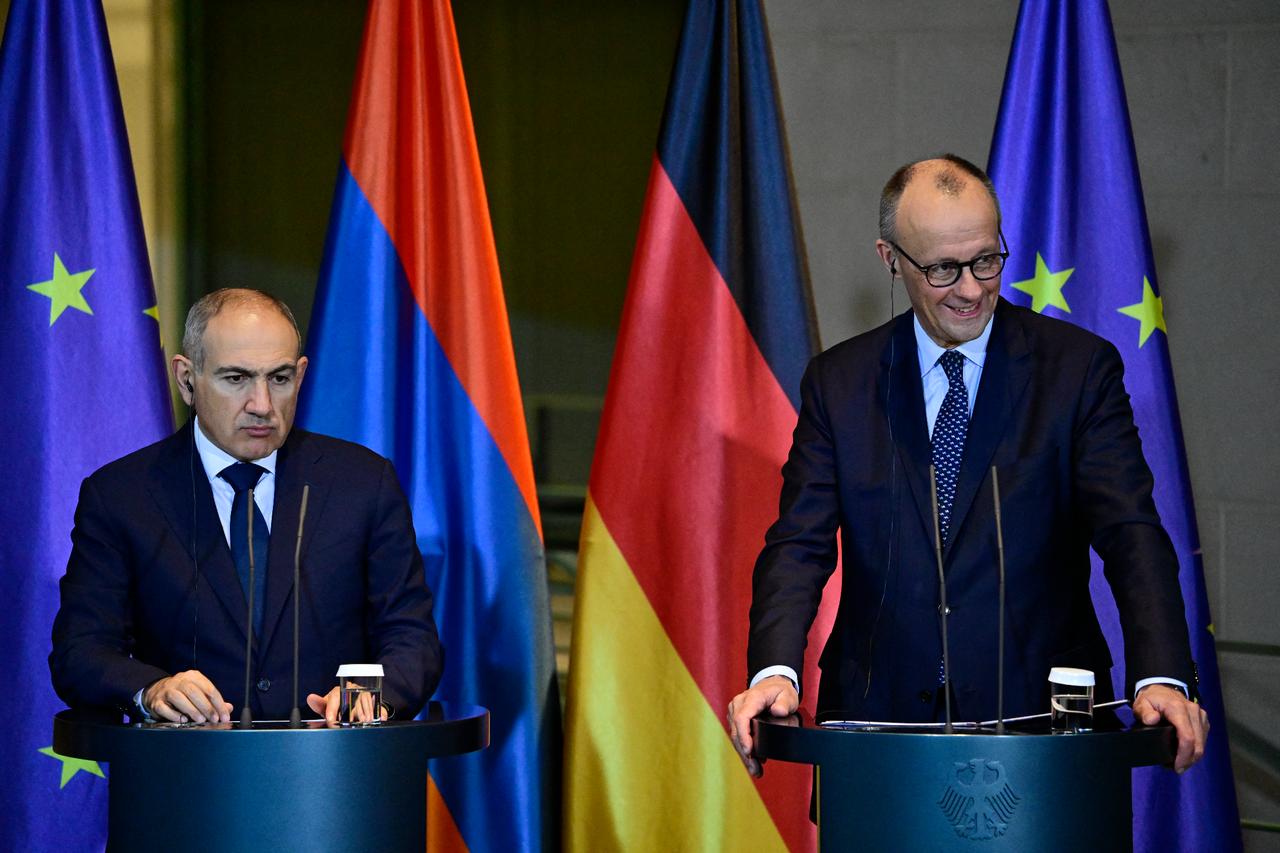
During a joint press conference with Armenian Prime Minister Nikol Pashinyan in Berlin on Tuesday, Merz claimed Moscow is actively working to manipulate Armenian voters as the country pursues closer European integration.
“Russia is trying to scare voters in Armenia,” Merz said. “They are spreading untruths about the goals and values of the European Union.”
The German leader characterized these alleged actions as part of a wider Russian strategy to destabilize democratic processes across Europe and its periphery. “It has become a distressing normality that elections are attacked by enemies of democracy,” Merz noted, adding that Moscow employs “disinformation and sabotage” tactics against both European nations and Armenia.
Armenia has been steadily distancing itself from Russia’s sphere of influence, despite historically close ties dating back to the Soviet era. The Armenian parliament took a decisive step in March by passing legislation formally launching the country’s bid for EU membership, signaling a dramatic shift in its geopolitical orientation.
Pashinyan, speaking through a translator provided by the German chancellery, acknowledged the challenges his country faces in protecting its democratic institutions. He referenced Armenia’s experience conducting elections “under very difficult circumstances” in 2021 and noted the country’s familiarity with countering disinformation campaigns.
The alleged Russian interference comes amid heightened concerns about Moscow’s covert operations across Europe. Western intelligence agencies have documented an increase in drone flights, sabotage attempts, cyberattacks, and disinformation campaigns attributed to Russia since its full-scale invasion of Ukraine in 2022.
While expressing support for Armenia’s European aspirations, Chancellor Merz emphasized that joining the EU would require substantial reforms. He described Armenia’s westward pivot as “a historic opportunity” but stressed that the country must “meet many conditions to join the European Union, including the Copenhagen criteria.”
Established in 1993, these criteria mandate that candidate countries demonstrate stable democratic institutions, maintain a functioning market economy, and prove their ability to adopt and implement EU laws and regulations—representing significant hurdles for the Caucasus nation.
Armenia’s geopolitical realignment occurs against the backdrop of improved relations with neighboring Azerbaijan. Following decades of territorial conflict over the disputed Nagorno-Karabakh region, the two countries signed a peace agreement in August under the auspices of the United States.
The conflict between Armenia and Azerbaijan has been one of the most intractable in the post-Soviet space, erupting into multiple wars since the collapse of the Soviet Union. The most recent major hostilities took place in 2020, resulting in significant territorial changes that largely favored Azerbaijan.
Russia, which has historically served as Armenia’s security guarantor and maintains a military base in the country, has seen its influence wane as Yerevan seeks new partnerships. Moscow’s inability or unwillingness to intervene decisively on Armenia’s behalf during recent conflicts with Azerbaijan has accelerated this shift.
For the European Union, Armenia’s interest represents an opportunity to extend its influence in a strategically important region. However, the bloc faces the challenge of supporting Armenia’s democratic transition while managing relations with Russia, which views the Caucasus as part of its traditional sphere of influence.
As Armenia prepares for parliamentary elections, the allegations of Russian interference highlight the high stakes of the country’s geopolitical reorientation and the obstacles it faces in charting an independent course between competing regional powers.
Fact Checker
Verify the accuracy of this article using The Disinformation Commission analysis and real-time sources.

19 Comments
The cost guidance is better than expected. If they deliver, the stock could rerate.
Good point. Watching costs and grades closely.
Good point. Watching costs and grades closely.
Nice to see insider buying—usually a good signal in this space.
I like the balance sheet here—less leverage than peers.
Good point. Watching costs and grades closely.
Exploration results look promising, but permitting will be the key risk.
Nice to see insider buying—usually a good signal in this space.
Good point. Watching costs and grades closely.
Silver leverage is strong here; beta cuts both ways though.
Silver leverage is strong here; beta cuts both ways though.
Good point. Watching costs and grades closely.
Good point. Watching costs and grades closely.
Nice to see insider buying—usually a good signal in this space.
Interesting update on Germany Warns Russia of Disinformation Campaign to Influence Armenian Election. Curious how the grades will trend next quarter.
Good point. Watching costs and grades closely.
Nice to see insider buying—usually a good signal in this space.
Silver leverage is strong here; beta cuts both ways though.
Good point. Watching costs and grades closely.