


Listen to the article
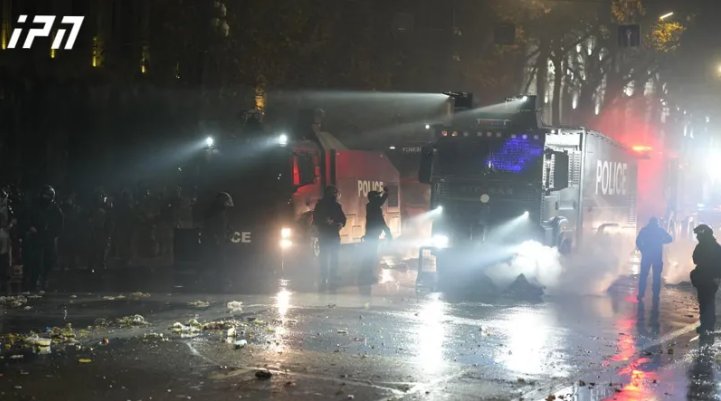
Police officials announced Monday that tear gas, not a World War I-era chemical weapon, was used during protests in Georgia last year, contradicting a BBC report that claimed more harmful substances were deployed against demonstrators.
Prime Minister Irakli Kobakhidze announced plans to file a formal complaint against the BBC, accusing the British broadcaster of spreading false information about police tactics during the anti-government demonstrations. Kobakhidze said the government would first appeal to the UK’s media regulator before potentially taking the case to court.
“We will use every legal avenue against the BBC so that the broadcaster will have to apologize,” Kobakhidze told university students during a meeting where he addressed the controversy.
The dispute centers on a December 1 BBC investigation that alleged Georgian police had used harmful chemicals, including a substance referred to as “Camit” – described as a World War I-era chemical weapon – in water cannons to disperse protesters. The BBC report cited self-reported symptoms from demonstrators and claims from former security officials.
Interior Minister Aleksandre Darakhvelidze rejected these allegations on Monday, stating that a State Security Service investigation confirmed only standard tear gas was used in the water cannons during last year’s demonstrations.
When questioned about allegations that trichloroethylene, a carcinogenic solvent, had been mixed into the water, Kobakhidze dismissed the claim, arguing that such a dangerous substance would have resulted in far more hospitalizations. He noted that only five people were treated for mild intoxication and quickly discharged.
The controversy has further strained already tense diplomatic relations between Georgia and the United Kingdom. During the student meeting, Kobakhidze responded to recent comments by the British ambassador, who had attributed deteriorating bilateral relations to what he characterized as anti-democratic pressure on opposition groups and civil society organizations in Georgia.
In parliament, Speaker Shalva Papuashvili escalated the rhetoric, accusing the UK ambassador of actively participating in a political campaign against Georgia’s government by spreading what he termed disinformation. According to the Georgian newspaper Rezonansi, Papuashvili suggested the BBC report might be part of a “hybrid operation” potentially involving the British state, rather than independent journalism.
“This suspicion is fueled by what appears to be the ambassador’s personal involvement in spreading disinformation,” Papuashvili said.
The dispute occurs against a backdrop of growing concerns about Georgia’s democratic trajectory. The ruling Georgian Dream party, which maintains close ties with Russia, has faced international criticism for policies that opponents claim undermine democratic institutions and threaten the country’s aspirations for European Union membership.
Last year’s protests erupted over contentious political issues, with demonstrators accusing the government of authoritarian tendencies. The use of water cannons and crowd control measures during these demonstrations became a flashpoint in the ongoing political tensions.
Kobakhidze also dismissed various claims circulating on social media regarding the effects of the alleged chemicals, including what he described as an absurd story about a parrot supposedly affected by substances used during the protests.
The Georgian government’s move to potentially take legal action against the BBC represents a significant escalation in its response to international media coverage of its domestic affairs, and signals growing sensitivity to external criticism of its governance and security practices.
Fact Checker
Verify the accuracy of this article using The Disinformation Commission analysis and real-time sources.

8 Comments
This highlights the challenges of verifying information, especially in a charged political climate. Both sides appear to have their own narratives, and it will be important to get to the bottom of the facts through a fair and impartial process.
Agreed. The use of potentially harmful chemical agents against protesters is a serious allegation, so it’s critical that the truth comes to light. I hope the legal process can resolve this dispute in a transparent manner.
Interesting case of alleged disinformation. The Georgian government seems determined to push back on the BBC report, citing use of tear gas rather than more harmful substances. It will be worth following the potential legal action and the BBC’s response.
I’m curious to see how this plays out. The government’s claims seem plausible, but the BBC report cited eyewitness accounts. Hopefully an objective investigation can shed light on what actually occurred during the protests.
The Georgian government’s threat of legal action against the BBC is a concerning development for press freedom. While I understand their desire to correct perceived inaccuracies, this could set a worrying precedent if taken too far.
You raise a good point. Media outlets should be able to report on sensitive issues without fear of retaliation, as long as they adhere to journalistic standards. This will be an important test case for balancing national interests and freedom of the press.
This dispute seems to reflect broader tensions between the Georgian government and the media. It will be interesting to see if the legal action against the BBC leads to a substantive review of the facts or becomes more of a political battle.
That’s a fair assessment. The government’s claims of disinformation should be scrutinized, but the BBC report also needs to be examined carefully. An independent, impartial investigation would be the best way to resolve this issue.