


Listen to the article
Deepfake Exposed: France 24 Never Aired Report on Anti-Pakistan Disinformation Campaign
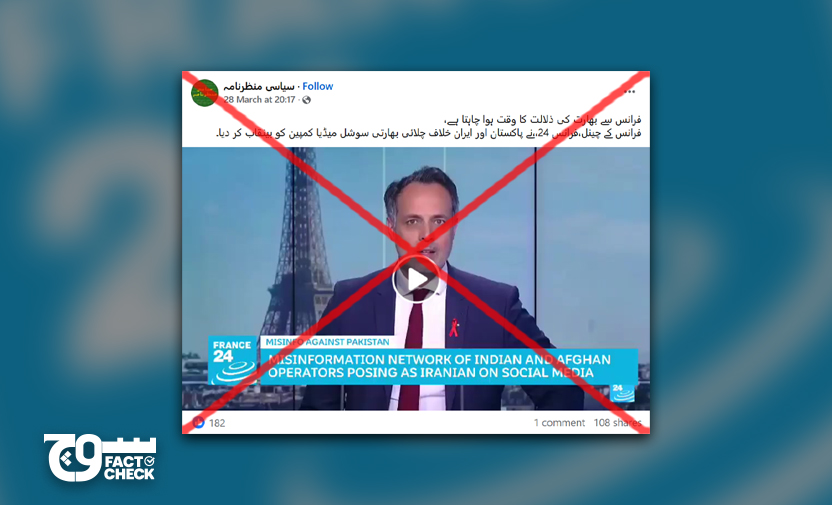
A sophisticated deepfake video falsely attributed to France 24 has been circulating widely across social media platforms, claiming to expose Indian and Afghan networks posing as Iranian users to undermine Pakistan’s diplomatic efforts.
In the manipulated clip, a presenter identified as William Hilderbrandt appears to discuss a “highly-coordinated” disinformation campaign targeting Pakistan, specifically designed to derail Islamabad’s mediation efforts between the United States and Iran. The video suggested these networks were adopting fake Iranian identities to inject false narratives into regional diplomatic channels.
Multiple Pakistani media outlets, including state-run Associated Press of Pakistan (APP) and Pakistan Television Corporation (PTV), shared the fabricated report on March 28, 2026, giving it an air of legitimacy. The story gained further traction when prominent figures, including ruling Pakistan Muslim League-Nawaz Senator Abid Sher Ali and HUM News Investigations Editor Zahid Gishkori, shared the clip on their social media accounts.
However, detailed analysis reveals the video is an AI-generated deepfake that manipulated genuine footage of France 24 journalist William Hilderbrandt.
Technical examination of the video revealed numerous tell-tale signs of digital manipulation. The presenter’s mouth appears blurred in the first seven seconds, the Eiffel Tower in the background vanishes at certain points, and lip movements frequently fall out of sync with the audio. Even the on-screen graphics differ from France 24’s standard format, displaying a solid blue chyron instead of the network’s typical translucent design.
Multiple deepfake detection tools confirmed the video’s inauthenticity. The Deepfake-O-Meter tool indicated up to 99.9% probability that the video was AI-generated, with audio analysis showing an even higher likelihood of manipulation at 100%. Similarly, Northwestern University’s Global Online Deepfake Detection System (GODDS) determined both visual and audio components were likely fake.
Sound engineering experts further identified critical flaws in the audio. The clip failed to meet European Broadcasting Union standards for broadcast audio, lacked natural breathing patterns, and contained an impossibly clean noise floor of -57 decibels – characteristics inconsistent with professional broadcast recordings. The expert noted, “Sample A is definitely a fabricated audio file utilizing an AI voice model.”
France 24 has officially confirmed the video is fake, stating, “The video is a fake using the images of one of France 24’s journalists, William Hilderbrandt, who anchors the Paris Direct news segment from Friday to Sunday, between 10AM and 2PM Paris time. The on-screen graphics are also inconsistent with France 24’s editorial design.”
The fabricated report emerged amid a sensitive geopolitical context. In early April, Pakistan had successfully mediated a two-week ceasefire between the United States and Iran following weeks of conflict that began on February 28. Prime Minister Shehbaz Sharif had announced the “Islamabad Talks” scheduled for April 10, crediting several countries including Turkey, China, Egypt, Saudi Arabia, and Gulf Cooperation Council members for their support.
The deepfake appears designed to undermine these diplomatic achievements by suggesting Pakistan had uncovered efforts by regional rivals to sabotage its mediation role. The fabricated report claimed Indian and Afghan operators were spreading false narratives that Pakistan had betrayed Iran by allowing vessels to transport oil to Iran’s enemies through the strategically vital Strait of Hormuz.
This incident highlights the growing sophistication of AI-generated disinformation in international relations, demonstrating how easily deepfake technology can be deployed to influence public perception around delicate diplomatic initiatives. As such technologies become more accessible, the challenge of distinguishing authentic news from fabricated content continues to grow for media consumers worldwide.
Fact Checker
Verify the accuracy of this article using The Disinformation Commission analysis and real-time sources.

7 Comments
This case demonstrates the complex geopolitical dynamics at play and the potential for malicious actors to leverage disinformation tactics. Maintaining an objective, fact-based understanding of regional issues is crucial for informed policymaking and public discourse.
The use of deepfake technology to create misleading video content is a growing threat to global information integrity. This incident highlights the need for stronger safeguards and media literacy efforts to combat the spread of disinformation.
You’re absolutely right. As technology advances, the potential for sophisticated manipulation of media will only increase. Fact-checking and digital forensics will be crucial going forward.
This is a concerning report on disinformation tactics being used against Pakistan. It’s crucial that we carefully verify information before sharing, to avoid amplifying falsehoods. Fact-checking by reputable outlets is essential in today’s media landscape.
While the details of this incident are concerning, I’m encouraged to see the disinformation commission investigating the matter and working to expose the truth. Fact-based reporting and media literacy efforts are essential to combat the spread of falsehoods.
It’s troubling to see state-run media outlets in Pakistan amplifying this fabricated report. Rigorous verification processes are essential to uphold journalistic standards and prevent the inadvertent spread of disinformation.
Agreed. Responsible reporting and a commitment to truth should be the top priority, especially for state media outlets. This incident underscores the need for robust media accountability measures.