


Listen to the article
In a startling shift of national security focus, a top FBI official recently claimed that the antifascist movement “antifa” represents the greatest domestic terrorism threat facing the United States, despite being unable to provide supporting evidence when pressed by lawmakers.
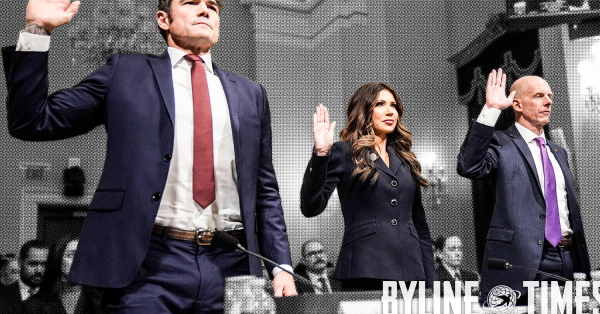
Michael Glasheen, director of operations in the FBI’s National Security Branch, told a congressional hearing that antifa is the agency’s “primary concern” and “the most immediate violent threat that we’re facing.” When questioned further about specific incidents or data supporting this assessment, Glasheen struggled to provide concrete examples or statistics.
Experts in extremism and disinformation quickly identified this as the adoption of a politically-driven narrative rather than an evidence-based threat assessment. The claim appears to reflect the influence of the Trump administration’s renewed control over federal agencies rather than the reality of domestic terrorism trends in America.
Statistical evidence from multiple credible sources directly contradicts Glasheen’s assertion. Over the past decade, right-wing extremists have been responsible for 76% of all extremist-related killings in the United States, compared to just 4% attributable to left-wing extremists, according to comprehensive studies of political violence.
The Center for Strategic and International Studies (CSIS) analyzed 900 politically motivated attacks and plots in the U.S. since 1994 and found only one deadly attack linked to antifascists – and in that single case, the only fatality was the perpetrator himself. During the same period, right-wing extremists carried out attacks resulting in 329 deaths. In both 2022 and 2024, right-wing extremists were responsible for every documented extremist murder in the country.
This stark disparity between official rhetoric and factual evidence points to what appears to be a coordinated disinformation campaign that dates back to at least 2016. This narrative has been amplified through right-wing media channels, social media influencers, and now government officials.
The antifa movement has been falsely implicated in numerous incidents, from starting wildfires to coordinating nationwide riots, making bomb threats, and carrying out mass shootings – allegations that investigations have repeatedly debunked. These false claims have occasionally triggered real-world consequences, including unnecessary highway shutdowns and armed vigilante responses to non-existent threats.
The politicization of domestic terrorism assessments became particularly evident following the January 6, 2021 Capitol insurrection, when some right-wing media figures suggested the attack was carried out by antifa provocateurs disguised as Trump supporters. Court proceedings later revealed the opposite dynamic – some right-wing militia members admitted to wearing all black clothing in hopes of being mistaken for antifa.
Trump’s administration has taken concrete steps to institutionalize this narrative. In September, Trump issued an Executive Order attempting to classify antifa as a domestic terrorist organization, despite legal experts noting that no U.S. law permits designating domestic political movements as terrorist groups. This was followed by a National Security Presidential Memorandum that presented select incidents as evidence of organized left-wing terrorism without establishing substantive connections between these events.
The reframing of national security priorities carries significant risks beyond mere political posturing. By misidentifying the primary domestic terrorism threat, resources may be diverted from monitoring and preventing the well-documented violence perpetrated by right-wing extremist networks. Additionally, labeling anti-fascist protest as “terrorism” creates a precedent for criminalizing political dissent.
What we are witnessing represents a troubling development in America’s security apparatus – the substitution of evidence-based threat assessment with politically expedient narratives. When the nation’s top law enforcement agencies begin prioritizing threats based on political ideology rather than factual analysis, both national security and democratic principles are undermined.
Fact Checker
Verify the accuracy of this article using The Disinformation Commission analysis and real-time sources.

10 Comments
This is a troubling development that highlights the need for rigorous oversight and accountability measures to ensure federal agencies like the FBI remain committed to evidence-based analysis, not political narratives. The public deserves an honest, objective assessment of domestic threats.
The FBI’s apparent embrace of a politically-charged narrative on domestic threats is deeply concerning. Objective, fact-based reporting should be the foundation for the agency’s work, not unsubstantiated claims that seem to align with a particular ideological agenda.
It’s troubling that a senior FBI official would make such claims without credible data to back them up. Antifa may be a concern, but right-wing extremism clearly poses the greater domestic terrorism threat, as the statistics indicate. The public deserves an honest, objective assessment of these threats.
Agreed. The FBI has a responsibility to provide accurate, unbiased information to lawmakers and the public. Politicizing threat assessments undermines the agency’s critical role in safeguarding national security.
This report highlights the importance of robust oversight and accountability for federal agencies tasked with safeguarding national security. Politicizing threat assessments undermines the credibility of the FBI and erodes public trust. Rigorous, evidence-based analysis is critical.
If the allegations in this report are accurate, it represents a serious breach of the FBI’s duty to provide the public and policymakers with impartial, data-driven intelligence. Restoring confidence in the agency’s integrity should be an urgent priority.
This is a disturbing development that raises questions about the integrity of the FBI’s leadership and decision-making processes. Policymakers must demand transparent, evidence-based analysis rather than politically-motivated claims from federal agencies.
It’s concerning to see the FBI apparently adopting a narrative that contradicts the available data on domestic terrorism trends. Maintaining public trust requires the agency to remain objective and fact-based in its assessments, not beholden to political agendas.
Absolutely. The FBI must uphold its duty to provide impartial, data-driven intelligence to inform national security policies, not propagate disinformation. Restoring confidence in the agency’s integrity should be a top priority.
This is a concerning development. If the FBI is spreading disinformation, it undermines public trust in the agency’s credibility and ability to assess genuine threats. Factual, evidence-based assessments should guide national security policy, not politically-driven narratives.