


Listen to the article
In a significant escalation of tensions over digital governance, the Trump administration on Tuesday imposed visa bans on a former European Union commissioner and several anti-disinformation campaigners, accusing them of censoring U.S. social media platforms. The move represents the latest development in Washington’s growing opposition to the European Union’s Digital Services Act (DSA).
Secretary of State Marco Rubio stated that the five individuals targeted “have led organized efforts to coerce American platforms to censor, demonetize, and suppress American viewpoints they oppose.” According to Rubio, “These radical activists and weaponized NGOs have advanced censorship crackdowns by foreign states – in each case targeting American speakers and American companies.”
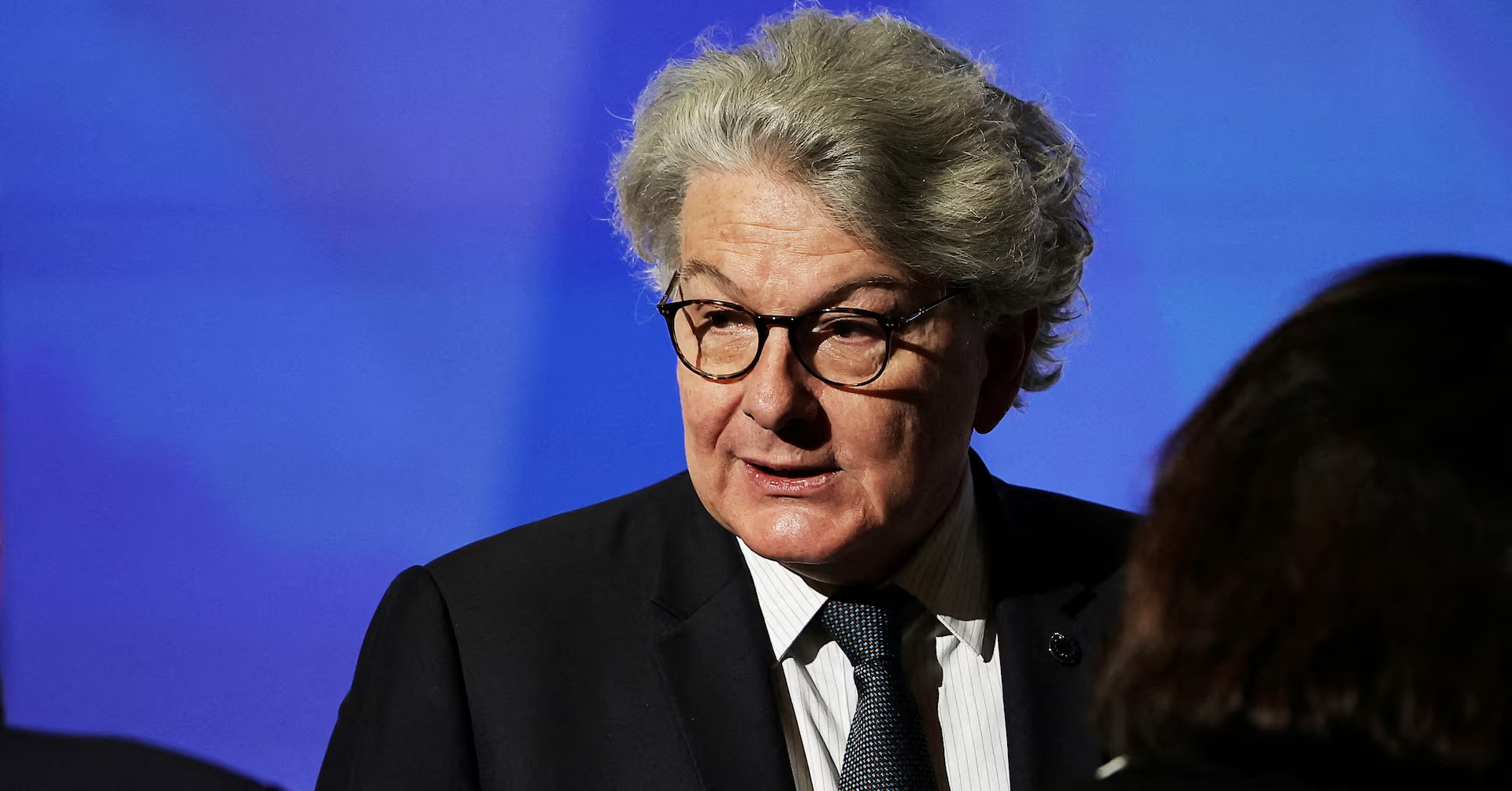
The most high-profile target of the visa restrictions is Thierry Breton, a French former business executive who served as the European commissioner for the internal market from 2019 to 2024. Under Secretary for Public Diplomacy Sarah Rogers specifically called out Breton as “a mastermind” of the DSA, claiming he once threatened X owner Elon Musk ahead of Musk’s interview with former President Donald Trump.
The other individuals facing visa bans include Imran Ahmed, the British CEO of the U.S.-based Center for Countering Digital Hate; Anna-Lena von Hodenberg and Josephine Ballon of the German nonprofit HateAid; and Clare Melford, co-founder of the Global Disinformation Index (GDI).
This action comes after the administration’s recently released National Security Strategy claimed European leaders were censoring free speech and suppressing opposition to immigration policies that it said risk “civilisational erasure” for the continent. Reuters had previously reported in August that U.S. officials were considering sanctions on officials responsible for implementing the DSA.
The Digital Services Act, a landmark piece of EU legislation, aims to combat hateful speech, misinformation, and disinformation on digital platforms. However, Washington views the law as overreaching, arguing it stifles free speech and imposes undue costs on American technology companies operating in Europe. U.S. diplomats have reportedly been instructed to build opposition to the legislation.
Those targeted by the visa bans have reacted strongly to the measures. Hodenberg and Ballon of HateAid released a statement characterizing the visa bans as an attempt to obstruct the enforcement of European law on U.S. corporations operating in Europe. “We will not be intimidated by a government that uses accusations of censorship to silence those who stand up for human rights and freedom of expression,” they declared.
A spokesperson for the Global Disinformation Index went further, calling the U.S. action “immoral, unlawful, and un-American” and describing it as “an authoritarian attack on free speech and an egregious act of government censorship.”
Rogers specifically accused Melford of falsely labeling online comments as hate speech or disinformation and using U.S. taxpayers’ money to “exhort censorship and blacklisting of American speech and press.” Melford, a former management consultant and TV executive, has previously stated that she co-founded GDI “to try to break the business model of harmful online content” by reviewing online news websites to allow advertisers to make informed choices about where they place their ads.
The Center for Countering Digital Hate did not immediately respond to requests for comment.
This dispute highlights the growing divergence between U.S. and European approaches to regulating digital platforms, with significant implications for international tech policy, free speech standards, and the operations of major American technology companies abroad. The visa bans represent an unusual step in transatlantic relations, targeting individuals involved in implementing democratically enacted legislation in allied countries.
Fact Checker
Verify the accuracy of this article using The Disinformation Commission analysis and real-time sources.

14 Comments
This is a complex and contentious issue at the intersection of free speech, digital governance, and geopolitics. It’s concerning to see such escalating tensions between the US and EU over content moderation policies. I’m curious to learn more about the specific allegations against these individuals and how this could impact the future of the DSA and US-EU relations.
This dispute raises important questions about the role of government in regulating online speech and the potential for such policies to be abused. While I can understand the desire to protect free expression, the EU’s efforts to harmonize content moderation also have merit. A nuanced, balanced approach will be needed to resolve this.
This conflict highlights the challenges of striking the right balance between free expression and content moderation online. It’s a complex issue without easy answers, and I’m curious to see how it plays out between the US and EU. Maintaining open lines of communication will be crucial to finding a mutually acceptable solution.
This situation highlights the growing tensions between different regulatory models for the internet and social media. It will be interesting to see how the Biden administration handles this issue compared to the previous administration’s more confrontational stance. Maintaining open lines of communication between the US and EU will be crucial.
I agree, open communication and finding a mutually agreeable path forward will be key. These are complex issues without easy solutions, but diplomatic engagement is critical to avoid further escalation.
While I can empathize with the US desire to protect free speech, the EU’s efforts to create a more harmonized regulatory framework for digital platforms also have merit. This dispute seems to be more about competing visions for the internet than clear-cut censorship. Hopefully the two sides can find a way to reconcile their differences constructively.
The alleged censorship and targeting of American viewpoints is certainly a serious charge. However, the DSA aims to create a more harmonized approach to content moderation across the EU. I wonder how this dispute will be resolved, as both sides likely want to protect their respective interests and visions for the digital landscape.
The use of visa bans as a retaliatory measure is concerning and could further escalate tensions. I hope both sides can take a step back and engage in good-faith negotiations to address their respective concerns over digital governance. A collaborative approach is likely the best path forward, even if it’s not easy to achieve.
While I can understand the US concerns over perceived censorship, the Trump administration’s use of visa bans seems like a heavy-handed approach. I hope cooler heads can prevail and that constructive dialogue can lead to a balanced solution that respects free speech principles on both sides of the Atlantic.
This dispute highlights the complexities and tensions inherent in governing the digital landscape. While the US concerns over censorship are understandable, the EU’s efforts to create a more harmonized approach also have merit. I’m curious to see how the Biden administration engages with this issue compared to the previous administration.
The allegations of censorship and targeting American viewpoints are serious, but visa bans seem like a disproportionate response. I hope the US and EU can find a way to constructively address their differences over digital governance without resorting to tit-for-tat measures that could further strain relations.
The allegations of censorship and targeting American viewpoints are certainly concerning, but I’m not sure visa bans are the best approach. These types of tit-for-tat measures often end up harming regular citizens and businesses more than the intended targets. A more collaborative, problem-solving mindset may be warranted here.
The use of visa bans in this context is concerning and could escalate tensions unnecessarily. I hope both sides can step back, engage in good-faith dialogue, and work towards a balanced solution that respects free speech principles while also addressing legitimate concerns over online content moderation. A collaborative approach is likely the best path forward.
This dispute illustrates the challenges of regulating the digital space, where competing visions of free expression and content moderation collide. While I can empathize with the US desire to protect American viewpoints, the EU’s efforts to create a more harmonized framework also have merit. Hopefully the two sides can find a way to reconcile their differences through constructive engagement rather than confrontation.