


Listen to the article
Foreign Propaganda Evolves with Technology, Now a Top Concern for EU Citizens
Foreign propaganda has a long and storied history, stretching back centuries. But in recent years, it has undergone a significant transformation, adapting to and exploiting new communication technologies. The internet and social media have created unprecedented channels for international propaganda efforts, including sophisticated misinformation and disinformation campaigns.
A recent Eurobarometer survey highlights this growing concern, finding that “foreign information manipulation, interference and disinformation, including in the context of elections” ranks as the second most serious challenge facing the European Union according to citizens. More than two in five Europeans (42%) shared this view, with this concern exceeding 50% in several nations.
Dr. Pawel Zerka, senior policy fellow at European Council on Foreign Relations (ECFR), cautions against over-interpretation of these results, telling Euronews Next that the framing of the question itself reveals much about the European Commission’s perception of challenges to democracy in the EU.
Closely related to foreign interference, Europeans also expressed concern about “the lack of transparency concerning whether political content online is promoted through new technologies like AI,” with nearly a third (32%) citing this as a serious challenge. However, the most pressing concern remains internal, with “growing public distrust towards democratic institutions and processes” mentioned by nearly half (49%) of respondents.
Media Amplification or Genuine Threat?
The question of whether foreign information manipulation represents a genuine threat or an overblown media narrative remains contested. Sander van der Linden from the University of Cambridge identifies two competing perspectives: one suggesting media bias is unnecessarily alarming citizens, while the other argues people are accurately perceiving a real and growing threat, now amplified by artificial intelligence.
“Personally, I would say that it’s true that the media is amplifying concern about foreign information manipulation but this concern is warranted,” van der Linden told Euronews Next.
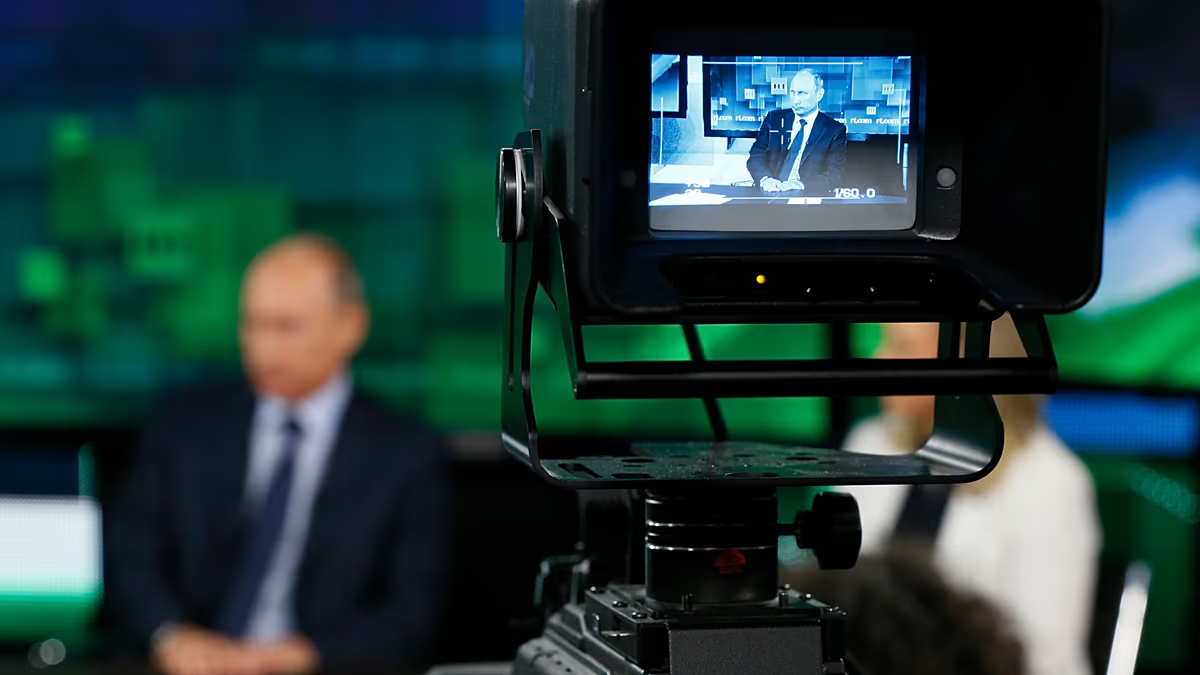
Ben O’Loughlin, professor at Royal Holloway, University of London, offers a more nuanced view, noting that “Europe’s political elites tell a story that foreign information operations must be bad because they might be bad.” He points to research conducted after the 2022 ban of Russia Today (RT) showing that while some RT content was manipulative, some was simply accurate reporting on events like protests in European capitals that highlighted citizen discontent.
“This then causes panic in European governments that RT is weaponising information to harm those very governments. This panic is doubled because there were challenges to democracy even if foreign manipulation didn’t exist,” O’Loughlin added.
Nordic Vigilance and Geographic Variations
The survey revealed striking regional variations in concern about foreign manipulation. Sweden stands as a significant outlier, with 73% of respondents identifying foreign information manipulation as the most serious challenge facing the EU.
Cristina Arribas, a researcher at the University Rey Juan Carlos, attributes Sweden’s heightened concern to “several factors, including its geographical proximity to Russia, its recent accession to NATO, and influence campaigns attributed to the Kremlin.” She also notes internal structural elements that contribute to this awareness, including “a strong tradition of media literacy, the cultivation of critical thinking, high educational attainment, a consolidated democratic culture, and a pluralistic media system.”
These features extend across Nordic countries, with Finland and the Netherlands following Sweden at 55%, Denmark at 51%, and Germany at 49%. By contrast, eight EU countries report concern levels below one-third, with Czechia, Portugal, and Estonia recording the lowest levels at 28%.
Interestingly, geographical proximity to Russia does not always correlate with heightened concern. Despite their location, Baltic states, Poland (29%), and Romania (31%) show comparatively lower levels of concern, suggesting that structural factors like media literacy may play a more significant role than geography in shaping perceptions of disinformation threats.
Among the EU’s largest economies, Germany records the highest concern at 49%, while France and Spain hover near the EU average at 43%, and Italy matches the average exactly at 42%.
Zerka suggests that recent experiences with foreign interference or cyberattacks in a country’s history may significantly shape public perceptions and explain some of these national variations, highlighting the complex interplay of factors influencing how Europeans perceive and respond to evolving information threats in the digital age.
Fact Checker
Verify the accuracy of this article using The Disinformation Commission analysis and real-time sources.

8 Comments
This is a concerning issue for the EU. Disinformation and foreign interference pose real threats to democratic processes. I’m curious to learn more about the specific tactics and sources being used to undermine European elections and institutions.
Yes, it’s crucial that the EU takes steps to counter these propaganda efforts and protect the integrity of its elections and institutions.
Protecting the integrity of elections and democratic institutions from foreign manipulation is crucial. I’m curious to learn more about the specific tactics and sources being used, as well as the EU’s strategies to counter these threats.
Foreign information manipulation is a major challenge for the EU. I appreciate the EU’s efforts to raise awareness and address this issue. It will be important to understand the evolving tactics used by bad actors and stay vigilant.
Agreed, the EU needs robust strategies to detect, expose, and counter foreign disinformation campaigns targeting its member states.
I’m skeptical of the framing of the Eurobarometer question on this issue. While foreign interference is a valid concern, the wording may have influenced the survey results. Still, the threat of disinformation is real and the EU must take it seriously.
That’s a fair point. The survey design and question phrasing can impact how respondents interpret and answer. Careful analysis is needed to fully understand the nature and extent of the problem.
The findings from the Eurobarometer survey are quite concerning. Over 40% of EU citizens view foreign information manipulation as a serious threat. This highlights the scale of the problem and the need for effective solutions.