


Listen to the article
Modern Agricultural Practices Under Fire as Science-Based Farming Faces Dual Threats
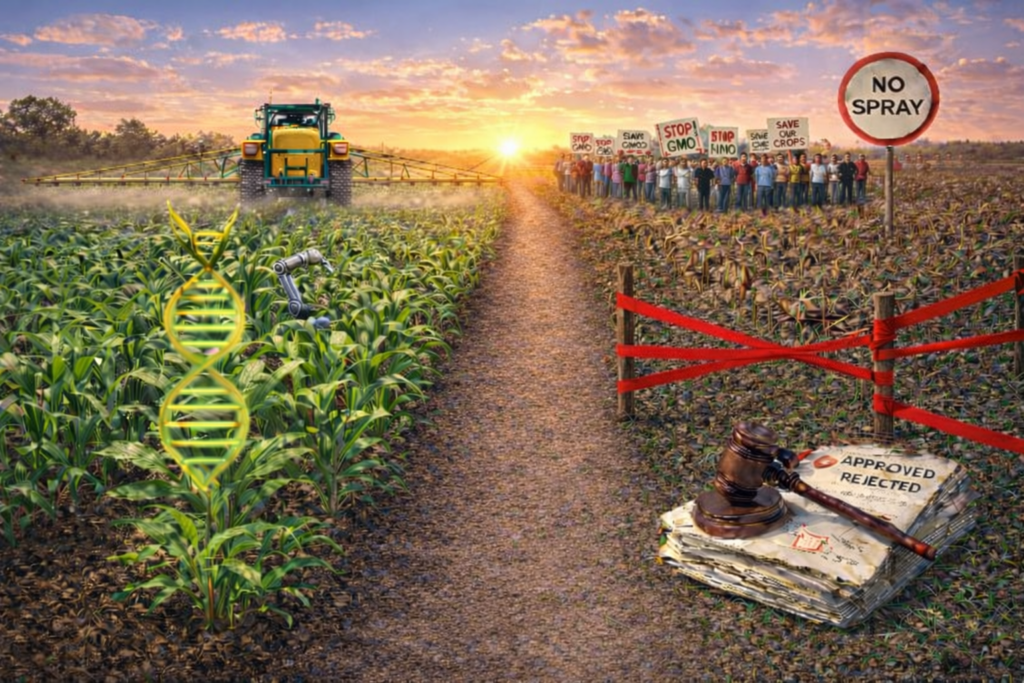
Conventional farming practices are facing intensifying challenges from environmental activists and the MAHA movement, even as Trump-era cuts to research and regulatory agencies have weakened science-based agricultural oversight. This two-pronged assault leaves farmers caught between ideological opposition and diminished governmental support at a critical time for global food security.
Critics of modern agriculture have built their opposition around two central claims: that genetic engineering poses inherent health risks with potentially devastating environmental consequences, and that conventional farming’s reliance on crop chemicals threatens both human health and ecological systems. However, scientific evidence contradicts both assertions.
“These critics have attempted to frame modern farming tools as inherently dangerous, ignoring decades of toxicology, risk assessment, and real-world data,” notes agricultural policy expert Jon Entine. “Around the world, similar rhetoric is pressuring regulators and policymakers to restrict proven technologies while offering no scalable alternative to feed billions of people.”
Modern conventional agriculture—integrating genetic engineering, advanced breeding, precision application of crop protection, and data-driven management—has demonstrated superiority in both productivity and safety. Over three decades of evidence shows genetically engineered crops reduce overall pesticide use and toxicity while increasing yields.
The scientific consensus is clear. Comprehensive safety assessments by the U.S. National Academy of Sciences, European Commission, World Health Organization, and American Medical Association have all reached the same conclusion: approved GM crops present no greater risk to human health or the environment than conventionally bred alternatives.
This scientific consensus, however, has not deterred opposition. The organic agriculture movement, recently rebranding much of its approach as “regenerative” farming, continues to promote what experts characterize as chemophobia—an irrational fear of chemicals that fails to distinguish between hazard and risk.
“‘Chemical’ is not a synonym for ‘toxic,’ and ‘organic’ is not a synonym for ‘nature-friendly,’ safer, or healthier,” explains Dr. Henry Miller, founding director of the FDA’s Office of Biotechnology. “Organic agriculture is not pesticide-free or even a low-pesticide farming model. It still relies on pesticides, some of which are less targeted, more toxic, and must be applied more frequently.”
The glyphosate controversy exemplifies this disconnect between science and public perception. Despite consistent findings from regulatory bodies worldwide that the herbicide is safe when used as directed, persistent legal challenges and media coverage have created massive uncertainty for farmers. The United States actually uses about half the toxic chemicals per acre as European countries like Belgium and France, largely because of its adoption of GM crops paired with glyphosate.
Environmental concerns also favor conventional approaches in many contexts. Organic systems typically yield 20-40% less than conventional farming, requiring more land, water, and energy to produce equivalent food volumes. This lower productivity can drive deforestation and habitat loss as farming expands to compensate, potentially causing greater environmental harm than high-yield conventional practices.
“Meeting future global food demand while meeting climate goals requires high-yield, biotechnology-driven agriculture,” says Alex Smith, Senior Food and Agriculture Analyst at Breakthrough Institute. “Framing agriculture as a binary choice between conventional and organic farming is misleading. An ‘all tools in the toolbox’ approach combining biotechnology, modern chemicals, soil-focused practices, and innovation offers the most realistic path forward.”
As global population grows and climate stress intensifies, agriculture faces the challenge of producing more food on less land with fewer inputs and reduced environmental impacts. While organic farming has a role in this complex future, efforts to demonize conventional practices through misleading marketing campaigns ultimately undermine both food security and environmental sustainability.
“Simply put, agriculture must produce more food on less land with fewer inputs and reduced environmental impact,” emphasizes Emily Bass, Associate Director at Breakthrough Institute. “Misinformation that treats modern farming tools, which are essential to meet this challenge, as inherently dangerous undermines both food security and environmental goals.”
Fact Checker
Verify the accuracy of this article using The Disinformation Commission analysis and real-time sources.

28 Comments
It’s concerning to see foreign disinformation campaigns targeting the U.S. agriculture sector. Maintaining the integrity of our food supply is critical for national security and global stability. While there are legitimate environmental concerns, the science overwhelmingly supports the safety and benefits of modern farming practices.
Agreed. We should be vigilant against attempts to undermine science-based agriculture, especially when driven by foreign actors with ulterior motives. Farmers need the support of policymakers and the public to continue feeding the world sustainably.
This is a complex issue with valid concerns on both sides. However, the scientific consensus is clear – modern agricultural tools and practices are safe and essential for meeting the world’s growing food demands. Policymakers must stand firm against disinformation campaigns that seek to disrupt this critical sector.
Agreed. Maintaining the integrity of the U.S. agriculture sector is a national priority. While open debate is important, decisions must be guided by rigorous, objective evidence – not ideological opposition or foreign manipulation.
I appreciate the attempt to frame modern farming as dangerous, but the scientific evidence tells a different story. Farmers should be free to use approved, safe technologies to meet the world’s growing food needs. Ideological opposition shouldn’t override evidence-based policymaking.
This is a concerning report. While I’m all for responsible farming practices, the anti-science rhetoric around GMOs and chemicals is misguided. Farmers need the best tools to meet global food demands sustainably.
Agreed. Sound science and data should guide agricultural policies, not ideology. Farmers face enough challenges without having to fight misinformation campaigns as well.
I’m curious to learn more about the specific disinformation tactics being used to target the US agriculture sector. What kinds of false claims are being spread, and how are they impacting farmers on the ground?
That’s a good question. Understanding the nature and sources of these disinformation campaigns will be key to countering them effectively. Policymakers need to take this threat seriously.
This article highlights the critical importance of maintaining the integrity of the U.S. agriculture sector. Genetic engineering and conventional farming tools have been extensively studied and proven safe. Policymakers must stand firm against attempts to restrict these technologies through disinformation.
Absolutely. Farmers need access to the best available tools and technologies to meet the world’s growing food demands. Undermining science-based practices in the name of ideological purity will only hurt the farmers and consumers who rely on a robust, productive agricultural system.
Modern agriculture has made remarkable strides in productivity and sustainability. While there’s always room for improvement, the demonization of genetic engineering and chemicals is not the answer. We need to support our farmers, not hamstring them.
I appreciate the balanced perspective presented in this article. While there are legitimate environmental concerns around modern agriculture, the science clearly shows the safety and benefits of these practices. Policymakers must rely on evidence, not ideology, when making decisions that impact our food supply.
Well said. Promoting sustainable, science-based farming is the best way to address environmental challenges while ensuring global food security. Disinformation campaigns that undermine these efforts are counterproductive and dangerous.
As someone concerned about global food security, I’m worried about the potential impact of these disinformation campaigns. We need to empower farmers with the best available tools and practices, not restrict them based on unsubstantiated claims.
I’m curious to learn more about the specific claims being made by critics of modern agriculture. What does the scientific evidence actually show regarding the safety of genetic engineering and crop chemicals? It’s important to rely on facts, not rhetoric.
From what I’ve read, the scientific consensus is that genetic engineering and approved crop chemicals are safe when used responsibly. Unfounded claims of inherent danger seem to be politically motivated rather than evidence-based.
It’s worrying to see how politics and ideology are interfering with science-based farming practices. Feeding the world’s population is a huge challenge that requires innovative, evidence-based solutions, not fear-mongering.
Absolutely. We can’t let ideological agendas undermine the expertise and hard work of our farmers and agricultural researchers. Fact-based policymaking is critical in this space.
I’m curious to learn more about the specific claims being made by critics of modern agriculture. What evidence do they have to support their assertions about health and environmental risks? It’s important to have a balanced, fact-based debate on these complex issues.
Valid point. It’s critical that policymakers and the public rely on rigorous scientific studies, not ideological rhetoric, when evaluating the merits of agricultural technologies. Maintaining an open, evidence-based dialogue is key to addressing legitimate concerns without falling prey to disinformation.
It’s disappointing to see farmers caught in the middle of this ideological battle. They need access to proven technologies, not restrictions based on misinformation. Maintaining strong scientific oversight and support for the agriculture sector should be a priority.
Disinformation campaigns targeting the US agriculture sector are deeply concerning. This is a critical industry that requires clear-headed, evidence-based decision making, not the spreading of unfounded fears. I hope policymakers take decisive action to counter these threats.
Concerning to see foreign disinformation campaigns targeting the U.S. agriculture sector. Farmers need science-based tools and government support, not ideological opposition that ignores evidence. Maintaining global food security is critical.
The challenges facing farmers are significant, with growing pressures from environmental activists and diminished government support. However, undermining science-based practices through disinformation campaigns is not the solution. We need policies that empower farmers to feed the world sustainably.
Well said. Farmers are on the frontlines of ensuring global food security. Policymakers should be strengthening research, regulatory oversight, and other support for the agricultural sector – not weakening it in the face of ideological opposition and foreign manipulation.
It’s disturbing to see foreign actors targeting the U.S. agriculture sector with disinformation campaigns. This goes beyond just ideological opposition – it’s an attempt to undermine our national security and global influence. Policymakers must act swiftly to protect the integrity of our food supply.
Agreed. This is a serious national security issue that requires a robust, coordinated response. Maintaining the strength and resilience of the U.S. agriculture sector is critical, not just for feeding our own population, but for upholding global food security and stability.