


Listen to the article
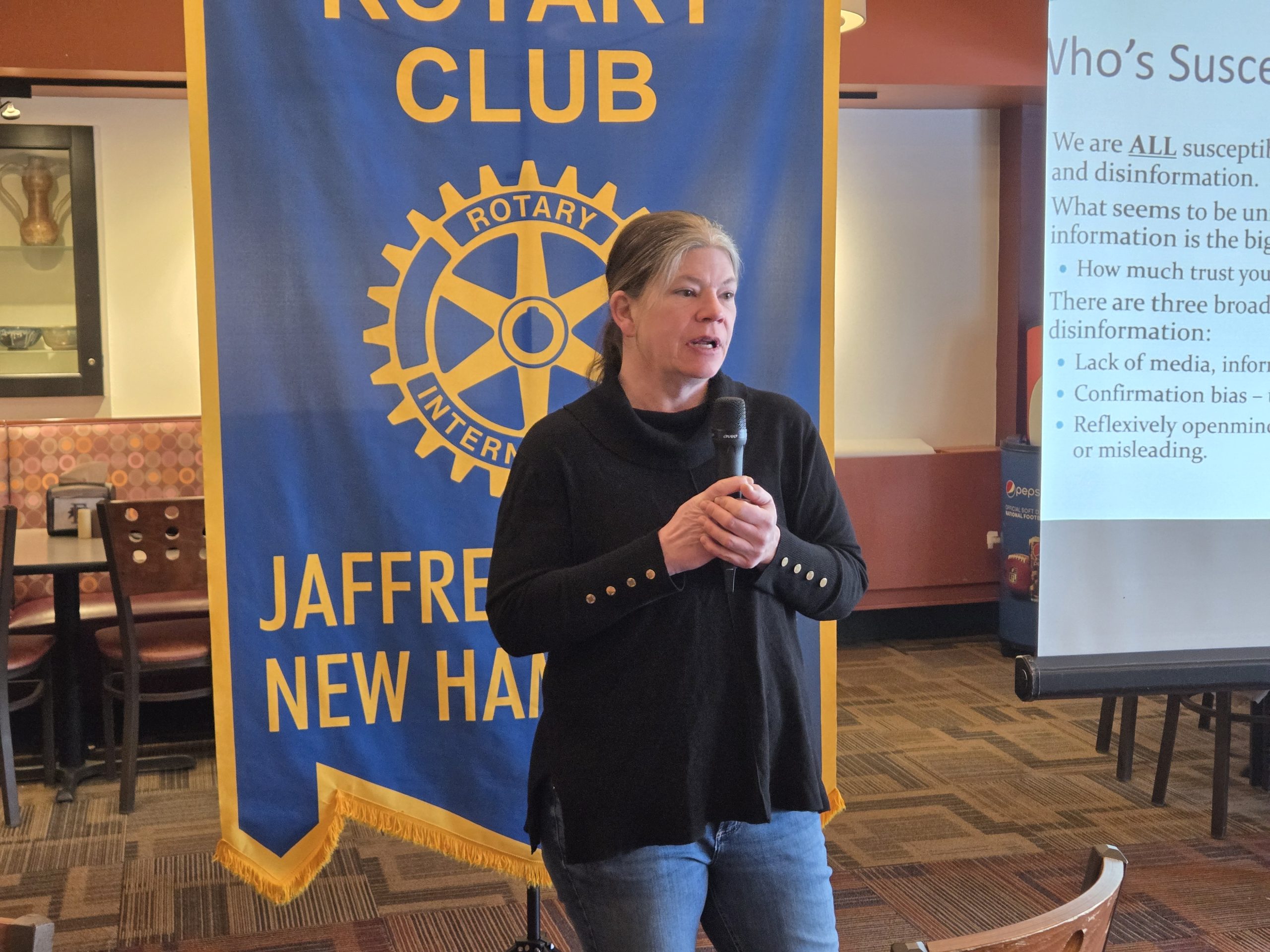
In an era of digital media saturation, understanding how to navigate misinformation has become increasingly crucial. This was the central message delivered by Dr. Christina Cliff, a political science professor at Franklin Pierce University, during her recent presentation to the Jaffrey-Rindge Rotary Club.
Speaking to local community leaders on February 12, Dr. Cliff provided insights into the growing challenges posed by misinformation and disinformation in today’s media landscape. Her presentation highlighted how technological advancements have made it easier than ever to create and distribute false content that appears authentic.
“Deep fakes and deliberately misleading content don’t just confuse people—they actively drive wedges between communities and deepen existing societal divisions,” Dr. Cliff explained to the assembled Rotarians.
One particularly concerning aspect she emphasized was the viral nature of false information. According to Dr. Cliff, fabricated news stories often spread more rapidly than accurate reporting precisely because they’re designed to trigger emotional responses. Content that provokes anger, fear, or outrage typically captures more attention and generates more engagement online.
The proliferation of sophisticated editing tools has compounded this problem. “Today’s technology allows almost anyone to manipulate images and videos or present them without proper context,” Dr. Cliff noted. “This significantly increases the risk of public deception, even among those who consider themselves media-savvy.”
The Monadnock region, like many rural areas across the country, isn’t immune to these trends. Local community groups like the Jaffrey-Rindge Rotary play a vital role in fostering informed citizenship through educational presentations such as Dr. Cliff’s.
Media literacy emerged as a central theme in Dr. Cliff’s recommendations. She encouraged attendees to develop stronger critical thinking skills when consuming news and information. One practical approach she suggested was cross-referencing information across multiple reputable sources before accepting it as fact—and certainly before sharing it with others.
“The responsibility ultimately falls on each individual,” Dr. Cliff emphasized. “Without careful consideration and personal accountability, fake news can cause tangible harm to our communities and personal relationships.”
The timing of Dr. Cliff’s presentation is particularly relevant as the United States enters another presidential election cycle, a period typically marked by increased circulation of misleading political content. In regions like the Monadnock area, where community ties remain strong, misinformation can be especially damaging to local discourse and decision-making.
Recent studies support Dr. Cliff’s concerns. The Reuters Institute Digital News Report has documented declining trust in news media across democratic nations, with the United States showing particularly troubling trends. This environment creates fertile ground for misinformation to flourish.
For the Jaffrey and Rindge communities, the presentation offered practical tools for navigating the complex media environment. Attendees were encouraged to consider not just the content of messages they encounter, but also the sources and potential motivations behind them.
Local officials in attendance acknowledged the importance of the discussion, particularly as rural communities increasingly rely on social media platforms for news and information about local events and governance issues.
Dr. Cliff’s expertise reflects broader academic concern about information integrity. As a political science professor at Franklin Pierce University, her research intersects with growing academic focus on how misinformation affects democratic processes and community cohesion.
The Jaffrey-Rindge Rotary Club regularly hosts speakers addressing topics of community interest as part of its mission to foster community engagement and education. This presentation underscores the organization’s commitment to promoting informed citizenship in the Monadnock region.
As digital media continues to evolve, presentations like Dr. Cliff’s provide essential guidance for communities seeking to maintain healthy information ecosystems—a challenge that extends far beyond the boundaries of Jaffrey and Rindge but resonates particularly strongly in close-knit New Hampshire communities.
Fact Checker
Verify the accuracy of this article using The Disinformation Commission analysis and real-time sources.

11 Comments
Dr. Cliff’s presentation on the dangers of misinformation is timely and important. As the digital landscape evolves, we must stay vigilant against attempts to sow division and confusion through false content. Her insights offer a helpful framework for addressing this challenge.
I appreciate Dr. Cliff’s focus on how technology has enabled the rapid spread of misinformation. Combating this issue will require multifaceted solutions, from media literacy education to platform accountability. Her expertise is valuable in these discussions.
Agreed. Misinformation can have serious societal consequences, so equipping the public with the tools to identify and resist it is crucial.
Interesting to hear Dr. Cliff’s perspective on how misinformation can deepen existing societal divisions. This is a complex issue without easy solutions, but raising awareness and promoting critical thinking are important first steps.
Interesting insights from Dr. Cliff on the growing challenge of misinformation. Her point about how false content designed to trigger emotions often spreads faster than factual reporting is concerning. Navigating the digital landscape requires critical thinking skills.
Dr. Cliff’s insights on the growing challenge of misinformation are a timely and important contribution to the ongoing conversation. Her focus on the need for media literacy and platform accountability is crucial as we work to combat the spread of false information.
I’m glad Dr. Cliff is shedding light on the dangers of misinformation. Her emphasis on how fabricated news stories often go viral due to their emotional impact is particularly concerning. This is a complex issue that requires a multifaceted approach.
Kudos to Dr. Cliff for bringing attention to the growing problem of misinformation. Her insights on the challenges posed by deep fakes and emotionally charged false content are a wake-up call. We all have a role to play in fighting the spread of disinformation.
Dr. Cliff’s emphasis on the viral nature of false information is concerning. Addressing this will require a multi-pronged approach, from media literacy programs to platform policies that limit the spread of deliberately misleading content.
Agreed. Combating misinformation is an ongoing battle, but it’s crucial for the health of our information ecosystem and our communities.
Dr. Cliff’s presentation highlights the importance of developing critical thinking skills to navigate the digital landscape. With the rapid spread of false information, equipping the public with the tools to identify and resist misinformation is essential.