


Listen to the article
After a three-year silence caused by technical failures and resource constraints, the Radio of the Armed Forces of the Democratic Republic of Congo (FARDC) is being revitalized in North Kivu’s Greater North region. The restoration comes through a MONUSCO Quick Impact Project valued at $49,192 USD, addressing a critical communication gap in an area plagued by armed conflict.
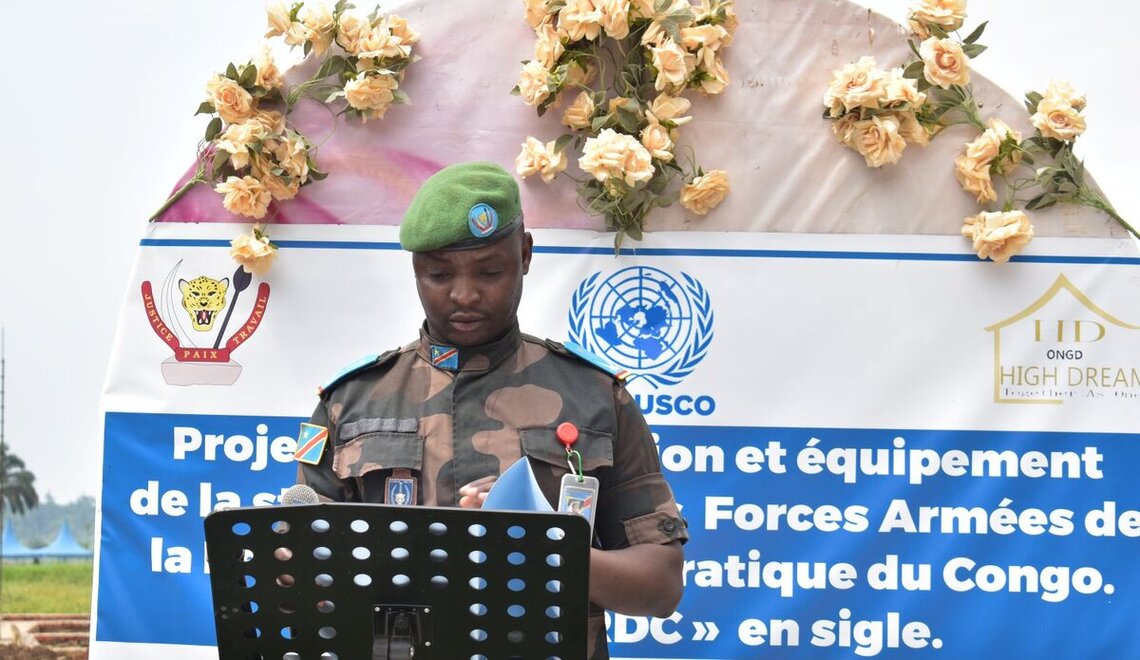
The foundation stone for the project was laid on December 20, 2025, at the General Shiko military camp in Beni’s Mambango neighborhood. Military officials, local authorities, and media representatives attended the ceremony, marking a significant step in restoring military-civilian communications in the volatile region.
Lieutenant Marc Elongo, spokesperson for Sokola 1 Grand Nord operations, emphasized the strategic importance of the radio station at the ceremony. “Radio remains one of the most accessible, fastest, and closest tools to the population,” he stated. “In a context marked by a major security challenge, it is essential to have a reliable tool to inform in real time, educate, and raise awareness among the population so that they embrace the ongoing military operations in North Kivu province and its surroundings.”
The radio station’s revival comes at a critical time for North Kivu province, where armed group activity has intensified in recent years. The circulation of rumors and misinformation has significantly undermined trust between local communities and security forces. Without its radio station, the FARDC has struggled to effectively communicate its operations and intentions to civilians caught in conflict zones.
Jean de Dieu Kanzoka Siliwere, chief of the Pasisi neighborhood, expressed optimism about the project’s impact on civil-military relations. “I know this radio will further strengthen relations between civilians and military personnel, because even civilians will come here for their communications and other things,” he explained.
The comprehensive project includes constructing a building with dedicated technical and newsroom spaces. The station will be equipped with essential broadcasting equipment, including computers, microphones, and a 1,000-watt transmitter. To ensure reliable operations in an area with inconsistent electricity, the facility will be powered primarily by solar energy, with a generator system as backup.
For MONUSCO, the United Nations stabilization mission that has operated in the DRC since 1999, the project aligns with broader efforts to combat disinformation in conflict zones. Michel Nolet, representing the head of MONUSCO’s Beni sub-office, highlighted this dimension during the ceremony. “We work tirelessly to combat disinformation. With the construction of this radio, we will be able to strengthen civil-military relations to better deal with false information that often hinders our activities,” he said.
The restoration of FARDC Radio represents more than just infrastructure development. In eastern DRC, where over 100 armed groups operate and where violence has displaced millions, reliable information channels are essential for civilian protection and military coordination. The station is expected to provide verified information that could help limit the impact of information manipulation, which has frequently exacerbated tensions in the region.
Senior Commissioner Donat Atwena, representing Beni’s mayor at the ceremony, characterized the support as a demonstration of “the international community’s commitment alongside the Democratic Republic of Congo in peace consolidation efforts.” He expressed hope that the radio would become “an instrument of responsible communication, promotion of peace, national unity, and the positive image of the army.”
The construction work is expected to be completed within three months, after which the station will resume broadcasting. This partnership between MONUSCO and FARDC highlights ongoing international support for stabilization efforts in eastern DRC, where security remains precarious despite years of UN intervention and government military operations.
Fact Checker
Verify the accuracy of this article using The Disinformation Commission analysis and real-time sources.

11 Comments
Effective military-civilian communication is so important in conflict zones. This radio station revitalization is a good step, but broader efforts to build trust and accountability are also needed.
Agreed. Restoring this radio station is just one part of the puzzle. Ongoing engagement and transparency from the military will be crucial.
Restoring the FARDC radio station could help counter disinformation and build trust between civilians and the military. Transparent and reliable communication is essential for security operations to succeed.
This is a positive step in improving communication and information sharing between the military and local communities in this conflict-affected region. Radio remains a vital tool for reaching people, especially in areas with limited internet access.
The $49,192 investment in this project seems quite modest, but could have an outsized impact in the region. I hope the new radio station can become a sustainable and trusted source of information.
Radio can be a powerful tool for both good and harm. I hope the FARDC uses this platform responsibly to inform and educate the public, not to spread disinformation or stoke tensions.
That’s a fair point. Oversight and accountability measures will be important to prevent the radio from being misused.
Reviving this radio station is a welcome development, but its long-term success will depend on securing ongoing funding and technical support. I hope this isn’t just a short-term fix.
You raise a good concern. Sustainable financing and capacity building will be crucial for this radio station to have a lasting impact.
While this project aims to improve communication, I’m curious about how the military will ensure the radio content remains objective and avoids propagandizing their operations. Maintaining journalistic integrity will be vital.
I’m curious to learn more about the specific challenges this radio station aims to address. What types of information and messaging will it provide to the local population?