


Listen to the article
Democracy Under Digital Siege: Misinformation During Benin’s Failed Coup
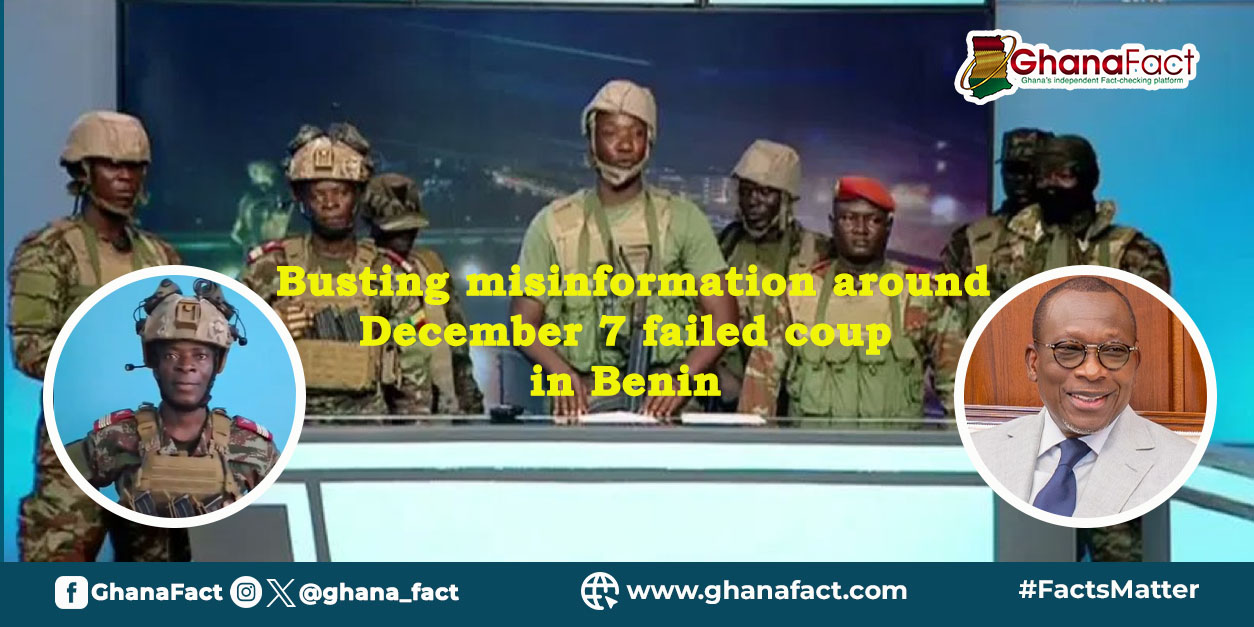
The attempted military coup in Benin on December 7, 2025, offers a stark illustration of how information disorder increasingly threatens democratic stability across Africa. As rogue soldiers briefly seized the national broadcaster to announce they had overthrown President Patrice Talon’s government, a parallel battle unfolded online, where misinformation spread rapidly through social media channels.
Within hours of the first reports of military action in Cotonou, a sophisticated campaign of false information began circulating. Despite the government’s swift announcement that loyalist forces had regained control—later reinforced by a presidential address—misleading content continued flooding platforms, creating confusion about the actual situation on the ground.
“Various researches have indicated that the threat of mis/disinformation and activities of threat actors is real across many parts of Africa,” explains Richard Kumadoe, a Fraud Prevention Expert and Security Intelligence Consultant. “This threat has become a major source of worry for many African leaders and their governments.”
The Benin incident follows a worrying pattern. According to the Africa Center for Strategic Studies’ March 2024 report, “Disinformation campaigns seeking to manipulate African information systems have surged nearly fourfold since 2022, triggering destabilizing and antidemocratic consequences.” The report highlights how increasing reliance on social media for news across the continent fuels the proliferation of such campaigns.
Anatomy of Digital Deception
A GhanaFact investigation identified multiple strands of misinformation that emerged during the coup attempt. One particularly viral example involved a video purportedly showing Beninese civilians marching in support of the military takeover. The footage, viewed over 159,000 times on X (formerly Twitter), was captioned: “Benin 07.12.25 / 13:31” and claimed that “The Beninese people have stormed the main thoroughfares of the capital Cotonou to support the military.”
However, reverse image searches revealed the video actually originated from Kenya, showing footage of mourners during former Prime Minister Raila Odinga’s funeral procession in October 2025. Despite being completely unrelated to Benin, the video’s comment section filled with statements like “Long live Africa, long live the Beninese soldiers” and “The coup d’etat in Benin has been confirmed.”
Similarly, images presented as protests supporting the coup were traced back to anti-government demonstrations in Benin from 2018, completely unrelated to current events.
Weaponizing Technology
The misinformation campaign extended to more sophisticated tactics. A fraudulent statement bearing the Beninese coat of arms and Foreign Affairs Ministry branding circulated online, purportedly outlining interim measures from the coup leaders. The ministry was forced to issue an explicit disclaimer, labeling the document as fake and urging citizens to rely only on official government communications.
Perhaps most concerning was the deployment of artificial intelligence to generate convincing but entirely fabricated images. One showed President Talon in handcuffs being led away by police officers—at a time when the president had simply not yet made a public appearance. Another depicted alleged coup plotters behind bars, distributed while the government had released no information about arrests.
When GhanaFact ran these images through Google’s SynthID Detector, both were flagged as containing AI-generated elements.
Foreign governments were also drawn into the misinformation vortex. Claims that Beninese officials had sought asylum at the French Embassy in Cotonou prompted an explicit denial from French Foreign Affairs spokesperson Pascal Confavreux, who stated: “Allegations suggest that Beninese authorities have sought refuge at the French Embassy in Cotonou. None of this is true. We formally deny it.”
Government Response
The Benin government has taken active steps to combat the surge of misinformation. On December 8, the National Cybercrime unit (Centre National d’Investigations Numeriques) launched a dedicated WhatsApp channel called “Anti Fake News Benin” to verify content published about the country. The channel actively debunks false information by sharing corrective content.
Meanwhile, Nigerian military intervention proved decisive in ending the physical coup attempt. The Nigerian Air Force conducted precision strikes against the coup plotters at the request of Beninese authorities, acting under ECOWAS mandate. President Talon later appeared on television to commend loyal forces for defending the constitution and assured citizens that constitutional order had been preserved.
By December 8, the government announced the arrest of 14 individuals, including 12 serving soldiers, while coup leader Lieutenant Colonel Pascal Tigri reportedly fled to neighboring Togo.
Broader Implications for African Democracy
The Benin case represents just one example of a growing trend across the continent. Similar information disorder operations have been documented during South Africa’s 2024 elections, Ghana’s electoral process, and during political instability in Ivory Coast and Cameroon.
“Social media platforms have become more available, and evasive characters have developed and evolved negative usage activities to deliberately denigrate and create misrepresentation of facts,” notes Kumadoe. “Social media users with huge followers have become suitable conduits for mis/disinformation across many African cities, hence the security risk it poses to African governments.”
As African nations grapple with these digital threats, many are turning to legislation as their primary response. However, activists and human rights defenders warn this approach risks undermining freedom of speech and other civil liberties. Finding the balance between combating harmful misinformation while preserving democratic rights remains an urgent challenge across the continent.
The failed coup in Benin demonstrates that in contemporary Africa, securing democracy requires vigilance not just against physical threats, but increasingly against digital deception designed to manipulate public opinion and undermine institutional trust.
Fact Checker
Verify the accuracy of this article using The Disinformation Commission analysis and real-time sources.

19 Comments
Interesting update on Fact-Checking Misinformation About Benin’s Failed December 7 Coup Attempt. Curious how the grades will trend next quarter.
Good point. Watching costs and grades closely.
Good point. Watching costs and grades closely.
The cost guidance is better than expected. If they deliver, the stock could rerate.
Good point. Watching costs and grades closely.
Good point. Watching costs and grades closely.
Exploration results look promising, but permitting will be the key risk.
Good point. Watching costs and grades closely.
Good point. Watching costs and grades closely.
Nice to see insider buying—usually a good signal in this space.
Good point. Watching costs and grades closely.
Uranium names keep pushing higher—supply still tight into 2026.
Good point. Watching costs and grades closely.
Good point. Watching costs and grades closely.
Exploration results look promising, but permitting will be the key risk.
Interesting update on Fact-Checking Misinformation About Benin’s Failed December 7 Coup Attempt. Curious how the grades will trend next quarter.
Good point. Watching costs and grades closely.
Silver leverage is strong here; beta cuts both ways though.
Good point. Watching costs and grades closely.