


Listen to the article
Peruvian Investigative Outlet Exposes Coordinated Disinformation Campaign Targeting Its Journalists
For eight years, Peruvian investigative media outlet IDL-Reporteros has faced relentless attacks following their high-impact investigative reports. These attacks have ranged from criminal complaints and attempts to force journalists to reveal sources to physical assaults on their headquarters and orchestrated harassment campaigns.
Rather than backing down, IDL-Reporteros has chosen to fight back with what they do best: investigative journalism. “When the disinformation campaigns intensified around 2023, we decided to combat disinformation against IDL-Reporteros with investigative journalism,” explained Romina Mella, editor in chief of IDL-Reporteros.
A groundbreaking investigation conducted in partnership with the Latin American Center for Investigative Journalism (CLIP) has now uncovered the existence of a sophisticated disinformation operation specifically targeting the outlet and its director, Gustavo Gorriti, a renowned figure in Latin American journalism.
“These are smear campaigns designed to attack, stifle and threaten investigative journalism,” Mella noted. “They aim to turn investigative journalists into targets of investigation, and politicians or those involved in serious corruption cases into victims of political persecution.”
The investigation, titled “All Disinformation Agents United Against IDL-Reporteros,” received technical support from Cazadores de Fake News and forms part of CLIP’s broader “Los Ilusionistas” series examining political disinformation across Latin America during the 2024 “super election year.”
José Luis Peñarredonda, editor of disinformation investigations at CLIP, emphasized Gorriti’s unique situation. “Gustavo is one of the deans of investigative journalism in Latin America with a decades-long, highly respected career. On the other hand, he has been the victim of attacks on a scale and proportion very difficult to measure compared to the size of the country.”
The attacks against Gorriti have been so severe that in 2023, the Inter-American Commission on Human Rights granted him precautionary measures. Currently, he faces at least one criminal investigation and has been called to testify before Congress on accusations of bribery, influence peddling, and obstruction of justice.
According to the CLIP investigation, the primary goal of the disinformation campaign is to discredit IDL-Reporteros’ reporting on major corruption cases including Lava Jato and Cuellos Blancos (White Collars). These investigative series exposed widespread influence peddling involving high-ranking prosecutors, judges, and magistrates manipulating judicial processes to benefit criminals, businessmen, and politicians.
The investigation revealed a five-stage method behind the “disinformation orchestration”: initiation, amplification, pressure, street harassment, and legal action.
The process typically begins with Willax Televisión, a channel owned by businessman Erasmo Wong, who himself faces legal investigations for alleged money laundering and has been mentioned in IDL-Reporteros’ reporting. Similar media outlets like Expreso and PBO Digital also participate in publishing information against the investigative outlet.
In the amplification stage, the disinformation spreads to social media, particularly X (formerly Twitter), where politicians, opinion-makers, and anonymous trolls push the narrative further. The investigation documented instances where up to 517 posts per hour appeared, with peaks reaching 1,500 posts hourly.
The pressure intensifies when lawyers and spokespeople for those being investigated demand legal action against the journalists, often threatening prosecutors and judges if they fail to comply.
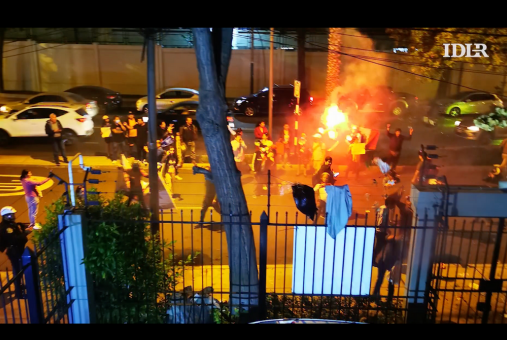
Street harassment follows, with far-right groups appearing at IDL-Reporteros headquarters “to utter insults, threats, defamation, in some cases to throw garbage, excrement, with total impunity and inaction from police,” according to Mella. Similar incidents have occurred at Gorriti’s home, accompanied by doxxing campaigns exposing personal information of IDL-Reporteros staff.
Finally, the cycle culminates when individuals linked to those under investigation file criminal complaints based on the disinformation that has been circulated.
“It’s important to have done this investigation to identify patterns in the attacks, how the campaigns are formed, how they are disseminated, and what the consequences are,” Mella said. “How disinformation campaigns are used by politicians under investigation for major corruption to discredit and delegitimize journalists and criminalize investigative journalism.”
While the IDL-Reporteros case is considered emblematic, Peñarredonda noted they’re beginning to identify similar patterns of attack targeting other media outlets in Peru. The investigation took six months to complete, involving analysis of tens of thousands of social media posts and careful documentation of attack patterns.
“Just as we investigate transnational corruption and illegal economies by joining forces as journalists, it’s also important to develop alliances to investigate how disinformation attacks, threatens and seeks to discredit investigative journalism, especially given the contexts in which we operate,” Mella concluded.
Fact Checker
Verify the accuracy of this article using The Disinformation Commission analysis and real-time sources.

10 Comments
Silencing the press through coordinated disinformation and intimidation tactics is a worrying trend we’re seeing in many parts of the world. This investigation sheds important light on the challenges faced by courageous investigative journalists in Peru.
Absolutely, this kind of repression of the media is a serious threat to democracy. The public deserves access to independent, fact-based reporting on important issues.
This is a disturbing report on the systematic efforts by Peruvian authorities to silence critical journalists. Attacking investigative outlets through disinformation campaigns and legal harassment is an alarming threat to press freedom.
Agreed, this undermines the public’s right to information and transparency. Journalists must be able to do their work without fear of retaliation.
This report highlights the challenging environment for journalists in Peru who dare to investigate corruption and wrongdoing. The coordinated disinformation and harassment campaigns are a chilling tactic to silence independent media.
Sadly, this is not an isolated incident. Attacks on press freedom are on the rise globally, posing a serious threat to democratic accountability.
It’s concerning to see the extent of the Peruvian government’s efforts to stifle critical journalism. Investigative outlets like IDL-Reporteros play a vital role in exposing corruption and holding authorities accountable.
You’re right, this kind of crackdown on press freedom is deeply troubling. Journalists need robust legal protections and support to do their jobs effectively.
The systematic efforts by Peruvian authorities to stifle critical journalism through disinformation and intimidation tactics are a serious concern. Investigative outlets like IDL-Reporteros play a vital watchdog role that must be protected.
I agree, this is a disturbing trend that undermines the public’s right to information. Journalists should be able to do their work without fear of retaliation.