


Listen to the article
The European Union, France, and Germany have vehemently condemned the United States’ decision to impose visa bans on five European citizens, calling the move an unjustified attack on regulatory sovereignty and freedom of expression.
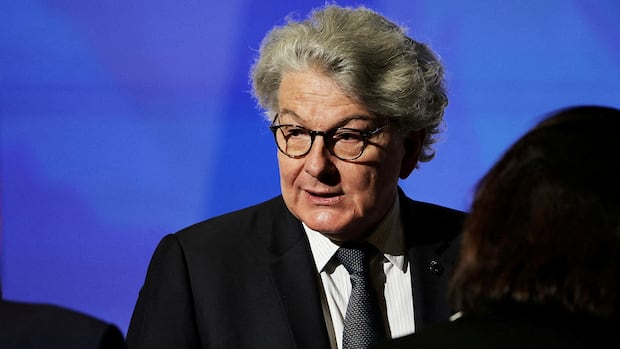
The bans, announced Tuesday by the Trump administration, target former EU commissioner Thierry Breton of France and four other Europeans who Washington claims are working to censor free speech or unfairly regulate American tech companies. The EU responded forcefully, threatening to “respond swiftly and decisively” against what it termed “unjustified measures.”
“Freedom of expression is a fundamental right in Europe and a shared core value with the United States across the democratic world,” a European Commission spokesperson stated while strongly condemning the U.S. decision.
The diplomatic clash comes at a particularly sensitive time in transatlantic relations, with growing divergences between Washington and European capitals on multiple fronts including defense policy, immigration, trade, and approaches to the Russia-Ukraine conflict. Just weeks ago, a U.S. National Security Strategy document warned that Europe faced “civilizational erasure” and needed to change course to remain a reliable American ally.
At the center of the dispute is the EU’s Digital Services Act (DSA), a landmark legislation championed by Breton that aims to make online platforms safer by requiring tech companies to take stronger action against illegal content, including hate speech and child sexual abuse material. The EU recently fined Elon Musk’s X platform €120 million (approximately $193 million CAD) for breaching these regulations, further inflaming tensions.
U.S. Secretary of State Marco Rubio justified the visa bans by claiming the targeted individuals “have led organized efforts to coerce American platforms to censor, demonetize and suppress American viewpoints they oppose.” Under Secretary for Public Diplomacy Sarah Rogers specifically named the affected individuals on X: Breton; Imran Ahmed, CEO of the U.S.-based Center for Countering Digital Hate; Anna-Lena von Hodenberg and Josephine Ballon of German non-profit HateAid; and Clare Melford, co-founder of the Global Disinformation Index.
French President Emmanuel Macron swiftly condemned the U.S. action, saying, “These measures amount to intimidation and coercion aimed at undermining European digital sovereignty.” He emphasized that the DSA was democratically approved and designed “to ensure fair competition among platforms, without targeting any third country, and to ensure that what is illegal offline is also illegal online.”
Breton, who frequently clashed with Musk over EU tech regulations—with Musk once referring to him as the “tyrant of Europe”—responded defiantly on social media: “Is McCarthy’s witch hunt back?” He pointed out that “90 percent of the European Parliament—our democratically elected body—and all 27 Member States unanimously voted the DSA. To our American friends: Censorship isn’t where you think it is.”
Germany’s Justice Ministry expressed “support and solidarity” for the two German activists from HateAid, describing the organization’s work as supporting victims of “unlawful digital hate speech” rather than engaging in censorship. “Anyone who describes this as censorship is misrepresenting our constitutional system,” the ministry stated. “The rules by which we want to live in the digital space in Germany and in Europe are not decided in Washington.”
A Global Disinformation Index spokesperson characterized the visa bans as “an authoritarian attack on free speech and an egregious act of government censorship,” adding that “The Trump administration is, once again, using the full weight of the federal government to intimidate, censor and silence voices they disagree with.”
This is not the first time the Trump administration has sanctioned European officials. In August, Washington sanctioned French judge Nicolas Yann Guillou of the International Criminal Court for the tribunal’s investigations involving Israeli leaders and past inquiries into U.S. officials.
The escalating tensions highlight fundamental differences in approach to content moderation and tech regulation between the U.S. and Europe, with potentially significant implications for transatlantic relations and the global digital economy.
Fact Checker
Verify the accuracy of this article using The Disinformation Commission analysis and real-time sources.

9 Comments
The US move to ban European officials over tech regulation seems like a heavy-handed response. While free speech is important, so is national sovereignty. I wonder if this is more about politics than substance.
That’s a fair point. Escalating diplomatic disputes rarely leads to productive outcomes. A more nuanced, good-faith dialogue would be better to address these complex issues.
This seems like another example of the growing ideological divides between the US and its traditional European allies. Navigating these differences constructively will be critical to preserving the transatlantic alliance.
As someone with an interest in mining and commodities, I’m curious to see how this dispute could impact trade and investment flows between the US and Europe. Regulatory uncertainty is never good for business.
That’s a good observation. Heightened tensions could disrupt supply chains and commercial relationships in our sector. Maintaining stable and predictable policies should be a priority for policymakers.
Interesting dispute over censorship and regulatory sovereignty. Curious to see how this EU-US clash plays out and what the broader implications may be for transatlantic relations.
Yes, it seems like a complex issue with valid concerns on both sides. Finding the right balance between free speech and reasonable regulation will be challenging.
This highlights the growing tensions between the US and its European allies on a range of policy fronts. Maintaining a unified transatlantic approach will be crucial, especially given the geopolitical challenges we face.
Agreed. Hopefully cooler heads can prevail and they can find a diplomatic resolution that respects the core democratic values shared by both sides.