


Listen to the article
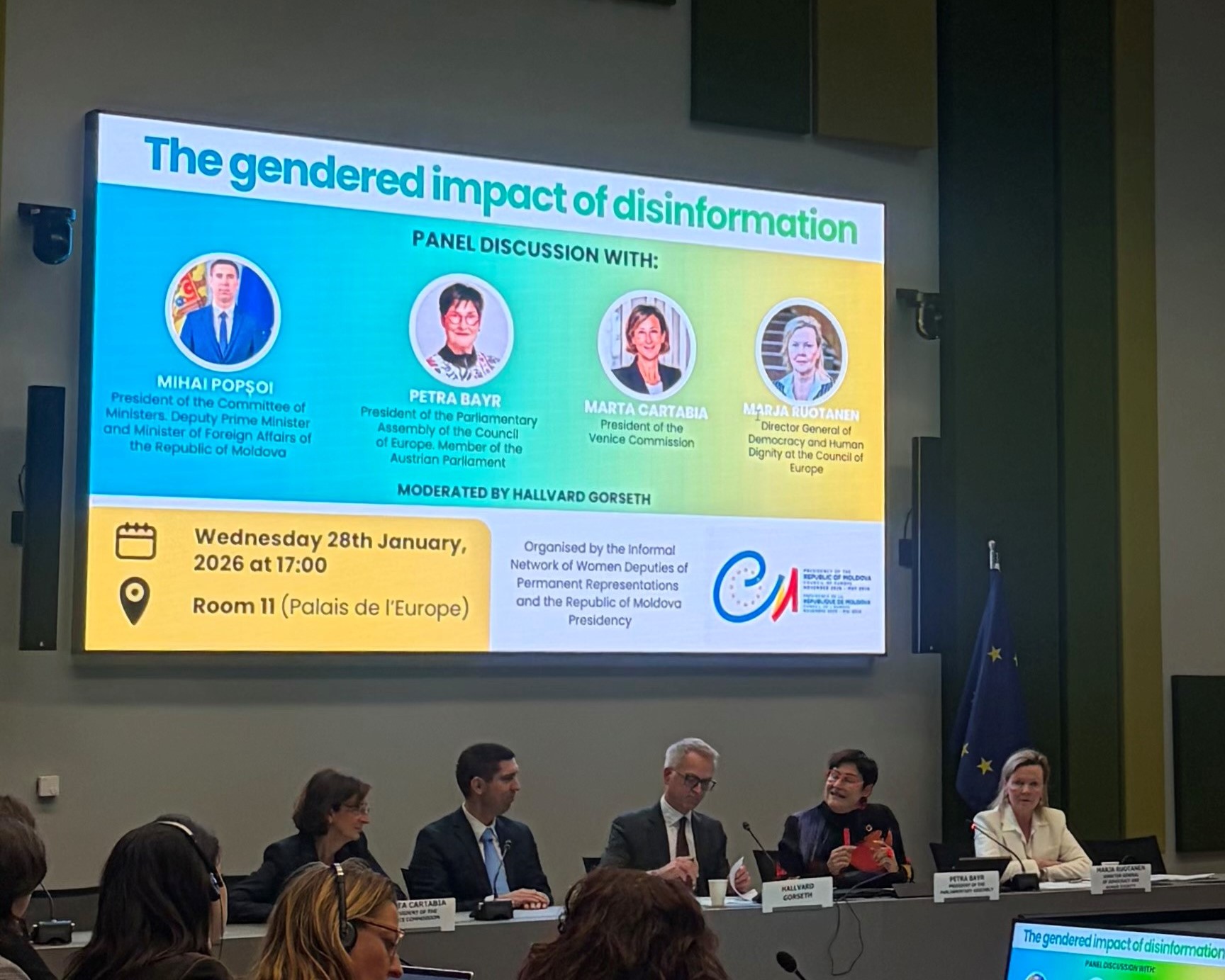
The European Union took a significant step in addressing digital threats to democracy by co-hosting a high-level panel discussion on “The Gendered Impact of Disinformation” on January 28. The event, organized in partnership with the Informal Network of Women Deputies of Permanent Representations and the Moldovan Presidency, brought together influential political and legal leaders to examine how disinformation specifically undermines women’s participation in democratic processes.
The panel featured prominent figures including Mihai Popșoi, President of the Committee of Ministers of the Council of Europe and Moldova’s Deputy Prime Minister and Foreign Affairs Minister; Petra Bayr, President of the Parliamentary Assembly of the Council of Europe; Marta Cartabia, President of the Venice Commission; and Marja Ruotanen, Director General of Democracy and Human Dignity at the Council of Europe.
Discussions centered on mounting evidence that disinformation campaigns disproportionately target women in public life, creating additional barriers to their political participation. This targeted approach often exploits gender stereotypes and personal attacks to undermine women’s credibility and discourage their involvement in democratic institutions.
Popșoi shared insights from Moldova’s experience with gender equality initiatives, highlighting the country’s progress in advancing women’s representation in politics. He pointed to Moldovan President Maia Sandu as a powerful example. Despite facing considerable criticism focused on her personal status as an unmarried woman without children, Sandu’s successful leadership has inspired a new generation of women to challenge traditional gender expectations in the political sphere.
“While we’ve made significant strides, including the criminalization of femicide, we must remember that progress isn’t irreversible,” Popșoi cautioned. “Continued vigilance and commitment are essential.”
Petra Bayr focused on the psychological impact of gendered disinformation, emphasizing its “chilling effect” on women’s mental health and willingness to participate in public discourse. The toxic environment created by coordinated disinformation campaigns often drives qualified women away from political engagement, ultimately weakening democratic representation.
Marta Cartabia brought attention to how disinformation threatens judicial independence, a cornerstone of democratic governance. As former president of Italy’s Constitutional Court, Cartabia noted that attacks on the judiciary serve to undermine the checks and balances essential to democratic systems.
“When courts are delegitimized through disinformation, democracy itself is endangered,” Cartabia explained. She advocated for developing new standards and mechanisms to protect democratic processes, particularly during election periods when disinformation campaigns tend to intensify.
Marja Ruotanen outlined the Council of Europe’s comprehensive strategy to combat gendered disinformation, which balances protective measures with preventive actions. This dual approach leverages existing frameworks including the European Convention on Human Rights, the Istanbul Convention on preventing violence against women, and specific recommendations on addressing hate speech and sexism.
Ruotanen also revealed that the Council is currently developing new tools to address technology-facilitated violence against women, recognizing the evolving nature of online threats. Both Cartabia and Ruotanen emphasized that effective solutions must extend beyond regulatory approaches to include education, awareness-raising, and constructive dialogue across various sectors of society.
The panel concluded that addressing gendered disinformation requires gender-conscious strategies rather than gender-neutral approaches. Participants agreed that countering these threats demands coordinated action across multiple stakeholders, including governments, civil society organizations, technology companies, and international institutions.
The discussion comes at a critical moment as the European Union considers a New Democratic Pact for Europe, with participants emphasizing that gendered disinformation should be recognized as a central concern within this framework. The consensus was clear: gendered disinformation is not a peripheral issue but a direct and growing threat to democratic institutions that requires prioritized attention and resources.
Fact Checker
Verify the accuracy of this article using The Disinformation Commission analysis and real-time sources.

18 Comments
It’s concerning to see how disinformation campaigns specifically target women in public life, creating additional barriers to their political participation. I’m glad the EU and partners are taking this issue seriously and exploring ways to address it.
Yes, this is an important area of focus. Addressing the gendered nature of these disinformation campaigns is crucial for strengthening democratic institutions and promoting inclusive representation.
The gendered impact of disinformation is a concerning phenomenon that deserves greater attention. I’m encouraged to see the EU and partners taking steps to examine this issue and explore ways to mitigate the barriers it creates for women’s political participation.
Yes, this is an important step in the right direction. Addressing the underlying gender dynamics that fuel these disinformation campaigns is crucial for strengthening democratic institutions and promoting inclusive representation.
Disinformation is a complex challenge, but the targeted approach towards women in public life is particularly troubling. I’m glad to see this panel discussion examining the gendered nature of these campaigns and their impacts on democratic processes.
Absolutely, this is a critical issue that deserves urgent attention. Bringing together influential leaders to explore solutions is a constructive way to drive progress and create a more equitable digital landscape.
The EU’s efforts to address the disproportionate impact of disinformation on women are commendable. Examining how gender stereotypes and personal attacks are weaponized to undermine women’s credibility is an important part of combating these pernicious trends.
Absolutely, this is a vital issue that deserves greater attention. Bringing together influential figures from the political and legal spheres is a constructive approach to driving meaningful change.
It’s critical that we understand and address the unique ways in which disinformation undermines women’s participation in public life. This panel discussion seems like a valuable forum for driving progress on this important issue.
Agreed, this is a complex challenge that requires a multifaceted approach. Bringing together diverse perspectives from the political, legal, and civil society spheres is an important starting point for developing effective solutions.
The EU’s efforts to address the gendered impact of disinformation are an important step in combating these pernicious trends. Examining how gender stereotypes and personal attacks are used to undermine women’s credibility is a crucial part of this work.
Agreed, this is a complex issue that requires a multifaceted approach. I’m encouraged to see the panel discussion bringing together diverse perspectives to develop effective strategies for mitigating the gendered impacts of disinformation.
While disinformation is a broader challenge, the gendered aspects of these campaigns are particularly troubling. I’m glad to see the EU and partners taking steps to shine a light on this issue and explore solutions.
Yes, the panel discussion highlights an important intersection between gender equality, digital rights, and the integrity of democratic processes. Addressing the disproportionate impact on women is a crucial step forward.
The panel discussion on the gendered impact of disinformation is an important step in understanding and addressing this complex challenge. Examining how gender stereotypes and personal attacks are used to undermine women’s credibility is a crucial part of this work.
Agreed, this is a vital issue that deserves greater attention. I’m encouraged to see the EU and partners taking a proactive approach to exploring solutions and driving meaningful change.
It’s concerning to see how disinformation campaigns specifically target women in public life, undermining their political participation. This is an important issue that needs greater attention and action to address the gendered impacts of online abuse and misinformation.
Agreed, tackling the gendered nature of disinformation is crucial for strengthening democracy and ensuring equal representation. The panel discussion seems like a positive step towards understanding and mitigating these challenges.