


Listen to the article
Armenian Lawmaker Warns of Hybrid Threats to Democratic Processes
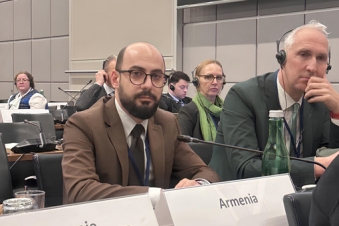
Democracy requires stronger protection mechanisms against hybrid interference, according to Artur Hovhannisyan, a member of Armenia’s National Assembly delegation. Speaking at a recent OSCE Parliamentary Assembly session, Hovhannisyan emphasized that such threats have evolved from theoretical concerns to tactical realities that directly threaten electoral integrity.
“Hybrid interference in electoral processes is no longer a theoretical threat,” Hovhannisyan stated. “It is a practical toolkit used to undermine political stability in states and weaken trust in democratic institutions.”
The parliamentarian outlined several specific mechanisms of interference, including coordinated disinformation campaigns, cyberattacks, artificial polarization, and influence operations driven by foreign policy interests. These tactics, he noted, typically intensify during pre-election periods.
With Armenia’s parliamentary elections scheduled for June 7, 2026, Hovhannisyan reported that such phenomena are already emerging within the country. “External political actors and related information networks are becoming active, generating information noise, attempting to shape the domestic political agenda, weaken public trust and influence public sentiment,” he explained.
The lawmaker stressed that this issue transcends national borders. “This is not only Armenia’s problem. It is an issue of democratic sovereignty,” he said, framing the challenge as one facing democracies worldwide.
To counter these threats, Hovhannisyan proposed a multi-faceted approach that includes strengthening cybersecurity around electoral processes, identifying and preventing coordinated disinformation networks, ensuring transparency of financial and political influences, and enhancing international cooperation.
The timing of Hovhannisyan’s comments is particularly significant as Armenia prepares for its upcoming elections. The South Caucasus nation has navigated complex geopolitical pressures in recent years, particularly following the 2020 Nagorno-Karabakh conflict and subsequent territorial changes in 2023. These developments have created a politically sensitive environment where information integrity has become increasingly crucial.
Election security experts broadly agree with Hovhannisyan’s assessment. Recent years have seen numerous documented cases of foreign interference in democratic elections across Europe and North America, with techniques growing more sophisticated and harder to detect. Social media platforms have become particularly fertile ground for influence operations, with artificial intelligence tools making disinformation increasingly convincing and pervasive.
The OSCE, which regularly deploys election observation missions throughout its region, has increasingly incorporated digital threat monitoring into its election observation methodology. Hovhannisyan specifically acknowledged the organization’s role, expressing confidence that “through cooperation and coordinated efforts, including with the support of election observation missions deployed by our Assembly, democracy in our countries will continue to remain protected.”
Armenia’s upcoming elections will serve as an important test case for the types of protections Hovhannisyan advocates. The country’s position at the crossroads of competing regional interests makes it particularly vulnerable to external influence attempts, while its relatively small media market can be more easily saturated with targeted messaging.
Political analysts note that maintaining electoral integrity has become a fundamental challenge for democracies worldwide, requiring constant adaptation as interference techniques evolve. The growing awareness among legislators like Hovhannisyan suggests increasing recognition of the need for both technological and regulatory responses to protect democratic processes from manipulation.
Fact Checker
Verify the accuracy of this article using The Disinformation Commission analysis and real-time sources.

6 Comments
Hybrid threats to democracy are a serious concern that need to be addressed with robust protective tools. Coordinated disinformation, cyberattacks, and foreign influence operations can undermine electoral integrity. Strengthening resilience against these tactics is crucial for safeguarding democratic processes.
Hybrid threats to democracy, such as coordinated disinformation and foreign influence operations, are a growing concern. Robust protective tools and mechanisms to counter these tactics are essential for preserving the integrity of electoral processes.
Hybrid threats to democracy, including coordinated disinformation campaigns and foreign influence operations, pose a serious challenge that requires comprehensive solutions. Developing effective protection mechanisms is vital for maintaining trust in democratic institutions and processes.
The rise of hybrid interference tactics targeting democratic institutions is alarming. Strengthening protections against cyberattacks, artificial polarization, and other disruptive measures should be a key focus for policymakers. Safeguarding the democratic process is crucial.
This is a timely warning about the evolving nature of hybrid interference in elections. With foreign actors increasingly active in exploiting information networks, democracies must stay vigilant and develop effective countermeasures. Protecting the integrity of the electoral process is paramount.
I agree, the threat of hybrid interference in elections is very real and needs to be taken seriously. Developing stronger safeguards and resilience mechanisms should be a priority for policymakers.