


Listen to the article
In the lead-up to Vietnam’s 14th National Party Congress, security officials have identified a coordinated campaign by opposition forces to undermine the event by targeting personnel affairs and attempting to fracture party unity.
Intelligence sources report that these groups are employing increasingly sophisticated tactics to sow discord within the Communist Party of Vietnam, particularly by creating artificial divisions between various factions and governmental bodies.
“The primary objective isn’t merely to damage individual reputations,” said a senior Party official who requested anonymity. “It’s a strategic effort to weaken internal cohesion and disrupt the bond between the Party, military forces, and citizens.”
The 14th National Party Congress represents a critical juncture in Vietnam’s political landscape, as delegates will select key leadership positions for the 2026-2030 term from among the country’s more than five million Party members. Such transition periods traditionally attract heightened attention from both domestic and international actors.
Security experts have noted a tactical shift in disinformation campaigns, moving beyond regional divisions to target professional backgrounds of senior officials. These operations now attempt to pit different sectors of government against each other, with particular focus on creating tension between military and security apparatuses.
“They’re specifically targeting what President Hồ Chí Minh described as ‘the two arms’ of the state – the Vietnam People’s Army and the People’s Public Security Force,” explained Dr. Nguyen Van Minh, a political analyst from Hanoi National University. “By attempting to drive a wedge between these institutions, opposition groups hope to weaken the entire governmental structure.”
The metaphor dates back to March 3, 1959, when President Hồ Chí Minh used the term “two arms” to describe the complementary relationship between these security forces during a ceremony establishing what would later become the Border Guard Command.
Vietnam’s integrated security approach relies on the army safeguarding the nation’s borders and sovereignty, while public security forces maintain domestic order and protect political institutions. This dual-pronged strategy has been central to Vietnam’s stability for decades.
The 13th National Party Congress clearly established national security priorities: “To firmly safeguard national independence, sovereignty, unity and territorial integrity; to protect the Party, the State, the people, the socialist regime, national culture and national interests.”
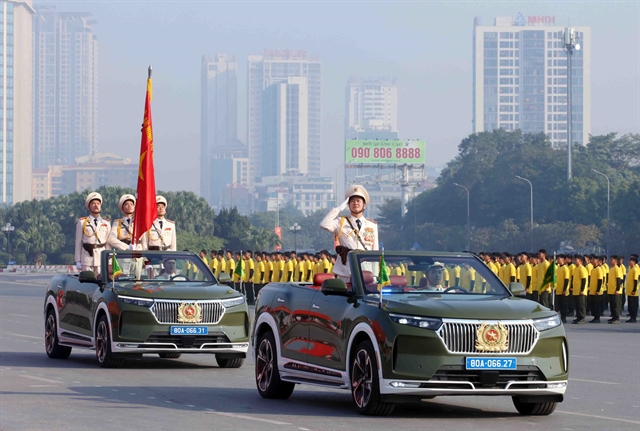
In response to these challenges, security forces conducted comprehensive rehearsals earlier this month in Hanoi. The January 10 exercises demonstrated the government’s determination to maintain order during the upcoming Congress.
The official slogans for the 14th Congress prominently feature “Solidarity – Democracy – Discipline – Breakthrough – Development!” with solidarity deliberately positioned first, underscoring its paramount importance in the Party’s hierarchy of values.
Vietnamese authorities have urged citizens to exercise caution regarding unverified information on social media platforms. Officials are particularly concerned about fabricated news designed to manipulate public sentiment around personnel decisions and create artificial rivalries between government branches.
“These divisive tactics represent nothing new in political disruption,” noted Dr. Tran Quoc Hung, a security studies expert. “What’s changed is the sophisticated use of social media as a delivery mechanism and the strategic targeting of institutional relationships rather than just individuals.”
The government has implemented enhanced cybersecurity measures in anticipation of the Congress while emphasizing the need for unity as essential to the nation’s continued stability and development.
Fact Checker
Verify the accuracy of this article using The Disinformation Commission analysis and real-time sources.

16 Comments
The strategic nature of these disinformation campaigns is concerning. Targeting internal divisions and weakening party cohesion could have far-reaching consequences for Vietnam’s political landscape.
I’m curious to learn more about the specific tactics being employed and how the security forces are adapting their responses to address this evolving threat.
The bond between the Party, military, and citizens is the foundation of Vietnam’s political system. Efforts to weaken this bond through disinformation campaigns are deeply concerning and must be addressed.
I’m hopeful that the security measures taken will be effective in countering these threats and preserving the unity and stability of Vietnam’s political landscape.
Disinformation campaigns targeting personnel affairs and party unity are a worrying trend. Vietnam’s vigilance in identifying and responding to these threats is an important step in protecting its political integrity.
Disinformation campaigns targeting party personnel and internal cohesion are a worrying trend. Vietnam’s proactive approach to identifying and countering these tactics is commendable.
The bond between the Party, military, and citizens is the foundation of Vietnam’s political system. Protecting this bond from external disruption is a vital national security concern.
The 14th National Party Congress represents a crucial juncture for Vietnam’s political future. Ensuring a smooth and secure transition of power is essential for the country’s continued stability and progress.
I hope the security measures put in place will be effective in thwarting any attempts to disrupt or undermine the proceedings through disinformation or other means.
The 14th National Party Congress is an important transition period for Vietnam. Ensuring the selection of capable leadership is crucial for the country’s continued development and stability.
Domestic and international actors will be closely watching this process. Robust security measures to safeguard the integrity of the proceedings are essential.
Combating disinformation is a critical challenge for modern democracies. Vietnam’s proactive stance in identifying and countering these threats is an important step in safeguarding its political system.
Maintaining party unity and stability is crucial for Vietnam’s continued progress. I hope the security measures taken will be effective in thwarting disinformation efforts and ensuring a smooth and transparent transition.
Protecting the integrity of political parties is critical for stable governance. I’m glad to see Vietnam taking proactive steps to identify and counter disinformation efforts aimed at undermining party unity.
Sophisticated tactics like creating artificial divisions are concerning. Vigilance and transparency will be key to thwarting these attempts to sow discord.
Protecting party integrity is a challenging task, especially in the face of increasingly sophisticated disinformation tactics. Vietnam’s proactive approach is a commendable effort to safeguard its political system.